
3 ideas for Valentine’s Day campaigns to win over your customers

3 ideas for Valentine’s Day campaigns to win over your customers

La Saint Valentin n’est pas seulement la fête des amoureux. C’est aussi une fête commerciale qui est devenue une date incontournable du calendrier marketing des marques. D’après les derniers chiffres disponibles issus d’une étude YouGov, près de 185 millions d’euros avaient été dépensés lors de la fête des amoureux en France, soit une progression de 275% en 10 ans. 

La Saint Valentin est d’ailleurs la 3e fête commerciale la plus importante en France, derrière Noël et Halloween. C’est donc l’occasion pour les marques de capitaliser sur les intentions d’achat des consommateurs en leur proposant des idées de cadeaux romantiques à offrir à leur moitié. 

Pour se démarquer durant cette période particulièrement concurrentielle de l’année, votre entreprise peut miser sur un levier marketing redoutable : la gamification. En intégrant des mécaniques interactives dans votre campagne marketing de Saint Valentin, vous pourrez en effet mieux capter l’attention de votre audience et les inciter à acheter leur cadeau auprès de votre marque. 

Dans cet article, nous vous partageons 3 exemples de campagnes gamifiées pour la Saint Valentin. Vous pourrez vous en inspirer pour dynamiser votre communication, engager plus efficacement votre public cible et booster vos ventes durant ce temps fort commercial. 

What should you aim in for in a Vlantine’s Day marketing campaign

Even though it remains the ultimate romantic holiday, Valentine’s Day is also an opportunity for brands to promote their offerings. This commercial holiday serves as a prime showcase for businesses that sell potential gifts for couples in love.

Of course, we think of the traditional bouquets of flowers. Industry professionals expect over a million flowers to be sold for Valentine’s Day this year, with two-thirds being red rioses. However, florists are not the only merchants celebrating Valentine’s Day. Fashion, beauty, culture, dining… Many sectors are involved in Valentine’s Day marketing.

Don’t forget about singles, who are also targeted by brands during this key commercial period. On dating apps, the annual peak of activity tends to occur at the beginning of the year. Singles often make New Year’s resolutions, and apps like Happn see an increase of over 20% in their sign-ups during the month of February.

The main objective pursued by companies in their Valentine’s Day marketing is therefore to increase sales and revenue. The goal of the campaigns implemented is to raise consumer awareness of their offerings ans encourage them to buy their Valentine’s Day gifts in-store (physical or digital).

But beyond the conversion objective, brands can also design their Valentine’s Day campaigns around other strategic goals.

Increase brand awareness

Valentine’s Day is an opportunity to gain visibility with a new audience. The aim of the campaign will be to boost brand awareness among couples (or singles) by leveraging viral marketing strategies (such as marketing contests, influencers collaborations, or co-branding).

Engage your customer community

After a quiet January following the holiday season, the marketing calendar kicks off with a bang thanks to Valentine’s Day. Businesses can take advantage of this key period to engage their audience. The idea is to increase interactions with the brand, particularly through gamification mechanics.

Contests, for example, encourage users to be creative and allow businesses to generate user-generated content (UGC).

Collect data

Customer knowledge is also a significant aspect of Valentine’s Day marketing. Brands can leverage interactions with their audience to collect relevant data, particularly regarding product preferences, as well as opt-ins for their future communication campaigns. This information can be utilized throughout the year to better segment their clientele and send personalized content and offers.

Foster loyalty and strengthen brand attachment

En mettant en jeu des récompenses attractives sur le thème de l’amour (comme des séjours en amoureux, des coffrets cadeaux, etc.), les marques peuvent ainsi booster leur rétention client. Les jeux marketing peuvent être proposés en post-achat (pour encourager le rebuy) ou réservés aux membres du programme VIP, pour augmenter la fidélisation. En récompensant ses meilleurs clients, l’entreprise pourra ainsi renforcer l’attachement à la marque et sécuriser des revenus significatifs.

3 Examples of gamification marketing Campaigns for Valentine’s Day

To stand out from their competitors and boost the performance of their Valentine’s Day marketing strategy, an increasing number of companies are betting on gamification. Here are 3 inspiring campaigns to achieve commercial goals and engage their audience more effectively.

1. Electrolux: a Memory game to enrich their database during Valentine’s Day

On the occasion of Valentine’s Day, Electrolux launched a campaign aimed at enriching its database, specifically encouraging product registrations. Through an engaging game mechanic, Memory, the brand was able to collect opt-in very effectively while showcasing its Duos product range.

Electrolux’s campaign generated significant enthusiasm, showcasing an excellent engagement rate (31K users and an average of 2 minutes per game session) and very good results in lead qualification. This campaign allowed the brand to retarget and retain acquired leads, highlighting the ability of a gamification marketing campaign to create meaningful interactions while achieving notable results in qualification.

electrolux valentine's day

Del Arte: a Shooter game to generate new leads

As every year, the Del Arte brand celebrates lovers on Valentine’s Day. The interactive campaign invites participants to play a Shooter game. They are then redirected to an instant-win opportunity to win particularly attractive prizes for the target audience (gift vouchers, Interflora bouqets, trips to Paris, etc. )

The campaign primarily enabled the company to generate over 40k new sign-ups to its mailing list and opt-ins. These leads were then reactivated throughout the year through strategic marketing campaigns for the brand.

del arte valentine's day

3. M&M’s: A shuffler game to boost Valentine’s Day sales

On the occasion of Valentine’s Day, My M&M’s launched a game to attract new customers by showcasing its product range. Users had to form all the pairs within a set time to access a Shuffler and immediately discover if they won their Valentine’s Day gift box. This highly engaging mechanic allowed M&M’s to generate 30k new leads.

m&m's valentines day

Conclusion

Consumers are particularly attentive to brand content around Valentine’s Day. Capitalize on their purchase intentions and engagement to achieve your strategic goals by launching a gamified marketing campaign. To enhance your communication and boost your results, all you need to do is customize one of our marketing game mechanics!

In just 30 minutes, we’ll show you how to launch your own high-performance interactive marketing campaign.

In store animation: Galeries Lafayette opts for gamification

In store animation: Galeries Lafayette opts for gamification

Even if consumers are increasingly buying online, the fashion sector is particularly concerned by in-store sales. We continue to visit stores to touch fabrics, appreciate cuts and colors and, above all, try on clothes.

On average, going in store to try and pay for their purchase is still preferred by 65% of French people.
Mais cette préférence recule chez les jeunes et oblige donc les marques à dynamiser leurs points de vente physique en plus de leurs canaux en ligne, notamment en organisant une animation marketing en magasin.

Whether to boost brand awareness, increase store and website traffic and thus generate more sales, or build loyalty through a unique shopping experience, sales promotion is an essential marketing lever. It has an even greater impact when it immerses customers in the brand’s universe, notably with in-store competitions offered via QR codes or interactive terminals.

In this article, we’ll take a look at Galeries Lafayette’s animated marketing strategy, through several examples of campaigns.

What is an in-store marketing event?

An in-store brand promotion is a commercial operation designed to boost the appeal and profitability of physical points of sale. Its one-off or regular actions can, for example, serve to promote the brand’s image, provide greater visibility for a new product launch, or simply boost sales and build loyalty.

Depending on the expected results, marketing activities can take a variety of forms: product demonstrations, competitions, distribution of discount coupons, treasure hunts in the aisles, and so on.

In all cases, the ultimate goal is to capture the public’s attention, be it the store’s visitors or the brand’s audience. Online, we speak of a drive-to-store strategy.
L’objectif étant toujours le même : augmenter le trafic en magasin.

Gamifying in-store sales events: the Galeries Lafayette example

Despite its well-established reputation, the brand is innovating to enhance the appeal of its stores, and attract and retain customers.

For several years now, the company has relied on marketing gamification (the integration of interactive and playful elements into its marketing activities) to energize its points of sale and online campaigns.

1. Boost store awareness with brand animation

The primary benefit of in-store marketing events is to raise brand awareness. In-store marketing events give the brand greater visibility, help it stand out from the competition and attract consumers to the store.

This includes the creation of POS (point-of-sale) advertising..
La marque va ainsi développer des supports de publicité installés directement dans sa boutique (en vitrine, devant l’entrée du magasin mais aussi dans les rayons) pour promouvoir le point de vente en lui-même, un événement de marque ou un produit.

To arouse the curiosity of consumers, Les Galeries created Tesla stands in their stores, giving the partner brand a high profile via an interactive quiz. organized during the Weekend de l’homme. By exhibiting cars and offering great prizes (a weekend in a luxury hotel with the loan of a Tesla), the brand was able to attract a large number of participants to the in-store operation.
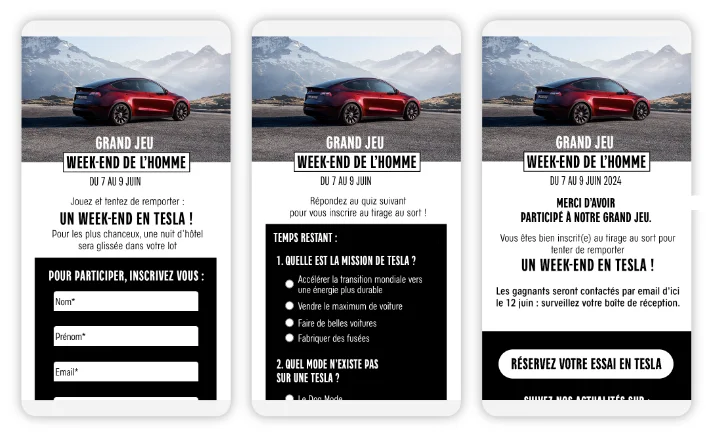
galeries lafayette animation marketing

2. Engaging in-store audiences with interactive kiosks

In-store marketing operations can also be designed to liven up the point-of-sale and engage customers. and encourage them to make a purchase (or increase their average shopping basket). Marketing contests, offered via interactive terminals displayed in store allow you to :

  • generate more interaction with customers,
  • maintain their interest through fun activities,
  • strengthen the relationship with the brand, in particular through the possibility of winning an attractive prize.

For Mother’s Day, Galeries Lafayette offered its customers a 100% winning one-armed bandit. Accessible via interactive terminals installed for 3 days in 6 stores in France, the aim of this marketing campaign was to energize sales outlets during this commercial highlight.

The marketing game was also available in mobile format in all stores. of France via a QR code displayed on site. This omnichannel strategy enabled the brand to increase the engagement and reach of its campaign. It was able to animate all its stores with particularly attractive prizes (Relais Châteaux stays, bouquets of flowers, gift cards, promotional codes, etc.).

These rewards also enabled the brand to target a second conversion objective. By offering generous value gift cards, this brand strategy boosted sales and collected qualified leads, which could then be reactivated with offers at the end of the game.
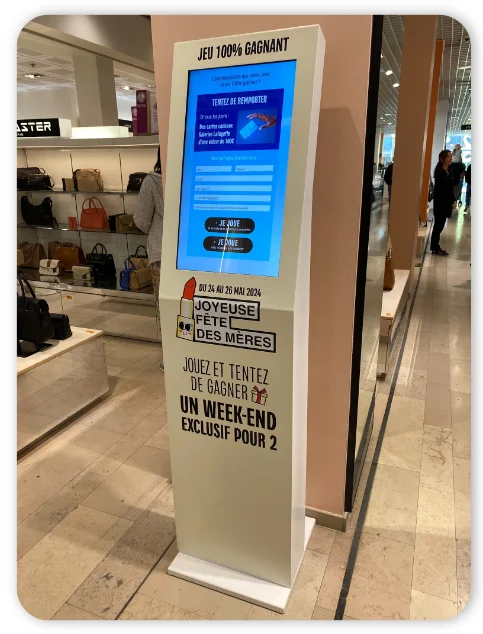
example gamification in store

3. Build customer loyalty and increase in-store re-purchase rates

Les animations marketing en magasin peuvent, pour finir, permettre à l’enseigne de renforcer le sentiment d’appartenance à une communauté de marque et ainsi fidéliser ses clients. 

Les Galeries Lafayette ont là encore misé sur les animations gamifiées pour réenchanter leur programme de fidélité en boutique. En organisant une Roue de la Fortune, l’entreprise a pu accroître la visibilité de la carte Galeries Lafayette Mastercard, à travers une activation post-achat

La campagne Mastercard reposant sur le principe de Gate Code, les participants devaient renseigner un code reçu  après un achat en magasin (par email) pour accéder à un jeu d’instants gagnants et ainsi tenter de remporter des chèques cadeaux. La campagne a rempli ses objectifs de rétention avec plus de 2 codes renseignés par participants (et autant d’achats réalisés en magasin avec la carte).
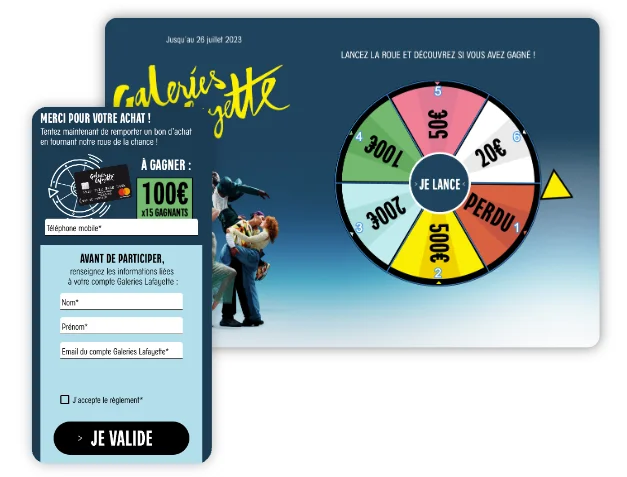
Wheel of fortune Galeries Lafayette

Conclusion

Organizing in-store marketing events is an innovative and creative way to captivate and engage customers. Inspired by the Galeries Lafayette use case, you can boost traffic and sales in your stores. Discover our catalog of gamified sales animations and customize them to suit your objectives and brand universe.

In just 30 minutes, we’ll show you how to launch your own high-performance interactive marketing campaign.

The end of printed flyers – why turn to e-catalogues?

The end of printed flyers – why turn to e-catalogues?

Le prix du papier s’envole, et les questions environnementales deviennent de plus en plus pressantes, c’est pourquoi on parle depuis quelques temps de la fin du catalogue papierDes initiatives comme Stop Pub ou Oui Pub existent depuis maintenant des années. L’inquiétude face aux prospectus n’est donc pas récente. Mais pourquoi entend-on subitement parler du e-catalogue ?

Cela est dû à l’annonce d’un grand groupe agroalimentaire qui a fait trembler le monde de la publicité et du marketing. E.Leclerc a décidé de ne plus distribuer de catalogues papiers dans la boîte aux lettres des Français. Ce qui a lancé le sujet de la digitalisation des catalogues papier.

Bien sûr, cette annonce n’est pas au goût de tous. Le catalogue représente une certaine nostalgie, toutes générations confondues. Mais alors que la durée de vie d’un catalogue tient au temps qu’il passe sur la table basse des Français, la digitalisation de celui-ci apparaît comme une solution plus simple et écologique, qui pourra suivre le consommateur partout où il va. 

Non seulement impactant écologiquement, il s’agit également pour ces enseignes de grande distribution d’entrer en conformité avec les normes de confidentialité des données. Alors comment toucher ces consommateurs qui ont déjà fermé leurs boîtes aux lettres aux catalogues et quelles sont les solutions existantes pour anticiper la fin des prospectus dès cette année ?

Between the environment and the RGPD, why are printed flyers doomed to disappear?

Why say goodbye to paper catalogues?

Créer un prospectus demande beaucoup de ressources et d’énergie, il est considéré comme un déchet non recyclable. Alors que l’Europe s’engage à réduire son émission de gaz à effet de serre, le transport de ces catalogues jusqu’à nos boîtes aux lettres est considéré comme trop polluant. 

En ce qui concerne la norme RGPD, le prospectus papier est très difficile à rendre conforme aux exigences de confidentialité et de sécurité des données. Ainsi, les entreprises choisissent de plus en plus de passer au format numérique pour leurs campagnes publicitaires afin de respecter les impératifs environnementaux et réglementaires.

Digital solutions as an alternative to flyers

Les médias numériques, qui peuvent offrir des contenus plus riches et plus interactifs, attirent aujourd’hui plus de consommateurs. Les technologies de l’information et de la communication permettent aux entreprises de communiquer directement avec les clients. Tout en leur fournissant des informations pertinentes et personnalisées, ce qui enrichît le e-catalogue. De plus en plus d’entreprises optent pour la promotion digitale pour promouvoir leurs produits et services. De plus, le coût des médias numériques est beaucoup plus faible que celui du papier, offrant ainsi de nombreux avantages aux entreprises.

When will flyers be a thing of the past?

Il n’est pas possible de déterminer avec certitude quand le prospectus papier disparaîtra définitivement. Cependant, de plus en plus de marques et de détaillants optent pour des alternatives numériques. Les solutions de promotions digitalisées permettent de réduire les coûts de production et de collecter des données en respectant le RGPD. Ces nouvelles solutions offrent des avantages en termes de traçabilité et d’engagement.

Social networks and e-catalogues: all the solutions you need to prepare for the end of flyers

How do you set up digital promotions?

Il existe des solutions pour se préparer à la fin des prospectus vers le e-catalogue. Plusieurs plateformes peuvent être utilisées comme canaux de communication et offrent de nombreux avantages, liés à l’engagement et au tracking des données. Il est vrai qu’un catalogue dans une boîte aux lettres ne garantit pas qu’il soit lu. 

Le catalogue numérique est facile à mettre à jour et à partager, il peut être libre d’accès pour un large public en ligne. C’est un outil très utile qui ravira les plus nostalgiques puisqu’il garde l’essence même du catalogue papier. Le e-catalogue peut également détailler des offres ou des produits, tout comme son prédécesseur.

Les newsletters peuvent contenir les offres du moment ou une redirection vers le E-catalogue, le site marchant ou l’application mobile. Les e-mails peuvent faire découvrir de nouvelles gammes de produits, avec des bons de réduction personnalisés selon les préférences clients, tout comme un catalogue.

Aujourd’hui il n’est plus possible de se détourner des réseaux sociaux, c’est indéniable. Vous avez sûrement vous-même déjà plusieurs comptes à votre actif ! Ces plateformes sont un excellent moyen de promouvoir un catalogue mais aussi d’interagir avec une audience. La possibilité de détecter des tendances et de répondre directement aux clients rend la diffusion du catalogue plus complète. Entre les “j’aime”, les partages et les commentaires, ce sont autant de moyens que les clients ont pour faire part de leurs avis !

What would it look like to create an interactive catalogue?

Le temps du client qui tourne passivement les pages du catalogue est révolu ! 

Aujourd’hui vous pouvez non seulement faire passer du temps avec votre marque, mais également détecter les préférences clients, faciliter le parcours utilisateur et ainsi faire découvrir vos offres de manière plus efficace. 

L’avantage de ce nouveau modèle est le nombre d’options qui peuvent y être ajoutées. Filtres, recherches ou options de navigation, toutes ces données peuvent-être collectées et utilisées pour fidéliser une base client mais aussi convertir à l’achat. Des images, des vidéos, des avis ou encore des liens vers des services supplémentaires permettent d’augmenter l’engagement d’un e-catalogue. Les possibilités sont infinies.

Our advice on how to stand out from the crowd and kick-start your digital transition

Capturing users’ attention can be difficult. Games remain an effective way of interacting with consumers and getting them to spend time with your brand. Promoting an e-catalogue through games is simple and will also enable you to meet your marketing objectives, whatever they may be. Enough to make you forget about the paper version!

End of e-catalogue flyers

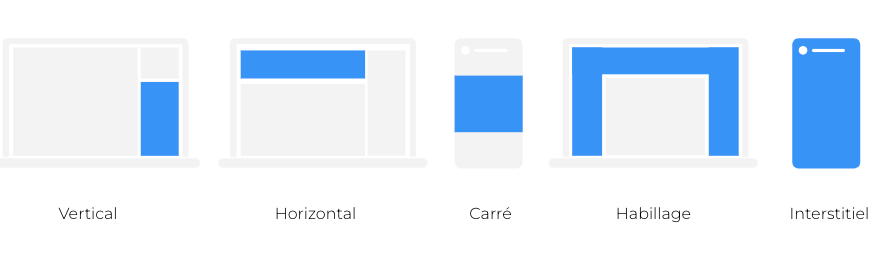
A native gaming experience in display slots

La bannière display interactive booste l’engagement et la performance des publicités. Elle optimise la visibilité des bannières publicitaires et favorise l’interaction au service de vos objectifs marketing !

Idéales pour donner de la visibilité aux campagnes, ces bannières display augmentent la mémorisation et le temps passé sur les campagnes. Il sera possible d’y mettre en avant des produits ou des promotions. Grâce à une redirection vers le e-catalogue ou le site marchand, optimisez le parcours utilisateur tout en engageant votre audience.

interactive display format

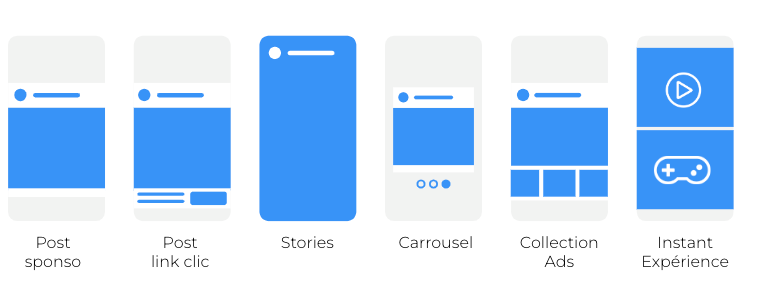
Social networks such as Facebook, Instagram and Tiktok are ideal platforms to promote a digital catalogue. Adapt your strategy to the age, format and trend of your target consumer. It’s just as precise as putting a flyer in a letterbox, I promise!

Each social network offers a different interface with specific advantages. All of them can promote an e-catalogue and redirect users to a website, Facebook shop or Instagram shopping page. In this new digital age, creating an interactive catalogue is simple and effective.

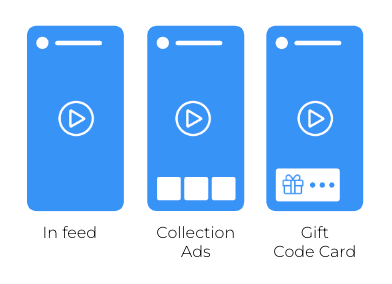
Facebook / Instagram & Tik-Tok examples

end of flyers facebook social network
tiktok ads

Conclusion

The end of flyers may frighten some people. After all, they have been part of our daily lives for decades. But as consumers increasingly question their ecological impact, it’s time to look at other alternatives for promoting products or services.

Whether through games, emailing, display banners or social networks, let consumers tell you what they want by interacting with them. This will be more effective than monitoring the stickers stuck on the letterbox!

You’re now ready to take the plunge and anticipate this change this year. We look forward to leafing through your new catalogues… and swiping, of course!

Need advice on how to prepare for the end of the flyer and switch to the e-catalogue?