10 reasons to collect data and how to activate them

10 reasons to collect data and how to activate them

At a time when artificial intelligence is redefining customer relations, first-party data (collected directly from your audience) is taking on a whole new dimension. It is no longer just a line in your CRM, but the essential fuel for powering the latest AI tools.

By collecting your own data, you enable your conversational agents and chatbots to offer ultra-personalized and seamless interactions. Even better, this proprietary data is the key to “Fine-Tuning“: it allows you to adjust generative AI models so they adopt your specific brand voice and respond precisely to your customers’ unique needs, whereas general models would only scratch the surface.

Understanding your customers and their LTV (Lifetime Value), both broadly (by creating buyer personas) and on a more individualized, contextual level—is crucial for boosting performance at every stage of the conversion funnel.

Conversely, a lack of audience data can lead to poor decision-making, missing out on new business opportunities, and losing market share to better-informed competitors.

In this article, we focus on the primary reasons why a company should collect data and how to activate it based on the specific results they aim to achieve.

Why is data the most valuable asset in 2026?

<a href="https://www.adictiz.com/en/blog/why-collect-data/
” style=”color: #000000; text-decoration: underline;”>Data collection
involves gathering, structuring, and utilizing information from various sources for the purpose of analysis or decision-making. This process involves systematically collecting and organizing data points, which can take the form of numbers, text, images, and more.

There are three main types of data:

  • Zero-party data or first-party data are obtained directly from consumers. The former are shared directly by users (via a form, for example), while the latter are derived from their behavior on a website. They are considered more reliable (since they come directly from the buyers), especially for analyzing the needs and expectations of prospects.
  • Second-party data: gathered by trusted partners and shared or sold as part of a collaboration;
  • Third-party data, obtained from external sources with no direct relationship to the potential customer or the company. They must therefore be used with caution due to the difficulty of assessing their reliability and potential GDPR & Privacy-first compliance issues.

Now that we are familiar with the different types of data, let’s move on to the right reasons to collect them!

10 strategic reasons to collect first-party data

1. Make better business decisions

Data is, first and foremost, information about consumers. The better a company knows its audience, the more it will be able to make the right decisions and avoid wasting its resources.

In addition to collecting relevant data on its customers, a company can use it to segment its clientele. This allows it to create different groups of prospects based on their purchasing behavior or preferences.

These customer segments will then help the company personalize its acquisition or retention strategies by tailoring its message to each group or by delivering it through the channel they are most likely to use.

2. Evaluate and boost customer loyalty

Retention has become just as important an issue, if not more so, than acquiring new customers. The data a company holds on its users will, in effect, allow it to identify purchasing behaviors and target them with more relevant offers based on their previous orders.

A loyalty program is an excellent way to collect data for this purpose. The brand will be able to track and reward purchases and other interactions made by its customers. This will increase their Lifetime Value and, consequently, the revenue generated from its most loyal customers.

3. Analyze and predict customer behavior using first-party data

First-party data (or behavioral data) represents all the information a company collects regarding how a customer interacts with its brand. This refers to the pages they visit on the website, the resources they have downloaded from the blog, or even the email campaigns they have opened over the past few months.

Performing an analysis of customer behavior is becoming increasingly important due to consumers’ ever-growing expectations for unique and personalized content. Interactive marketing is an excellent lever for collecting even more granular data on buyer behavior and offering tailored marketing content and commercial deals.

4. Improving your offering through customer feedback

Much easier to collect than feedback from a user test, customer reviews are a goldmine of information on how customers use a product or service. In addition to being a powerful reassurance lever for prospects, customer reviews bring to light ideas for improvements or new features that will make the company’s offering more relevant.

Co-creation strategies, through surveys or idea-sharing and customer feedback forms, …are extremely useful for collecting and activating customer data. They make it possible to establish an interactive relationship, target specific pain points, and optimize the offering with ultra-high efficiency.

The brand Cyrillus thus shared its data collection form via a personalized landing page. The latter enabled it to facilitate the enrichment of its CRM with missing and valuable information (first names + phone numbers). This allowed the brand to requalify its database to better reach and convert its target audience.

5. Optimizing your marketing strategy by collecting customer data

As we’ve seen, customer data makes it possible to build a more accurate profile of the target audience. The company can then adapt its marketing strategy accordingly, for example, by identifying more effective rewards or prizes to boost participation rates in its contests.

6. Streamlining prospect targeting and customer retargeting

The data collected at every stage of the customer relationship provides valuable information to better target prospects and retarget former customers. A visitor who has viewed a product page on the company’s website can thus be retargeted on another platform with an ad corresponding to the item in question or to similar products.

7. Enhancing the customer experience

Companies that analyze their prospects’ behavioral data will also be able to better understand their users’ buying journey. This is an extremely effective way to pinpoint potential barriers to purchase. The company can then remove them by minimizing friction or by providing relevant information (on pricing, delivery details) at the right moment.

8. Reducing lost business opportunities

Transactional or behavioral data are also excellent levers for maximizing customer lifetime value (LTV). In general, collecting and deeply analyzing customer data allows you to allocate your resources where they are most needed. More concretely, this data can power product recommendation algorithms at every stage of the buying journey. As a result, they are valuable tools for boosting upselling and cross-selling, thereby increasing the average basket value for every consumer.

9. Collecting data to drive innovation

Customer data represents an invaluable opportunity for innovation by building on a detailed analysis of consumer trends. Not only do they fuel product innovation (through co-creation, for example), but they also facilitate marketing innovation (exploring new formats and communication channels).

10. Automating interactions between the brand and its customers

Data-driven marketing also makes it possible to systematize communication between the brand and its customers. By studying interaction patterns with its audience, a company can configure automation tools with specific triggers. Adictiz’s Segment tool specifically allows for automated audience communication, delivering the right message at the right time, based on data collected from previous marketing campaigns.

In 30 minutes, we show you how data collection can revolutionise your marketing strategy

How to attract new customers with a marketing game

How to attract new customers with a marketing game

In an increasingly competitive environment, it is becoming more and more difficult for companies to attract and retain new customers. Traditional marketing and advertising methods are no longer as effective, so brands need to think outside the box to stand out from the crowd.

Gamification is an innovative approach to attracting new customers. This strategy involves incorporating playful elements (from the world of video games, for example) into a marketing campaign to capture the attention and engage the audience.

By making the brand experience more fun and interactive, marketing games can help companies win over new consumers. In this article, we share examples and practical advice at 4 different stages of the customer journey:

  • Lead generation ;
  • Brand awareness ;
  • Conversion ;
  • Creating a customer account.

1. How to attract new customers with marketing games

Identifying and engaging potential customers is the first step in the sales pipeline of a company. The company needs to determine the audience it wants to reach (i.e. the customers most likely to be interested in what it has to offer) and develop a relevant strategy to attract their attention.

The organisation can use a mix of several marketing levers such as content marketing and search engine optimisation (SEO). Or social media marketing by sharing entertaining content on social networks.

Lead gen will then involve encouraging these prospects to interact with the brand, by giving them an email address to which it can send them personalised emails.The marketing game is a particularly interesting tool for collecting the contact details of new leads. The promise of a reward (such as a discount voucher offered via an instant win) will encourage consumers to fill in a lead generation form.


Which marketing game to use to generate leads?

At this stage in the sales funnel, when the consumer is not yet familiar with the brand, the key is to capture their attention through a simple mechanism that requires little commitment.

The company can therefore bet on a winning moment like a wheel of fortune. Le prospect pourra y accéder après avoir partagé son adresse mail, par exemple. Cette action créera automatiquement un profil de prospect sur la plateforme de gestion de la relation client (CRM) de l’entreprise

The participant will know instantly after launching the game whether they have won a prize or not. By focusing on a prize that encourages people to buy (such as a discount or an attractive prize), it will be easier for the company to convert this new prospect into a customer.

The choice of distribution channel is also important. For lead generation, companies can rely on social networks, which allow them to reach a wider audience. Spreading the campaign on social networks is therefore vital for reaching a large audience. The brand can also give participants the chance to maximise their chances of winning by sharing the marketing game, thereby making the campaign go viral.

how to attract new customers

2. Using gamification to develop brand awareness and recall

To attract new customers, companies also need to raise their profile with their target audience. Gamification is an excellent way of achieving this objective and making your brand more easily recognisable. Marketing games can be used to create a memorable and differentiating brand experience.

Gamification generates commitment by making each piece of marketing content interactive. Prospects can interact with the brand via a fun mechanism which, as well as entertaining them, potentially allows them to unlock advantages or benefits. attractive endowments.

But gamified marketing campaigns are also more effective in terms of receptiveness and memorability of commercial messages. In fact, gamification is already used in a learning context (known as edutainment) because it increases retention of new information.

By transforming the consumer into a player in the marketing game, the company enables them to become more actively involved in the content that she shares with him. This commitment strengthens attention and enables the information shared to be mobilised in concrete situations (such as a memory or a quiz, for example).

Gamification therefore enables marketers to educate and inform people about the brand, its products or services.

how to attract new customers

Which marketing game to use to boost brand awareness

The Memory is a very popular memory game that involves finding pairs of identical cards from a set of face-down cards. The game is entirely customisable. Companies can therefore use it to promote a new product or service. They can personalise the cards according to their graphic charter and the offers and products they wish to promote, for example. Participants will discover it in a more entertaining way, increasing their memory of its characteristics and advantages.

Another option: the puzzle, which involves reconstructing a brand logo or product image.

3. Gamification to increase your conversion rate

The next step is to turn these new prospects into customers Here again, gamification enables companies to increase their conversion rates.

As we have seen, marketing games are highly effective tools for collecting customer data. L’entreprise peut s’en servir non seulement pour obtenir les coordonnées de ses prospects. Mais elle peut aussi mobiliser des formats interactifs (comme the swiper or a form for choosing your favourite product) to identify the preferences of their audience. This customer knowledge will then enable them to retarget their prospects with personalised content that is more likely to convert.

But gamification can also provide prospects with incentives encouraging them to carry out a specific action (in this case, completing a purchase). Through a competition or instant win, the company will give its audience the chance to win discount vouchers or other benefits (such as free delivery). To take advantage of this, participants will be redirected to the company’s website or invited to visit its physical points of sale.

Which marketing game to use to increase your conversion rate

Competitions are a highly effective way of converting new prospects. The brand can offer prizes that are likely to generate a sale (such as a discount or voucher). It can also make these rewards time-limited to generate a sense of urgency that will encourage consumers to take advantage of them before it’s too late.

how to attract new customers

4. Using gamification to boost account creation

Finally, gamification can be used to encourage customers to create an account. As with a loyalty programme, the customer account enables the company to strengthen the relationship with the consumer by offering a series of benefits:

  • product previews,
  • faster, simpler ordering ;
  • vouchers after accumulating a certain number of points.

For them, it’s an opportunity to have a direct channel of communication with their customers. Elle pourra par ce biais réactiver ces derniers avec des recommandations de produits personnalisés, des offres exclusives, etc.

In addition to the benefits offered, brands can encourage the creation of customer accounts thanks to a marketing game. To access the interactive animation, participants will need to create an account.

Which marketing game to encourage the creation of a customer account

To boost the creation of customer accounts, the Ouest France media distributed an Advent calendar . Ce format très populaire en période de fêtes de fin d’année a permis à l’entreprise de capter l’attention de plus de 81K personnes. Only participants with an account could access the game and hope to win attractive prizes (holidays, high-tech equipment, vouchers, etc.).

ouest-france-example

Conclusion

Gamification is therefore a powerful lever for attracting new customers. From lead generation to increasing brand awareness, not forgetting conversion and loyalty, marketing games make it possible to capture and engage your audience. Discover our interactive game mechanics to reach and convert a wider audience.

En seulement 30 minutes, nous vous montrerons comment lancer votre propre campagne de marketing interactif performante.

Increase your target audience with co-branding games

Increase your target audience with co-branding games

If you’re looking to raise awareness of your brand while increasing sales and expanding your audience, co-branding is a relevant marketing strategy. Partnerships are an excellent way of reaching a wider audience.

By teaming up strategically with other brands, companies can broaden their commercial offering and capitalise on their partner’s visibility to boost their own brand awareness.

Co-branding has many advantages. But it is important to master this marketing strategy well before taking the plunge, to avoid associating your image with a brand that is not aligned with your values or that does not address a strategic market for your company.

In this article, we share with you some practical tips for increasing your target audience through a co-branding campaign.

What is co-branding?

Co-branding, or brand partnership, is a marketing strategy that involves teaming up with another brand to promote or co-create a product or a service. This does not mean simply associating the names of two brands on an item. A co-branding partnership combines the resources, identities and stories of each partner to create an exclusive offering.

Co-branding means sharing resources and expertise, but also sharing your community of clients. The aim is for each partner to benefit from the strategic advantages of the other. This may involve a wider audience in general, or a new market that the company wishes to conquer in particular. But co-branding can also facilitate the transfer of technology and know-how.

What are the advantages of co-branding for a company?

Co-branding offers a number of advantages for all the partners involved. This type of partnership enables each player to benefit from the strengths of the other company, particularly in terms of :

  • Reaching a wider audience. Brand partnerships enable companies to increase the exposure of their brand to their partner’s customers. A co-branding campaign can be broadcast across both companies’ communication channels (physical and digital).
  • Engage a new audience and increase sales. Consumers are more likely to trust recommendations from a brand they know well and have been buying from for several years.
  • Boost brand awareness and credibility. Establishing a brand partnership with a recognised player allows the company to strengthen its own credibility not only with its current audience, but also with its target audience. For example, a street-wear brand teaming up with a luxury brand will significantly upgrade its brand image. Its products will be perceived (by its community and high-end customers) as being of higher quality. This could lead to an increase in pricing, and therefore profitability.
  • Reduce the risks and costs of a marketing campaign. Developing a new product or service, entering a new market or launching a new activity can be risky for a company. Joining forces with a brand that is already present in this market or that has long experience in this new vertical reduces the commercial risks. All the more so since, as we have seen, this type of partnership involves pooling resources. The companies will therefore be pooling their costs, which reduces the budget they would have to invest in this new project.

Boosting the effectiveness of a co-branding campaign through gamification

The aim of a co-branding campaign is therefore to increase an audience, or even to develop a new audience (with a persona not previously targeted by the company).

This marketing strategy in itself makes it possible to achieve this objective by multiplying the communication channels. Indeed, the campaign can be disseminated by both partners (publication on social networks, emailing, display format on their respective websites or in their physical shops, etc.).

However, partners can boost the effectiveness of their co-branding strategy by making their marketing campaign fun and interactive through gamification.

By integrating interactivity into their co-branding campaign, the two partner brands can more easily capture the attention of their respective communities and engage their customers. The fun mechanics of the game and the chance to win a reward will set them apart from other promotional content.

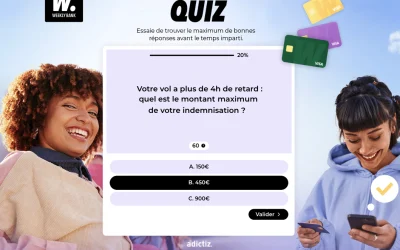
The marketing game can be used to help people discover the co-created product in a more entertaining way (via a quizIt can also tease its launch and optimise consumer expectations by offering them the chance to win free products via a competition or instant win (scratch cards, one-armed bandit). Le jeu permet aussi de faire gagner un produit de la marque partenaire pour booster la notoriété de celle-ci en s’appuyant sur la première.

Examples of gamified co-branding campaigns

The famous drinks brand Coca Cola is a master of the art of co-branding. The company uses this strategy to develop its audience and increase sales.

For example, it has teamed up with fruit juice brand Capri Sun to convert new customers. Its co-branded game campaign incorporated a proof-of-purchase mechanism into its prize draw form in order to boost its conversion rate and increase sales. In addition to the co-branded aspect of the campaign, the choice of an attractive prize (an iPhone) helped convert more than 5,000 visitors.

Coca-Cola has also developed a co-branding marketing campaign with energy drink brand Monster. Here again, the mechanic used was to upload a proof of purchase to access the game in order to generate more sales. As the two brands’ universes are more similar, this campaign had a participation rate of 75% and over 1,000 visits.

Example of co-branding

4 tips for a successful co-branding campaign

Before embarking on co-branding, it is important to consider the right factors to choose a relevant partner that will enable the brand to achieve its objectives.

  • Target markets. The most important thing is to make sure that your target audience and that of the brand with which you are planning to partner overlap. The partnership will not work if the companies are both targeting extremely different audiences or, conversely, if they are too similar.
  • Brand image. The personalities and worlds of the two brands must be compatible. The partners must share common and complementary values, at the risk of losing or alienating their community.
  • Market needs. A co-branding campaign must also respond, to a certain extent, to a market need. This partnership can enable the brand to address a need of its audience that it has not yet met.
  • Adapting the mechanics of your marketing game to the challenges of co-branding. In particular, this means choosing a prize that reflects the two brand universes. It also means announcing the winners on their respective channels, or providing an opt-in for the partner brand, etc.

Once the company has found the right partner, it is crucial to define everyone’s roles and responsibilities in the roll-out of the co-branding campaign. To achieve this, it is important to be able to count on a reliable and transparent partner who will contribute equally to the project.

Conclusion

Gamification is an excellent way of boosting the impact of a co-branding campaign. It will boost your brand’s reputation and its ability to develop a new audience. Discover our interactive competition mechanics to make your campaigns even more engaging and convert these new prospects more effectively!

In 30 minutes, we show you how to launch your own high-performance interactive marketing campaign