
2025 marketing calendar: playable marketing ideas

2025 marketing calendar: playable marketing ideas

S’appuyer sur un calendrier marketing est essentiel pour planifier ses différentes animations marketing en fonction de sa stratégie. En effet, selon les secteurs d’activité, les spécificités des audiences mais aussi des objectifs que les marques se fixent, celles-ci peuvent se positionner sur différents temps forts, tout au long de l’année. Dans cet article, nous creusons donc l’importance de créer et optimiser son calendrier marketing 2025.

Quels sont les marronniers à ne pas manquer, les objectifs marketing stratégiques qu’ils peuvent vous permettre d’atteindre et les différents formats que vous pouvez diffuser pour animer votre audience ? Voici notre guide complet !

What is a marketing calendar and why create one for your brand?

To be effective, rationalise their efforts and avoid missing an important date, brands need to plan their promotions around the main marketing events of the coming year.

The marketing calendar enables brands to engage their prospects and customers throughout the year. It includes all the key dates: Sales, Black Friday, Mother’s and Father’s Day, Christmas , Valentine’s DayBrands know exactly when to broadcast their campaigns. The is to capitalise on purchase intentions, for example, or simply to animate their community and stay top of mind.

calendrier marketing 2025 téléchargement

Different marketing themes to activate different strategic objectives

Beyond the commercial evergreen contents, planning the 2025 marketing calendar should be an opportunity for brands to choose the right highlights for their vertical and their audience. The idea is not to position yourself on every holiday and event of the year. But rather to identify those that resonate with prospect and customers and that are aligned with the company’s overall objectives.

End-of-year festivities, sales of seasonal events can be ideal occasions to launch interactive campaigns focusing on discounts or exclusive offers to generate more sales! But special occasions such as sporting events and international days (for pizza, pets, etc.) can also enable brands to raise their profile or raise awareness of their commitments (via interactive quizzes, for example).

More generally, events planned throughout the marketing calendar can be aimed at stimulating and engaging the community. Commercial highlights are an opportunity to multiply the points of contact with your audience. It’s also a good time to strenthen ties and achieve love brand status

In this way, brands can move away from a purely transactional relationship with their community. The idea is to encourage exchanges through interactive activities. Competitions to showcase their creativity, sports games to capitalise on the excitement of a sporting event. By adopting different playable marketing formats , with this new technology, companies can entertain and activate their audience throughout the year. They can also adopt target different objectives and adapt to different types of event (commercial, sporting, cultural, institutional, etc.)

4 ideas for interactive animations for your 2025 marketing calendar

As we have just seen the whole point of creating a marketing calendar is to be able to identify the relevant commercial highlights for its brand. But also to vary the entertainment offered to your audience!

Engaging customers, recruiting new prospects, collecting data to personalise future campaigns or generating sales… here are 4 playable marketing formats for 4 marketing events in 2025.

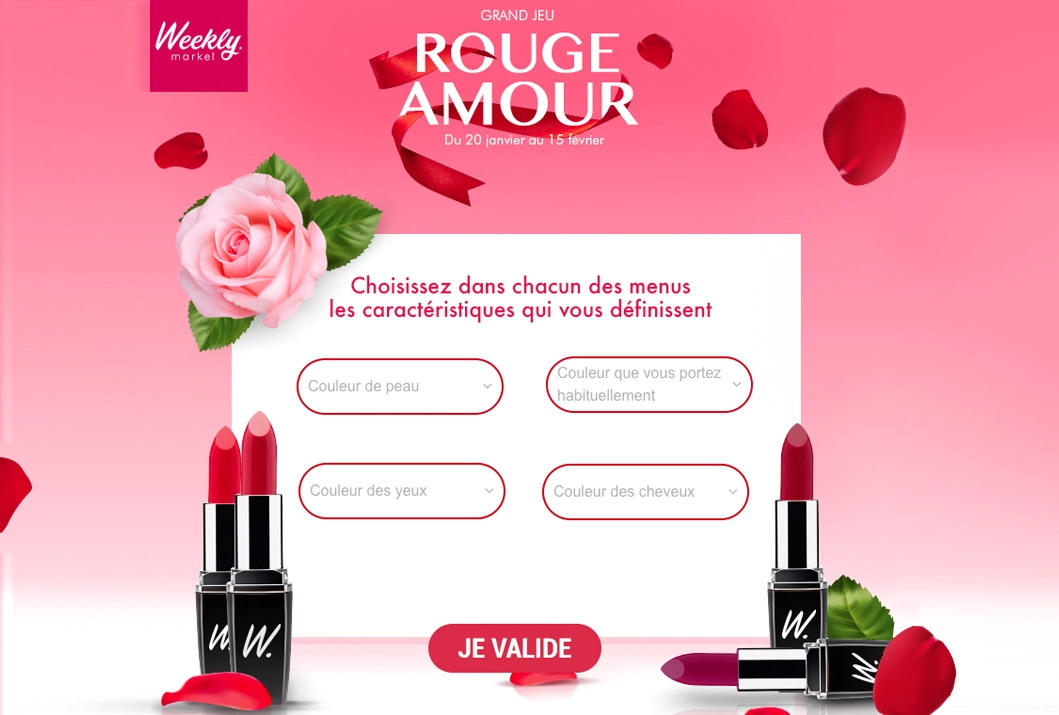
1. A Gift Finder for Valentine’s Day

Valentine’s Day is the ideal opportunity for brands to capitalise on the purchasing intentions of consumers looking for a gift for their loved one. It’s also the perfect time to offer a Gift finder to its audience. This gamified animation enables participants to answer a series of questions and then access a personalised recommendation of products or services to offer their partner.

Why this Playable marketing idea works: The Gift finder not only boosts Valentine’s Day sales by intelligently redirecting prospects to products or services that are likely to interest them. But its also an excellent format for collecting data (particularly product preferences) on your audience so that you can activate them more effectively in future campaigns.

gift finder

2. An anecdote competition for Mother’s Day

For Mother’s Day, brands can enliven their community by organising a competition. Plutôt que de miser sur la photo ou la vidéo, elles peuvent plus facilement engager les acheteurs en les invitant à partager l’anecdote la plus marquante avec leur mère. L’idée étant de partager facilement un contenu de manière anonyme. Les histoires les plus touchantes peuvent être repartagées sur le compte de la marque et les personnes auxquelles elles appartiennent seront récompensées avec des bons d’achat ou des codes promo.

Why this Palayable marketing idea works: competitions allow you to engage your community through creative challenges that are easy to complete. It’s also an excellent way for brands to generate UGC and therefore diversify their content strategy more easily.

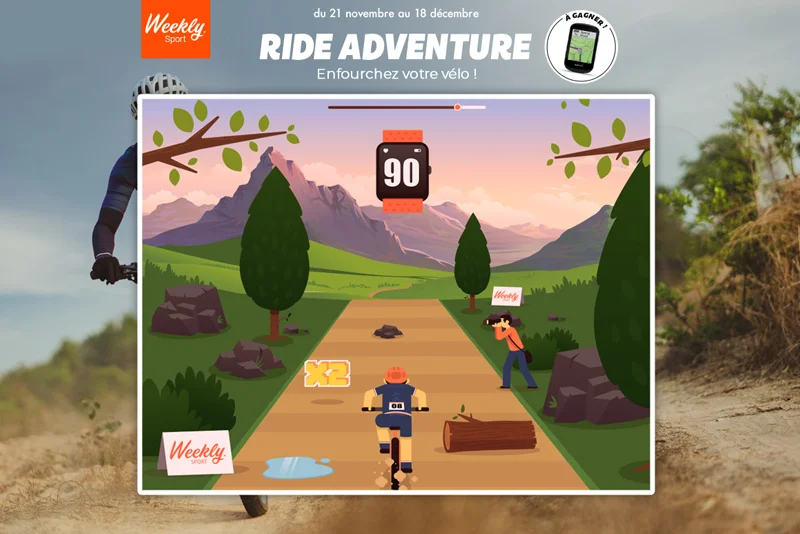
3. An Outrun for the Tour de France

Sports games are particularly well suited to major sporting events and competitions. They enable brands to engage their audience by capitalising on the visibility and excitement surrounding the feature discipline. For the Tour de France, companies can share an Outrun on their digital channels or in-store via an interactive terminal.

Why this Palayable marketing idea works: The marketing animation format allows the company to perfectly match the theme of the event. It’s an opportunity to generate engagement with your target audience more easily.

game outrun mechanic adictiz

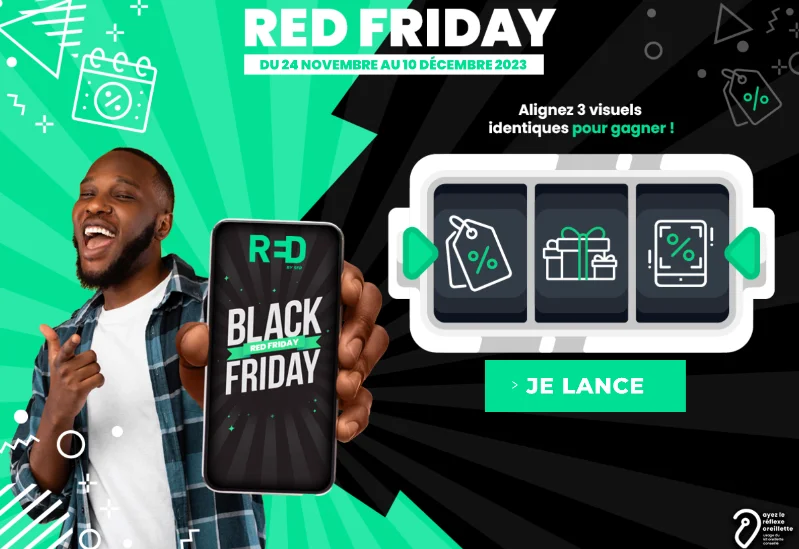
4. A 100% winning One-Armed bandit for Black Friday

Every year, Black Friday is an opportunity for consumers to make savings on their Christmas shopping and treat themselves at a lower cost. For this highlight of the 2025 marketing calendar, brands can offer games like a 100% winning One-armed Bandit to distribute discounts to their audience and generate more sales.

Why this Playable marketing idea works: 100% instant wins make it easier for brands to attract the attention of their prospects, who are particularly solicited during this busy sales period. It’s also a format that’s easy to adapt to your sales-boosting objectives. You can add a deadline or conditions of use (on the online shop, in physical shops, etc.)

marketing game black friday

Conclusion

Creating your 2025 marketing calendar is the best way to effectively plan your sales events for the whole year and control your resources (time and money). Download our free comprehensive guide to fine-tune your strategy and optimise your competitions!

In just 30 minutes, we’ll show you how to launch your own high-performance interactive marketing campaign.

What are Playable Ads? Examples

What are Playable Ads? Examples

Against a backdrop of advertising saturation, brands need to redouble their creativity to capture the attention of their audience. To vary from traditional advertising formats, display banners can now be interactive and even playable. This is what is known as Playable Ads, a playable marketing advertising format that involves gamifying banner ads to make them more captivating, engaging and memorable.

In this article, we’re going to take a look at playable advertising and the many advantages it can offer your brand. W’e’ll also share some concrete examples to inspire you and some practical tips to boost your advertising strategy!

What are Playable Ads?

Playable Ads are an interactive advertising format designed to capture the audience’s attention by offering them a playful experience. Drawing on the codes of video games, this format engages users by encouraging them to actively interact with the content, whether to solve a challenge, explore a world or complete a task.

Unlike traditional static banners, Playable Ads transform passive interaction into an immersive experience in which the user becomes an actor. This active participation stimulates attention and helps the message to be better remembered, increasing the chances of conversion and boosting the overall impact of the advertising campaign.

By playing on the pleasure of interaction, this advertising format not only improves engagement, but also key indicators such as click-through rates and time spent with the brand.

Playable Ads KPI’s

To assess the effectiveness of a Playable Ads campaign, several key performance indicators (KPIs) are used to measure both the traffic generated and the level of engagement. These KPIs include:

  • Number of impressions: corresponds to the number of times the ad has been loaded.
  • Visibility rate: indicates the proportion of impressions during which the ad was actually seen.
  • Click-through rate (CTR): for Playable Ads, this rate far exceeds the standards for traditional display formats, where the average CTR is around 0.46% (source 2023). For Playable Ads, it can be as high as 3.8% (internal benchmarks 2023/2024).
  • Click-to-play rate: this KPI measures the percentage of users who interact with the ad content. It is around 9.6%, demonstrating the ability of Playable Ads to generate interaction and engage a qualified audience.
  • Landing rate: calculates the ratio between clicks and visits to the site, indicating how many users continue their journey after interacting with the ad.

These indicators show that Playable Ads are particularly effective at capturing attention, engaging users and maximising the impact of campaigns.


The different display formats for Playable Ads

Playable advertising comes in different display formats. Each can be adapted to different display distribution networks:

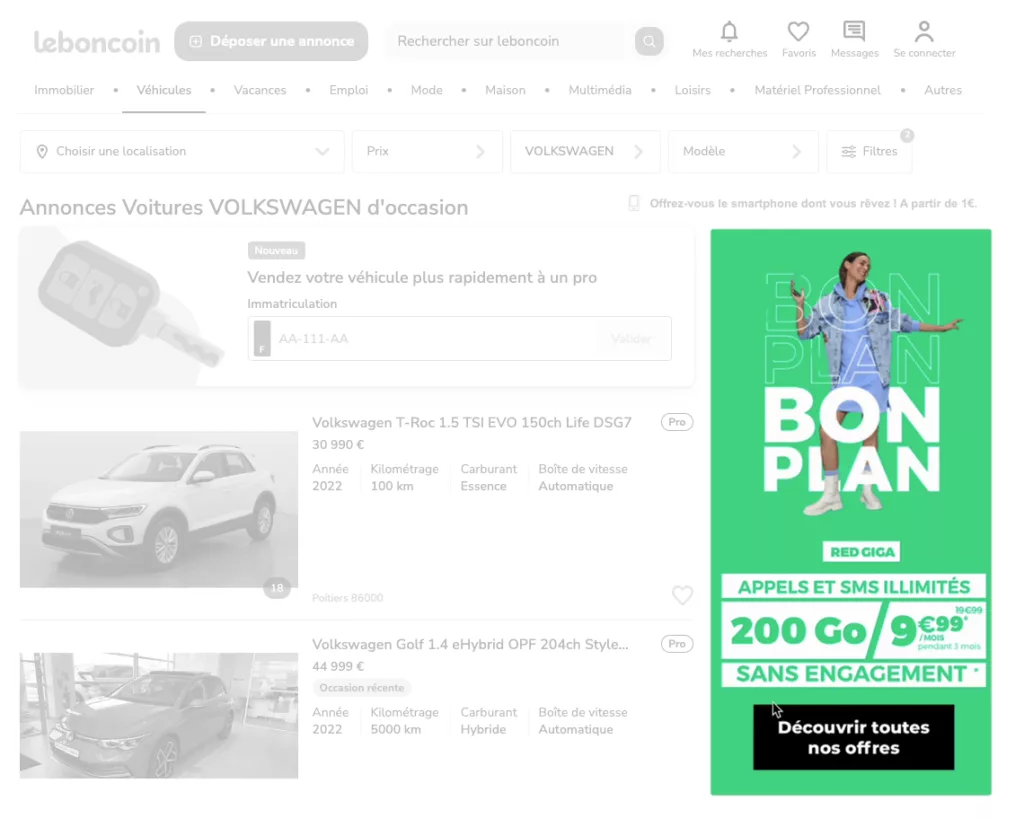
  • The pavé: this is the most popular advertising format. It makes it easier to integrate Playable Ads into (or close to) editorial content. This has the advantage of limiting the effect of banner blindness and capturing consumers’ attention more effectively.

  • Interstitials: this format is compatible with a wide variety of creations. It can appear during natural transitions in an application or in an online gaming experience.

  • The wide angle or half-page: this stands out because of its size. It therefore has a greater impact and allows the advertiser’s animation and content to be displayed in greater detail.
formats diffusion playable ads

The different mechanics of Playable Ads

Depending on the objectives it has set itself, the brand choose a suitable playable advertising mechanism. For example:

  • Engaging mechanics that display promotional codes and reproduce the idea of winning, such as scratch cards or wheel of fortune. The principle is simple and the reward immediate (display of a simple promotional code, for example), making it an excellent lever for visibility and engagement.

What are the objectives of playable advertising?

Like any traditional advertising format, Playable Ads enables brands to generate leads and convert new customers by highlighting their products and services and emphasising their value proposition.

Playable ads are a way of meeting strategic marketing challenges for retailers. Here are the main objectives of Playable Ads:

  • L’engagement. Contrairement à une publicité classique que l’on se contente de regarder, le format interactif encourage les prospects à passer du temps avec la marque. Les avantages sont évidents : les produits sont plus visibles, le trafic est optimisé, et l’engagement supérieur.
  • Qualification and conversion. The interactive mechanics of playable advertising are also a powerful lever for collecting customer data. For example, format such as Swiper or Battle are ideal for capitalising brand awareness and also attracts potentially more qualified traffic, making conversion more likely.

    Reconcile consumers with digital advertising

    5 examples of playable advertising to inspire you

    Before you get started with Playable Advertising, you can take inspiration from the foolowing examples:

    1. Raise your profile

    Nickel used the Playable Ads format to promote the personalisation capability of its bank cards. users had to choose a card color via a Wheel of Fortune mechanic Once the wheel had been launched, users clicked om a map to discover the offer via one of 15 personalised messages.

    nickel playable wheel of fortune

    2. Present the advantages of an offer

    To support its TV advertising campaign on the connected station, Sowee used the Playable format to enable its audiences to discover the benefits of its product.

    The Memory format was particularly effective here in familiarising prospects with the company’s unique value proposition. Participants had to reform pairs with items such as “fixed prices for 3 years” or “an offer with no commitment”.

    sowee advertising playable

    Reinforce interaction with your audience

    Neo-bank Floa has used Playable Ads to promote its available payment services and appeal to a younger audience segment that appreciates the flexibility offered by banks.

    Users were invited to discover the payment facilities available to them (payment in instalments, no need for proof of payment, etc).

    floa quizz

    4. Reinventing the customer experience

    Carrefour has decided to modernise its brand image by launching an interactive advertising campaign. Thanks to the playable advertising format, the brand offered its audience an immersive experience inspired by slot machines. Offering instant gratification, this format, customised to respect the brand’s universe, enabled Carrefour to better engage its prospects and customers. It was a fun and memorable experience that not only raised brand awareness, but also boosted sales by giving away vouchers.

    Playable ads slot machine carrefour

    5. Improve recall of the promotional message

    Uber Eats has also opted for Playable Marketing to engage its audiences. The company opted for a captivating game mechanic called Rattrape-tout. Customised to reflect the world of Uber Eats, this marketing game enabled the brand to multiply and extend interactions with its audience by totally immersing them in its world. This unique and engaging experience encouraged the creation of an emotional connection, while giving the company the opportunity to anchor its key messages in the minds of consumers.


    Annonces jouables Uber Eats

    Feel free to browse other examples of Playable Ads created by Adictiz clients and run your own playable ads!

    Broadcast your own playable interactive displays!

    3 ideas for Valentine’s Day campaigns to win over your customers

    3 ideas for Valentine’s Day campaigns to win over your customers

    La Saint Valentin n’est pas seulement la fête des amoureux. C’est aussi une fête commerciale qui est devenue une date incontournable du calendrier marketing des marques. D’après les derniers chiffres disponibles issus d’une étude YouGov, près de 185 millions d’euros avaient été dépensés lors de la fête des amoureux en France, soit une progression de 275% en 10 ans. 

    La Saint Valentin est d’ailleurs la 3e fête commerciale la plus importante en France, derrière Noël et Halloween. C’est donc l’occasion pour les marques de capitaliser sur les intentions d’achat des consommateurs en leur proposant des idées de cadeaux romantiques à offrir à leur moitié. 

    Pour se démarquer durant cette période particulièrement concurrentielle de l’année, votre entreprise peut miser sur un levier marketing redoutable : la gamification. En intégrant des mécaniques interactives dans votre campagne marketing de Saint Valentin, vous pourrez en effet mieux capter l’attention de votre audience et les inciter à acheter leur cadeau auprès de votre marque. 

    Dans cet article, nous vous partageons 3 exemples de campagnes gamifiées pour la Saint Valentin. Vous pourrez vous en inspirer pour dynamiser votre communication, engager plus efficacement votre public cible et booster vos ventes durant ce temps fort commercial. 

    What should you aim in for in a Vlantine’s Day marketing campaign

    Even though it remains the ultimate romantic holiday, Valentine’s Day is also an opportunity for brands to promote their offerings. This commercial holiday serves as a prime showcase for businesses that sell potential gifts for couples in love.

    Of course, we think of the traditional bouquets of flowers. Industry professionals expect over a million flowers to be sold for Valentine’s Day this year, with two-thirds being red rioses. However, florists are not the only merchants celebrating Valentine’s Day. Fashion, beauty, culture, dining… Many sectors are involved in Valentine’s Day marketing.

    Don’t forget about singles, who are also targeted by brands during this key commercial period. On dating apps, the annual peak of activity tends to occur at the beginning of the year. Singles often make New Year’s resolutions, and apps like Happn see an increase of over 20% in their sign-ups during the month of February.

    The main objective pursued by companies in their Valentine’s Day marketing is therefore to increase sales and revenue. The goal of the campaigns implemented is to raise consumer awareness of their offerings ans encourage them to buy their Valentine’s Day gifts in-store (physical or digital).

    But beyond the conversion objective, brands can also design their Valentine’s Day campaigns around other strategic goals.

    Increase brand awareness

    Valentine’s Day is an opportunity to gain visibility with a new audience. The aim of the campaign will be to boost brand awareness among couples (or singles) by leveraging viral marketing strategies (such as marketing contests, influencers collaborations, or co-branding).

    Engage your customer community

    After a quiet January following the holiday season, the marketing calendar kicks off with a bang thanks to Valentine’s Day. Businesses can take advantage of this key period to engage their audience. The idea is to increase interactions with the brand, particularly through gamification mechanics.

    Contests, for example, encourage users to be creative and allow businesses to generate user-generated content (UGC).

    Collect data

    Customer knowledge is also a significant aspect of Valentine’s Day marketing. Brands can leverage interactions with their audience to collect relevant data, particularly regarding product preferences, as well as opt-ins for their future communication campaigns. This information can be utilized throughout the year to better segment their clientele and send personalized content and offers.

    Foster loyalty and strengthen brand attachment

    En mettant en jeu des récompenses attractives sur le thème de l’amour (comme des séjours en amoureux, des coffrets cadeaux, etc.), les marques peuvent ainsi booster leur rétention client. Les jeux marketing peuvent être proposés en post-achat (pour encourager le rebuy) ou réservés aux membres du programme VIP, pour augmenter la fidélisation. En récompensant ses meilleurs clients, l’entreprise pourra ainsi renforcer l’attachement à la marque et sécuriser des revenus significatifs.

    3 Examples of gamification marketing Campaigns for Valentine’s Day

    To stand out from their competitors and boost the performance of their Valentine’s Day marketing strategy, an increasing number of companies are betting on gamification. Here are 3 inspiring campaigns to achieve commercial goals and engage their audience more effectively.

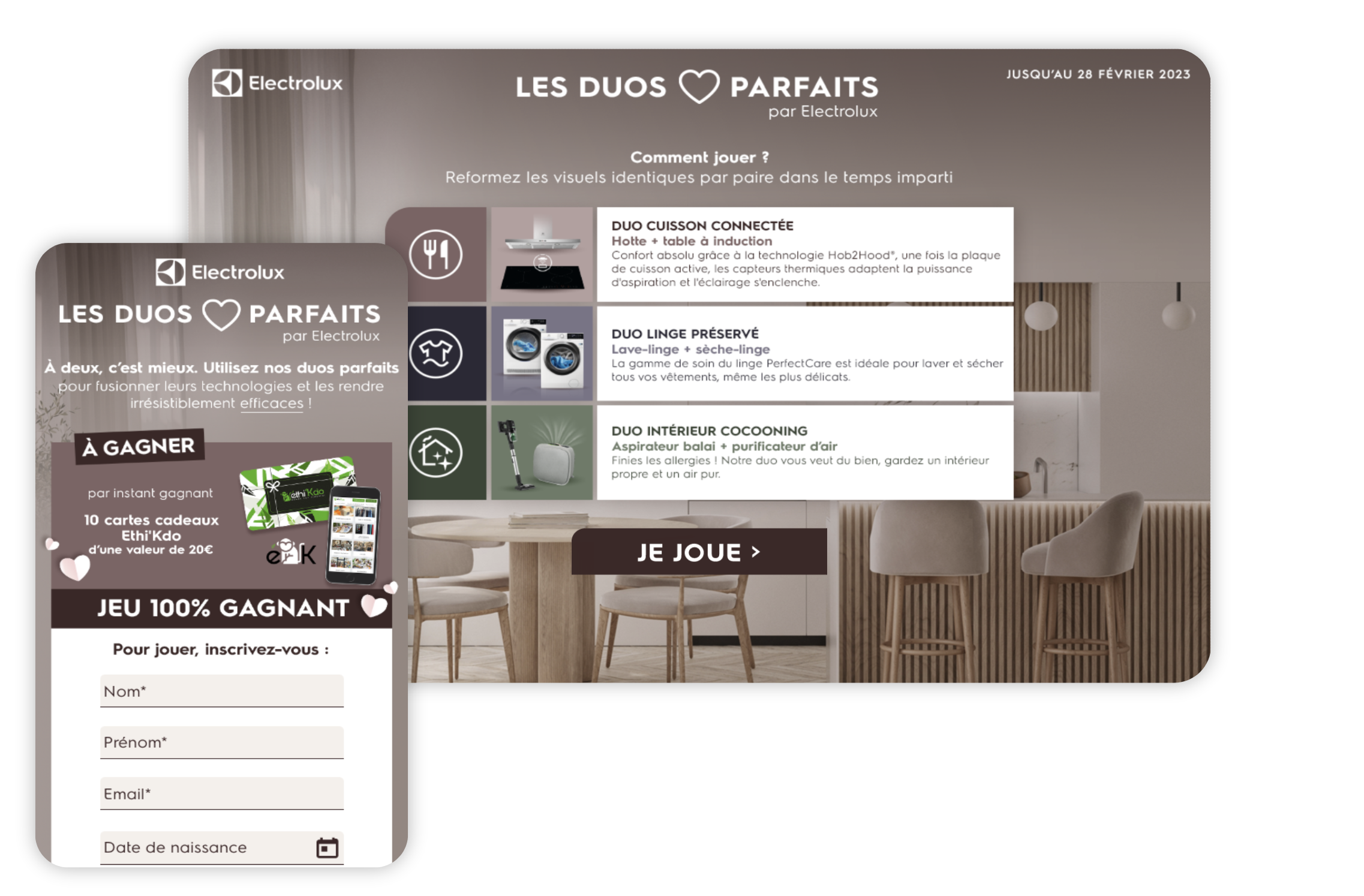
    1. Electrolux: a Memory game to enrich their database during Valentine’s Day

    On the occasion of Valentine’s Day, Electrolux launched a campaign aimed at enriching its database, specifically encouraging product registrations. Through an engaging game mechanic, Memory, the brand was able to collect opt-in very effectively while showcasing its Duos product range.

    Electrolux’s campaign generated significant enthusiasm, showcasing an excellent engagement rate (31K users and an average of 2 minutes per game session) and very good results in lead qualification. This campaign allowed the brand to retarget and retain acquired leads, highlighting the ability of a gamification marketing campaign to create meaningful interactions while achieving notable results in qualification.

    electrolux valentine's day

    Del Arte: a Shooter game to generate new leads

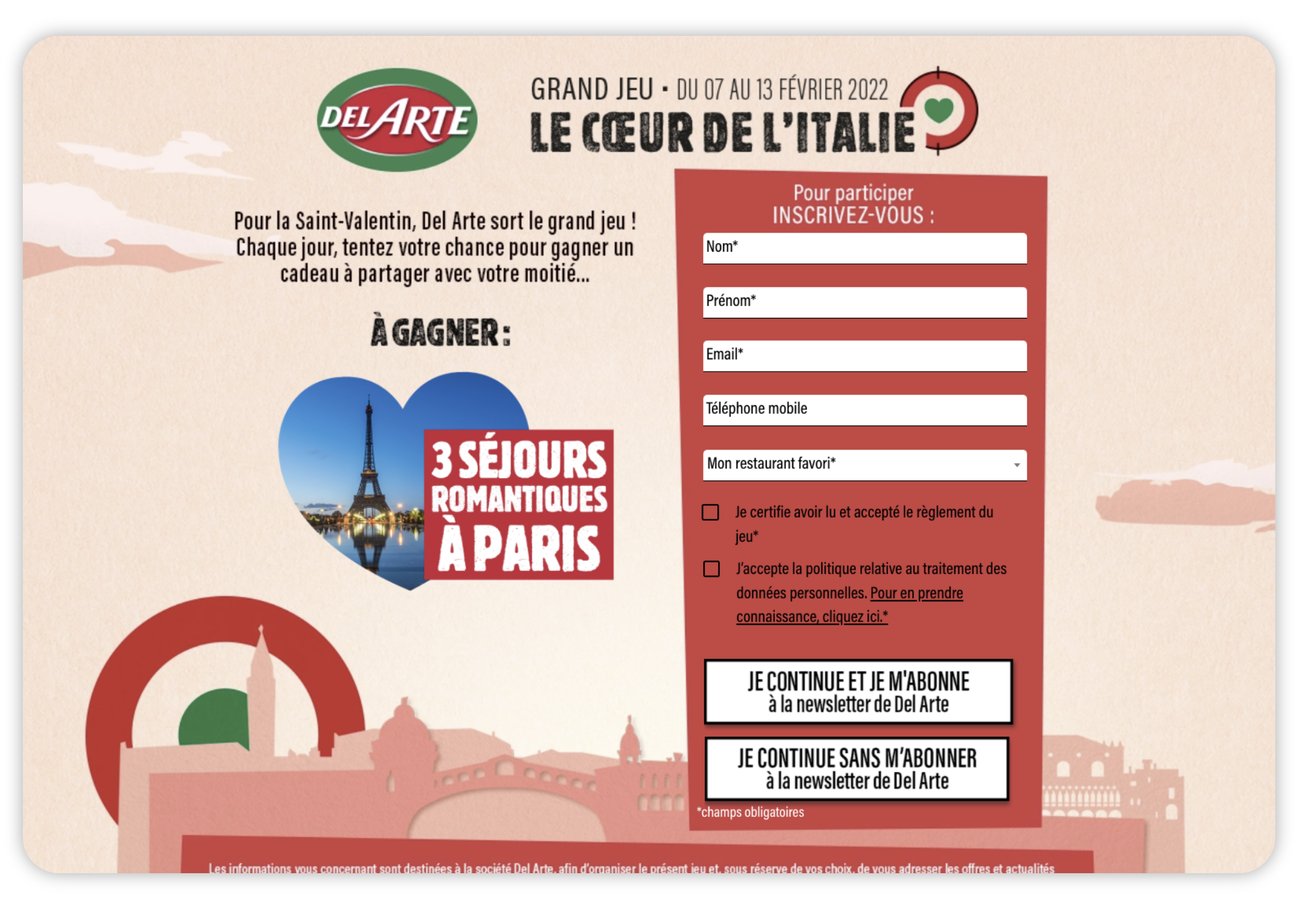
    As every year, the Del Arte brand celebrates lovers on Valentine’s Day. The interactive campaign invites participants to play a Shooter game. They are then redirected to an instant-win opportunity to win particularly attractive prizes for the target audience (gift vouchers, Interflora bouqets, trips to Paris, etc. )

    The campaign primarily enabled the company to generate over 40k new sign-ups to its mailing list and opt-ins. These leads were then reactivated throughout the year through strategic marketing campaigns for the brand.

    del arte valentine's day

    3. M&M’s: A shuffler game to boost Valentine’s Day sales

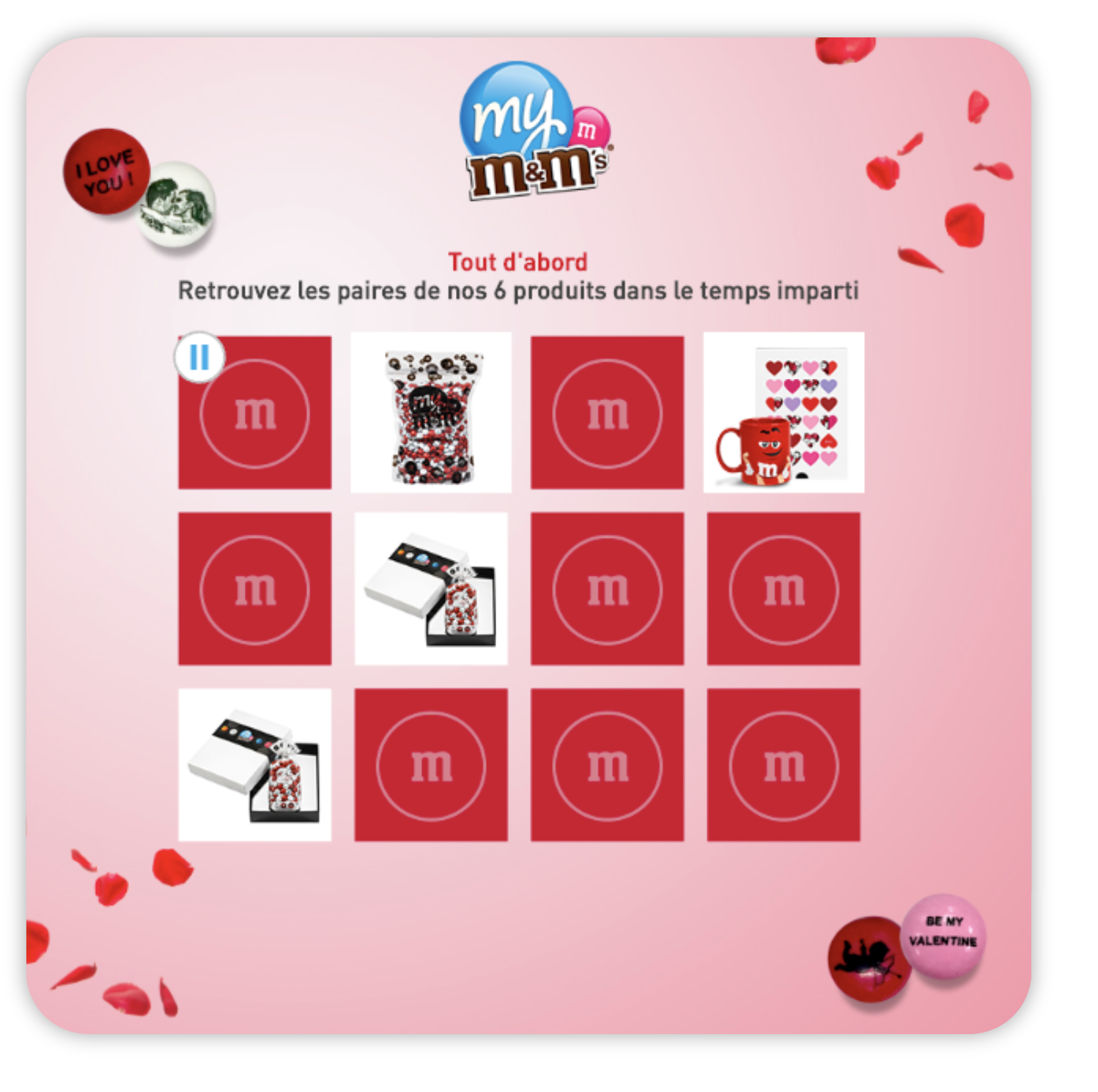
    On the occasion of Valentine’s Day, My M&M’s launched a game to attract new customers by showcasing its product range. Users had to form all the pairs within a set time to access a Shuffler and immediately discover if they won their Valentine’s Day gift box. This highly engaging mechanic allowed M&M’s to generate 30k new leads.

    m&m's valentines day

    Conclusion

    Consumers are particularly attentive to brand content around Valentine’s Day. Capitalize on their purchase intentions and engagement to achieve your strategic goals by launching a gamified marketing campaign. To enhance your communication and boost your results, all you need to do is customize one of our marketing game mechanics!

    In just 30 minutes, we’ll show you how to launch your own high-performance interactive marketing campaign.