
Gift cards and gamification, boosting customer engagement

Gift cards and gamification, boosting customer engagement

Brands are constantly looking for marketing levers to engage and convert their audience. Gift cards are one of the most popular tools for boosting brand awareness and encouraging purchases or repeat purchases.

They are widely adopted by retailers, from fashion to restaurants, not forgetting supermarkets. However, gift cards are also used by smaller brands to engage their audience. They are all the easier to mobilise as part of an omnichannel customer experience. They can be physical or digital.

In this article, we’ll be sharing how to strenghten your relationship with your audience using gift cards. We’ll explore ways of gamifying a gift card program and making the experience interactive and engaging.

The explosion of gift cards as a mtehod of payment

In 2024, brands reported an increase of almost 25% in gift cards purchases. Gift cards are no longer reserved for the festive season, when they are given as Christmas presents. It is now becoming more widespread during high points such as sales, Black Friday, Mother’s Day and Valentine’s Day (when consumers want to give pleasure or treat themselves).

Another new development is the dematerialisation of gift cards. Long confined to physical shops, they are now exploding in e-commerce. According to a Global POS analysis, the average value of gift cards activated on the web has riser from €50.73 to €59.56 in 12 months, an increase of 17.42%!

For consumers, they are becoming the preferred method of payment, both in retail and online. The distribution of market shares remains equivalent, with fashion leading the way in terms of usage. Nevertheless, we are seeing an increase in purchases made using this methods of payment during the sales period, demonstrating the growing importance of gift cards in consumer habits.

What are the advantages of gift cards for brands?

As well as being popular with shoppers, gift cards also offer benefits for brands. Theses include:

A significant increase in revenues

Gift cards are an opportunity for brands to increase their sales. This is an advance payment that is not always used by its holders. According to CEB TowerGroup, 10% of gift card balances remain unused, which represents a considerable margin. In one year, a brand like Starbucks can make a profit of 1 billion dollars from unused gitf cards. Buyer who use these cards generally spend more than the initial amount,increasing the company’s revenues. 61% of consumers who opt for this payment method spend more than thier balance.

An opportunity to acquire new customers

Many of the customers who buy a gift card are new customers. It is therefore a lever of brand awareness, which capitalise on recommendations to boost visibility. Overall , gift cards reduce acquisition costs. The brand takes advantage of the visibility and traffic of other brands to raise its profile by placing its gift cards in a distribution network (or on platforms such as my gift card).). C’est d’autant plus efficace quand elles sont affichées à côté de celles d’entreprises comme Amazon ou Netflix.

A lever for customer retention and loyalty

Gift cards improve the shopping experience by offering consumers greater flexibility. They benefit from greater flexibility of choice, and the dematerialisation of cards simplifies their use. This tool can also be a way of strengthening the loyalty program and make it stand out from the crowd. By sending them to customer who cross a threshold (or number of loyalty points), brands can increase the repurchase rate. It’s a way of strengthening the relationship with our most committed customers by rewarding them with an e-card.

A tool for collecting customer data

The use of gift cards enables retailers to improve their customer knowledge. They are able to track purchases and collect data (the time between the purchase of the card and its use, the amount of the purchase, the products or services purchased, etc.).

Dematerialised gift cards, sent via an email campaign (as part of a loyalty program), can be used to refine these analyses.. L’entreprise peut suivre le parcours client et calculer son ROI.

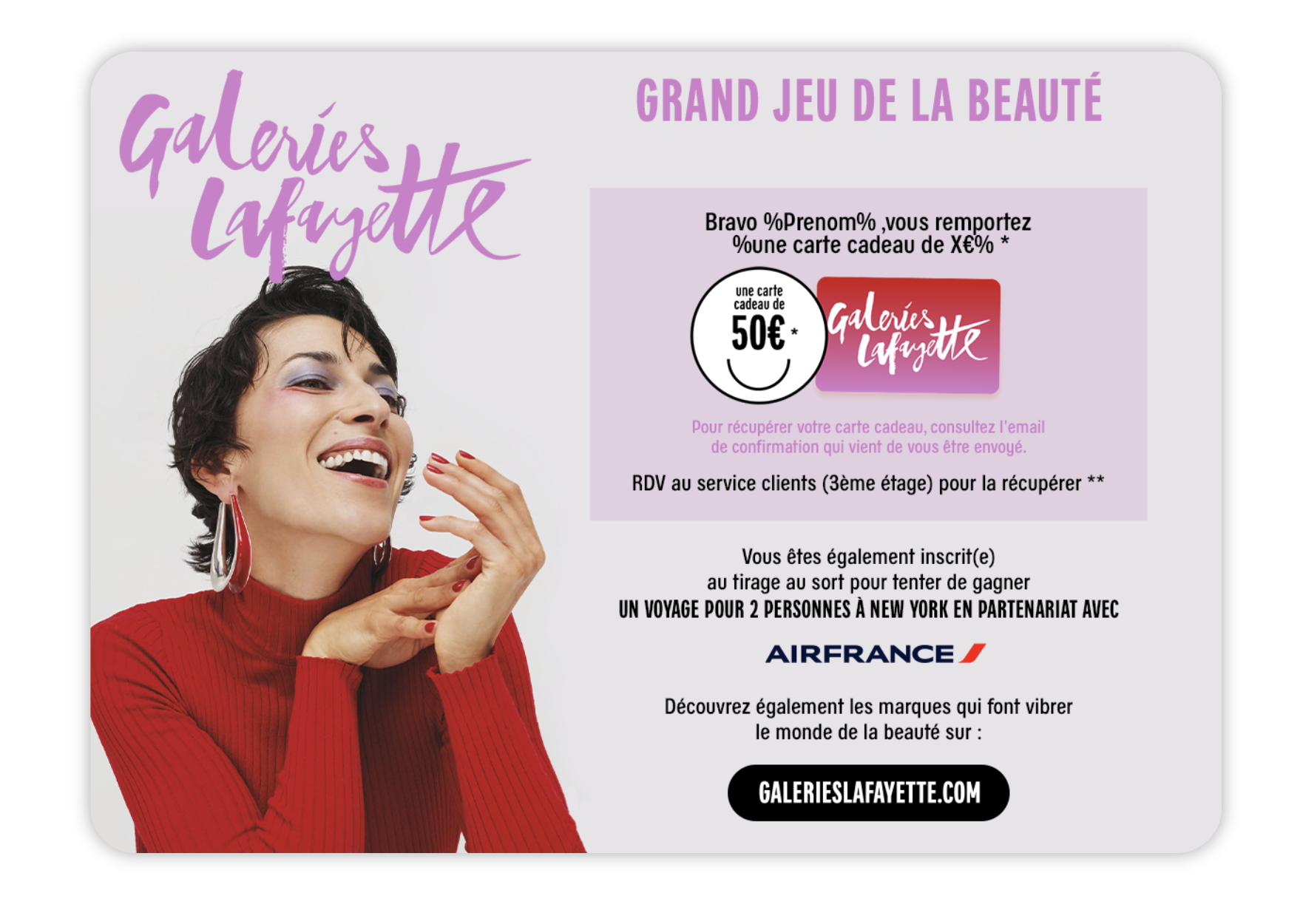
Galeries Lafayette - Gift card give away

How to gamify gift cards to boost buyer engagement

While the gift card is a tool for expanding and engaging its audience, it remains a competitive arena. To stand out from the crowd, brands can enhance the experience by opting for gamification. Gamification strengthens the interaction between the company and the consumer, through playable formats and attractive rewards. In the context of a gift card program, this can take the form of:


  • Interactive promotional campaigns. Playable Marketing is an excellent way of boosting visibility and encouraging audiences to buy gift cards. the brand can launch a gamified campaign on social networks in order to generate leads and acquire new clients. Le format du contests increase the virality of the campaign and makes it more attractive.

  • Gamified rewards: shoppers can increase the value of their card or unlock rewards (free goodies, free delivery) by taking part in a marketing game or challenge. The brand can integrate a QR code into its gift card, taking consumers to a winning instant to encourage them to buy one.

Conclusion

Gift cards are all the rage, both in-store and online. They’re ideal for raising your brand’s profile and engaging your audience. To make them more attractive and generate more sales, gamify your shopping experience with our interactive mechanics!

In just 30 minutes, we’ll show you how to launch your own high-performance interactive marketing campaign.

What is data collection? What methods are used?

What is data collection? What methods are used?

Collecting data is crucial for businesses. Organisations rely on data to optimise their day-to-day operations, facilitate strategic decision-making and better address their needs.

What’s more, to refine your knowledge of your business and your audience, it’s important to put in place a data collection strategy. In this article, we look at methods for collecting and qualifying customer data.

What do we mean by data collection?

Data collection is the process of extracting data from a source to gather information. Then, from the user’s point of view, it can be deployed with surveys, interviews and focus groups as part of market research.

Today, every point of contact is an opportunity for companies to gather valuable information. Browsing a website or application, visiting a shop and interacting on social networks are all opportunities to understand the behavior and expectations of audiences.

The qualification and analysis of this data can then be used to:

  • evaluate the company’s performance (in terms of customer satisfaction, conversion and retention);
  • make better decisions (sales, marketing, operational, etc);
  • predict future market trends and anticipate audience expectations.

The different types of data

Before looking at the different methods of data collection, we need to differentiate between the 3 main types of data.

  • First-party data, i.e. behavioural information collected when customers interact with their sites, applications, products or social networks.

  • Third-party data, collected by third parties, but the reliability, quality and ethical nature of this data is less than that of the previous types.

Why collect customer data?

First of all, when collecting data, you need to identify the reasons why the company wants to have the information. There are many reasons for collecting data (not all of which are mutually exclusive):

  • Enhancing your CRM database. These days, brands need to collect new qualified contacts in order to gather information about their customers. Feeding the CRM is an objective that enables key messages to be communicated. This is made possible by communication levers such as newsletters and SMS. It’s also an excellent way of refining customer knowledge and better addressing needs.

  • To compensate for the deletion of data (which occurs every 3 years). The RGPD stipulates that European authors (including companies) may retain their customer data for 3 years. It is therefore crucial for organisations to plan for data collection opportunities in order to renew their database on an ongoing basis.

The main data collection methods

Depending on the quality and nature of the data, the company can use different data collection methods:

  • Quantitative data collection, using systematic methods. This type of data is distinguished by its ability to provide a basis for statistical analysis of the company. It can be collected via surveys (with closed questions), behavioral observation (data observed on the website, etc.).

  • Qualitative data collection focuses on non-numerical data. This approach favors precision and depth over breadth by offering an insight into the preferences and motivations of its audience. In addition, it can be collected via open surveys and in-depth interviews (one-to-one or via focus groups, etc.).

  • Primary data collection refers to the capture of data that has not been processed beforehand. This is data collected at source (directly from prospects and customers) via forms, questionnaires or interviews.

  • Secondary data collection involves searching for and using data that has been collected for a purpose other than that of the company. This secondary data is often historical and provides a backdrop for new research. It is collected through archival research or database mining.

Gamified tools for collecting customer data

The golden rule of data collection is that the closer you are to the source of the data, the more qualitative, accurate and reliable it is.

Companies therefore need to mobilise tools to collect information from their prospects and customers. They can rely on gamified and interactive formats. These encourage their audience to share information freely and accurately. What’s more, this information can relate to their purchasing habits.

These gamified data collection tools include :

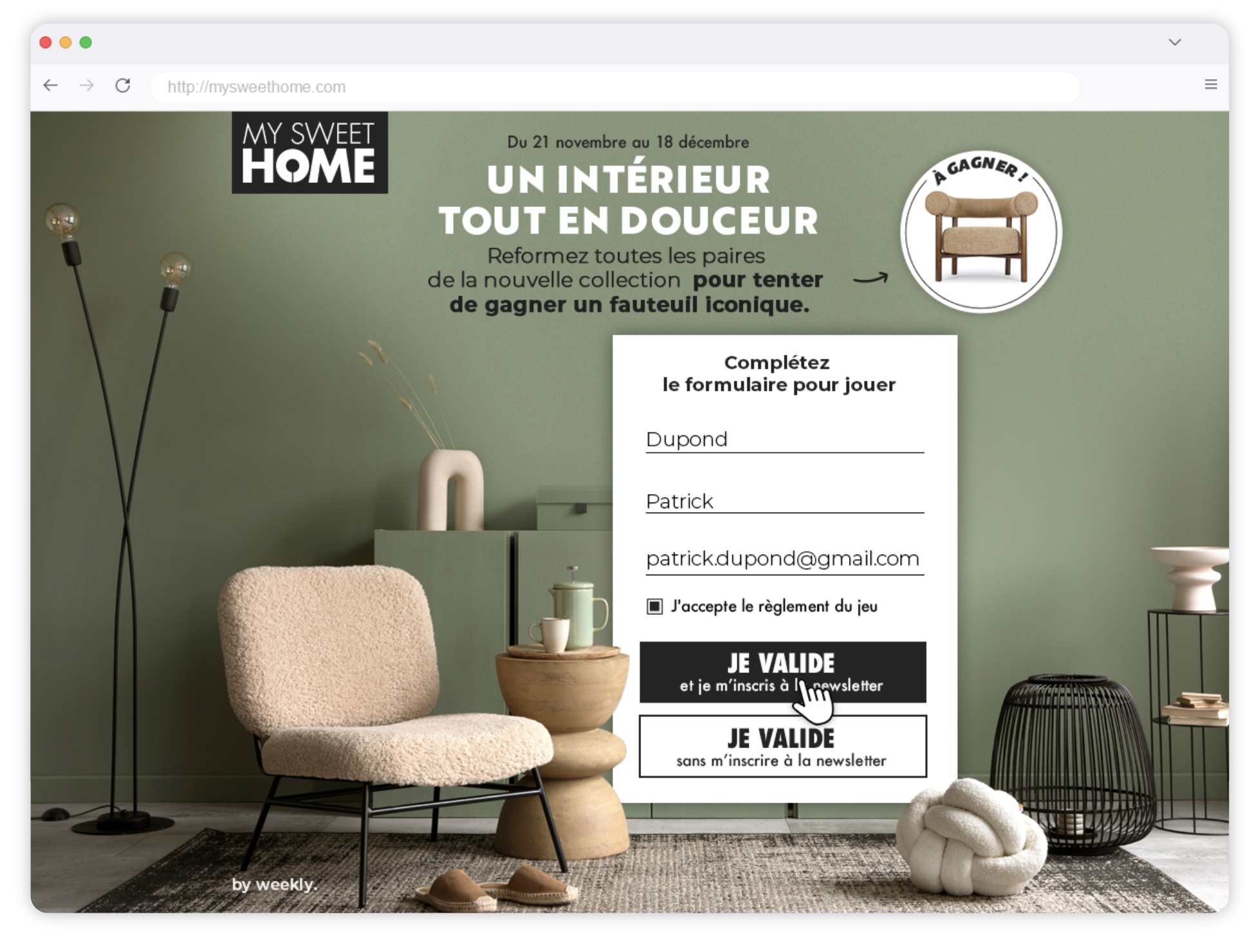
  • The marketing game, ideal for recruiting, engaging and converting. To take part in a competition, users first have to fill in a form. Then, the game mechanics can multiply the number of interactions with the user and the collection of first-party data.
Weekly - collection methods
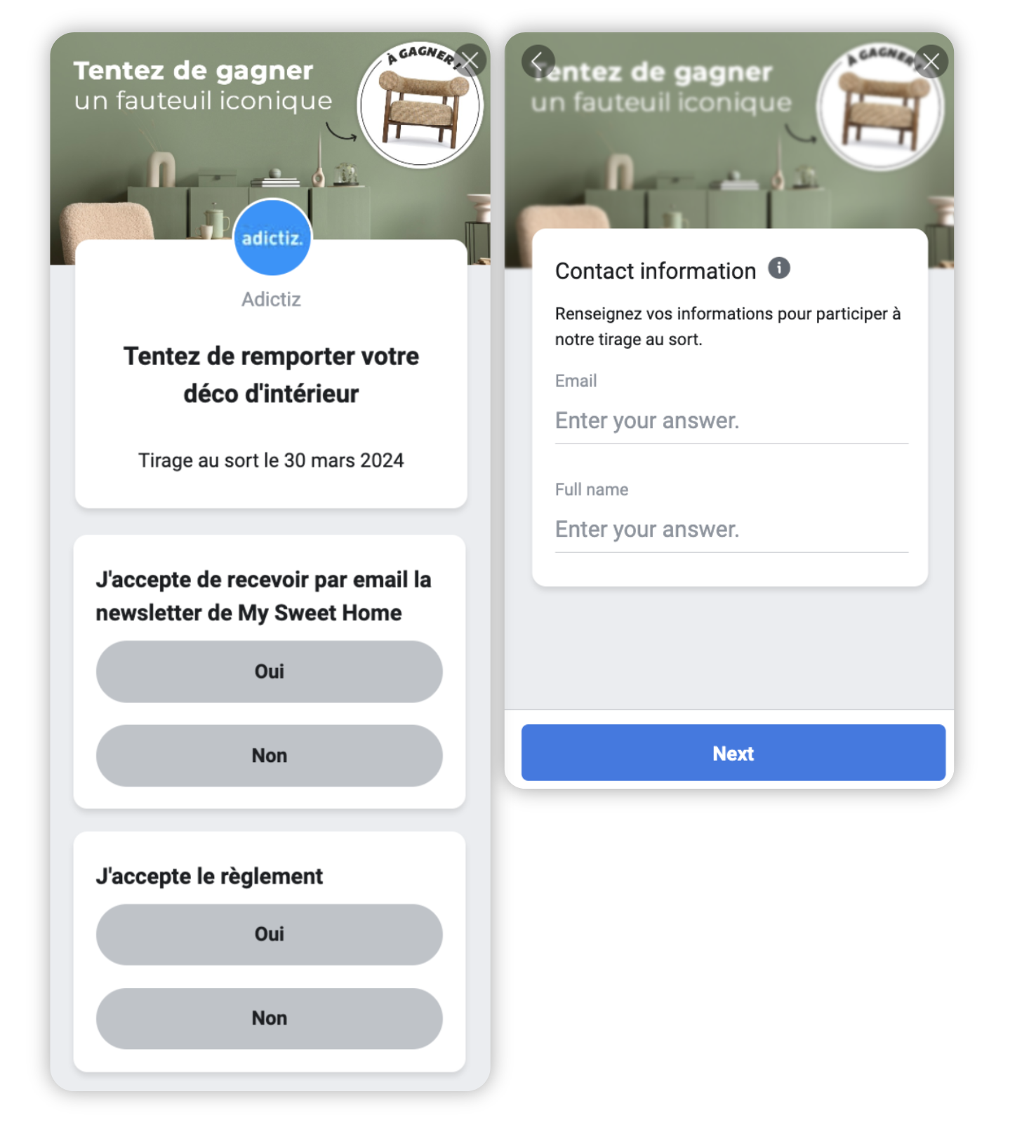
  • The lead generation form. This tool enables you to recruit and qualify subscribers using a form integrated into the platforms. This is an excellent format for inviting Internet users to share their contact details.
Weekly - lead generation
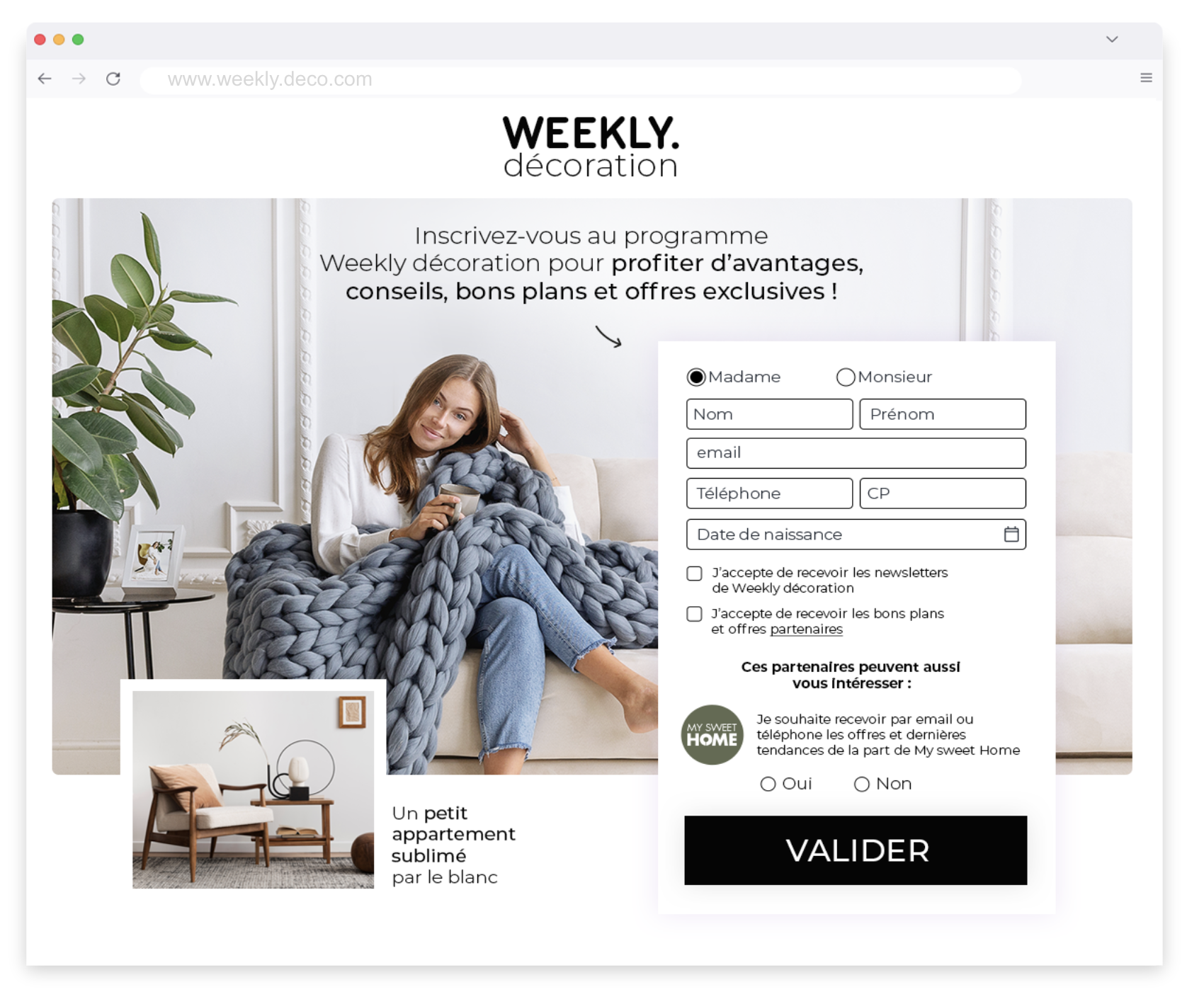
  • Co-registration to recruit opt-ins. This format enables you to pool your recruitment efforts by associating your company with a complementary collection method (via a partner brand).
weekly - data collection
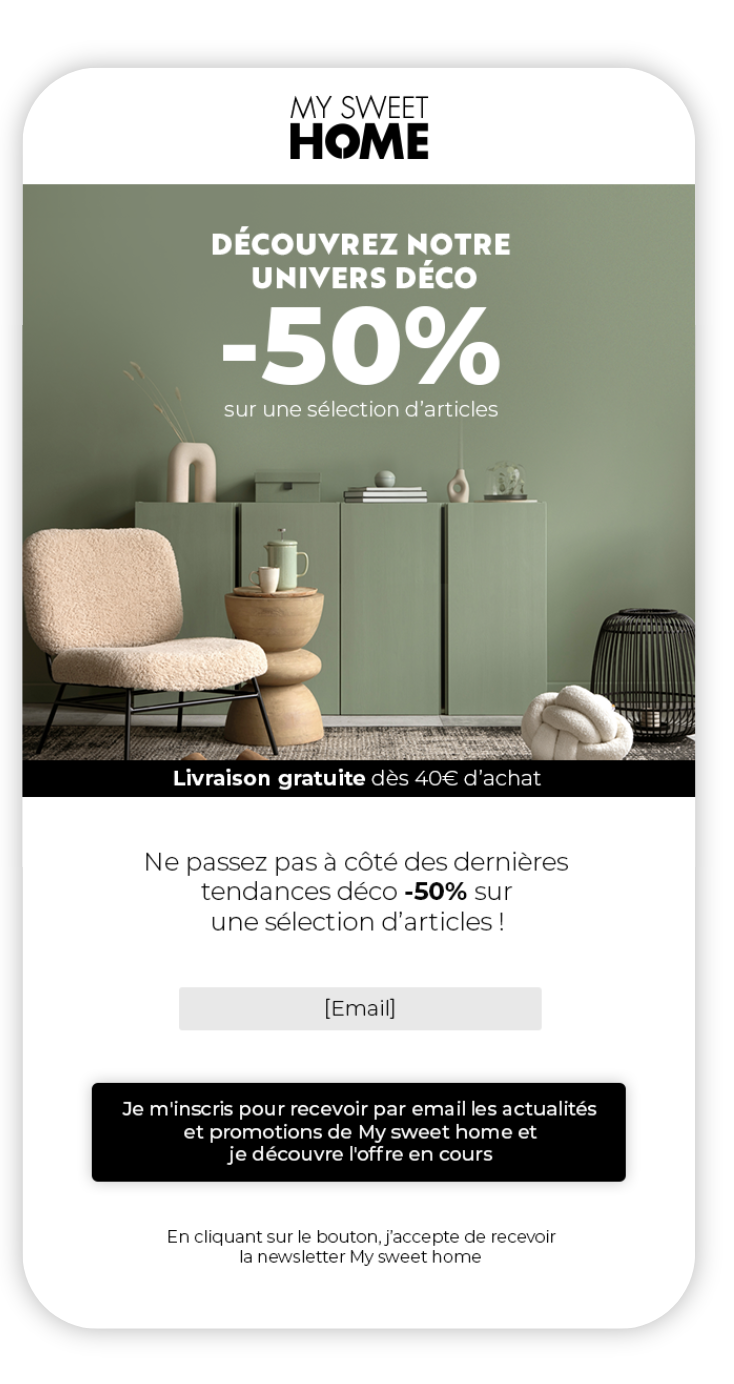
  • The click to lead email. The brand highlights an offer to encourage the user to subscribe to its newsletter and thus expand its customer database. The opt-in is generated by the click and the user is then redirected to the e-commerce site.
Weekly - email clic to lead

Conclusion

Implementing a data collection strategy is crucial if you are to make the right decisions and target your audience as effectively as possible. To meet today’s data collection challenges, your company needs to multiply its methods and tools so that it has a precise understanding of its market and its audience. Discover our gamified formats to help you recruit leads and share quality data!

In just 30 minutes, we’ll show you how to launch your own high-performance interactive marketing campaign.

Corum L’Épargne: sports marketing and gamification to boost brand awareness

Corum L’Épargne: sports marketing and gamification to boost brand awareness

CORUM L’Épargne is just one of the brands that have embraced gamification as a communications tool.This French company, which offers transparents and accessibl savings solutions, has chosen Playable Marketing coupled with sports sponsorship to raise its profile and effectively address its audience.

In this article, we’ll look at the relevance of gamification in meeting marketing challenges of the banking sector in general, and CORUM l’Épargne in particular. Through examples of playable campaigns she has run alongside Adictiz, Lucie Odoux, Head of Sports Sponsorship, shares with us the best practices she has learned from them.

Why has Corum l’Épargne chosen gamification to optimise its marketing campaigns?

The banking sector is facing a number of challenges: creating a closer relationship with a younger audience, improving the customer experience, increasing user loyalty, adapting to new digital communication and usage channels, and so on.

To meet all these challenges, and in particular to strengthen its reputation, CORUM l’Épargne has decided to implement a gamification strategy. As the company has been heavily involved in sport sinces 2018 (supporting 21 athletes in a wide variety of disciplines), gaming is part of its brand DNA. But above all, playable marketing enabled it to achieve several of its commercial objectives.

Boosting awareness marketing through gamification

Above all, gaming is an excellent way to satnd out from the crowd and reach a wider audience.

As Lucie Odoux, Head of Sports Sponsorship, explains in her testimonial:

Gamification allows us to address a new audience, or at least our audience, but in a different, more playful way. It allows players to spend more time with the brand, without really realising it.

By offering fun marketing games, CORUM l’Épargne’s primary objective is to develop its brand awareness. The idea is to multiply the points of contact with its audience via interactive and engaging experiences, in order to work on the presence of mind.

The games enable the company to collect new contacts (via opt-in forms for subscribing to its mailing list and sharing opt-in forms)). New contacts that the company would not necessarily have been able to reach with more traditional communications, such as members of GenZ for example.

Generally speaking, playable marketing is an excellent way of modernising your brand image and humanising your branding. Interactive formats are highly effective in engaging audiences around unifying values and creating a strong emotional bond that traditional communications (static advertising, etc.) are unable to generate.

Raising awareness of the need for better financial management

In a sector as complex and sensitive as banking and savings, play-based marketing can also be a way of raising awareness and educating customers. This is especially true when you’re targeting a fairly young audience, for whom it’s important to share good practice in a fun way.

With these marketing games, CORUM l’Épargne is making its saving message much more accessible. It is also demonstrating transparency, a strong value for the company, by helping its users to understand where they are investing their money.

Improving customer relations and building audience loyalty

Finally, gamification helps to strengthen the bond with its audience: a major challenge for a 100% digital player like CORUM L’Épargne. Gamification makes it possible to extend the time that users spend with the brand: qualitative time that creates a stronger customer relationship, based on positive emotions such as surpassing oneself, creativity, etc.

It’s also a lever for maintaining contact that has been established with prospects and new customers by collecting opt-in data. But also by collecting customer data (via a participation form or by analysing interactions within the game) so that they can be reactivated later with personalised, and therefore more powerful, content.

2 examples of successful gamification campaigns

To achieve these objectives, CORUM L’Épargne has set up two gamification campaigns:

A customizer to boost your marketing profile

The company was involved in sailing, with a boat taking part in various races such as the Vendée Globe and the Route of Rhum, and decided to use this as a lever to raise its profile. With the boat due to undergo major modifications before its next participation in a race, CORUM L’Épargne took the opportunity to involve its audience in the project to decorate the hull and sail.

The Customizer mechanism was ideal for inviting users to suggest ideas for decorations (with elements chosen by the brand beforehand). The players were then able to submit various proposals for the artistic decoration of the boat.

The campaign worjed very well with the CORUM L’Épargne audience, as it allowed them to take an activa part in a mjor project for the brand and let their creativity shine through. The Customizer enabled the company to achieve an excellent opt-in rate (via subscription to its newsletter) and thus raise its profile with its target audience.

Customizer Corum

A game mini-site to optimise your sports marketing

CORUM L’Épargne has also used Playable Marketing to engage its audience and reaffirm its commitment to sport. As a reminder, the company supports 21 athletes in a wide vartiety of disciplines, from fencing and climbing to judo and Formula 2 racing.

As sport is a powerful lever for reaching a wide audience, but also for engaging its public and uniting them around strong values, the company has combined its sports marketing to its gamification strategy. To this end, it has launched a site with six mini sports games allowing users to discover six of the athletes supported by the brand.

This immersive experience enabled CORUM to bring participants into the sporting world of its athletes, while maximising the time spent with brand.

corum l'épargne gamification sport

3 tips for boosting marketing awareness through gamification

Drawing on her experience of gamified marketing, Lucie Odoux shares 3 tips on how to optimise your campaigns and turn them into powerful levers for building brand awareness.

  • Choosing the right entertainment format, depending on tis strategic objective and target audience. They key is to offer an interactive experience that is aligned with the brand’s universe (in this case, sport) and the results you want to achieve. To boost its brand awareness, CORUM relied on popular sports games, but also on initiatives that anebled its audience toget involved in a major renovation project.

  • Track the right KPIs to assess the effectiveness of your campaign and improve what needs to be improved. CORUM L’Épargne wanted to raise its profile, so it monitored its brand image with a sufficiently large panel. The company also monitored its number of subscribers on social networks and its opt-in rate (two key metrics for assessing its ability to reach a new audience).

  • Equip yourself with an effective gamification marketing tool. CORUM chose Adicitiz to give it access to a wide variety of games that are both highly adaptable and easy to customise ot its challenges. It also enlisted the support of the Adictiz teams to create high-quality, innovative experiences and work on the media coverage of its campaigns to reach the right targets.

Conclusion

Gamification is a highly effective way of boosting brand awareness in marketing. Expand your audience and strengthen your brand image with our fun, interactive advertising tools!


In 30 minutes, we show you how to launch your own high-performance interactive marketing campaign