
A complete guide to Data Collection: strategies, tools and best practices

A complete guide to Data Collection: strategies, tools and best practices

Data collection has become a crucial resource for brands, offering a powerful lever for personalising experiences and optimising campaigns. This guide will help you to understand the challenges of data, even without technical expertise, and to use it to boost your company’s performance.

6 reasons for data collection

Brands can’t navigate by sight. To make the right decisions and above all refine their strategy to remain competitive, they need to understand who they are talking to and what their audience wants. The data enables them to refine their customer knowledge and gain better visibility of their operations.

So why collect data at all?

1. Getting to know your customers better

Data enables brands to identify the expectations, behaviours and preferences of their customers. By understanding their buying habits, interests and online journeys, they can refine their strategies and improve their offering.

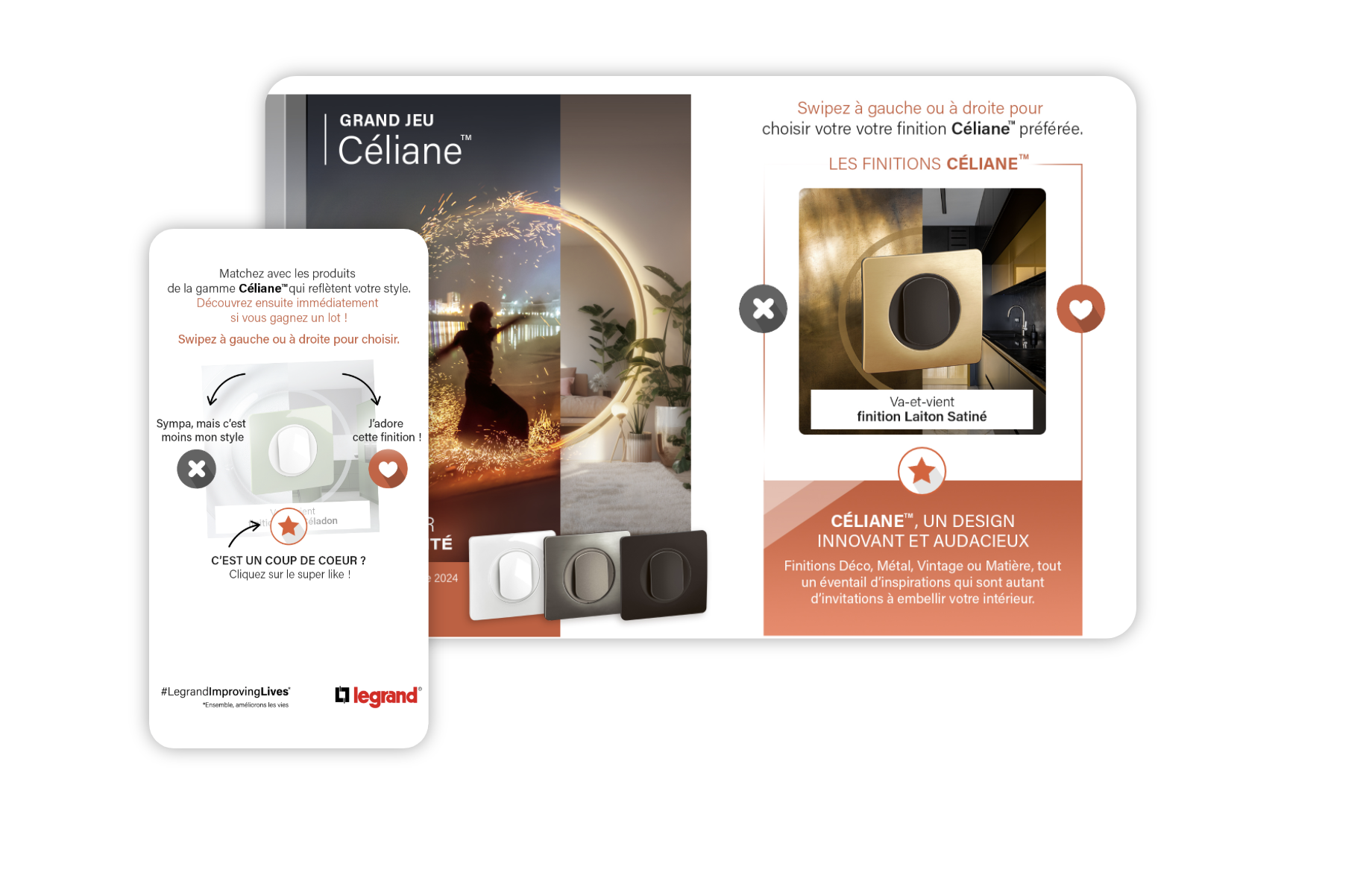
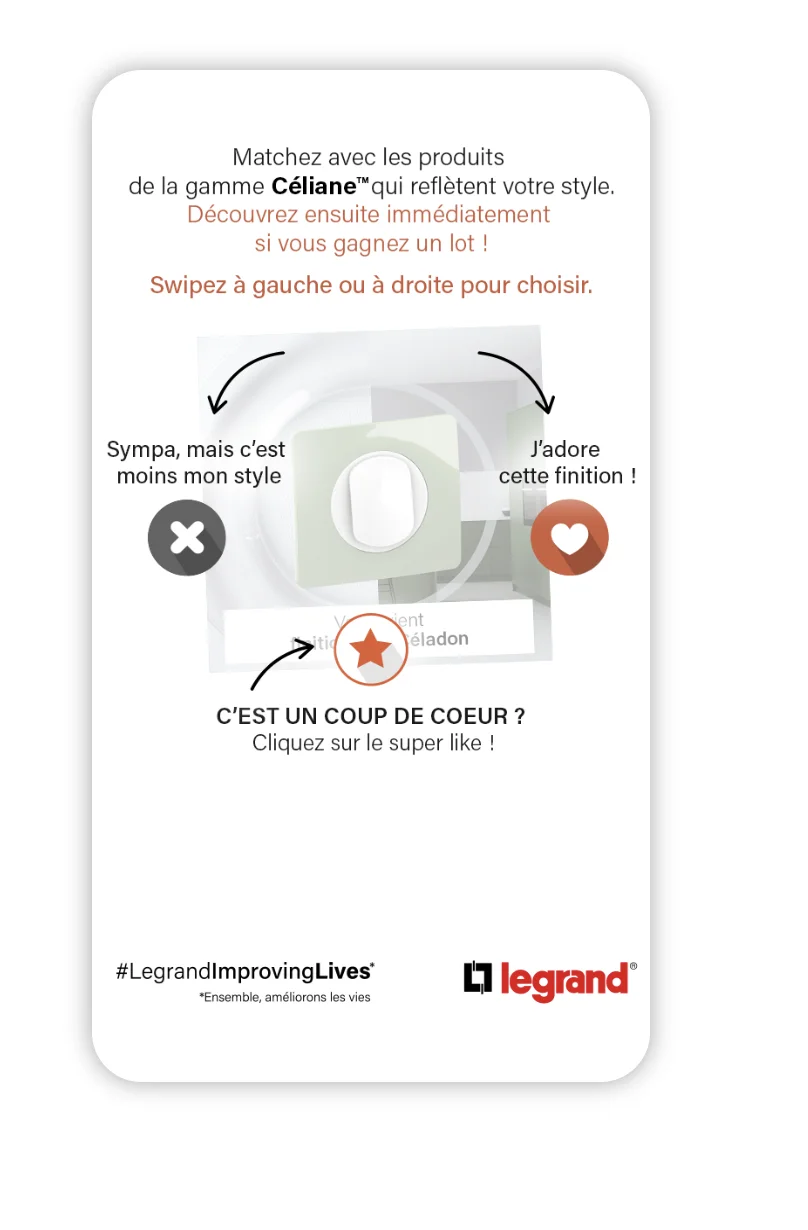
Example: A retailer can analyse its customers’ purchasing history to identify their favourite styles. Based on these insights, it can send them recommendations. This is what Legrand did with its campaign for the Céliane brand. Thanks to the interactive mechanism Swiper, Legrand was able to collect more than 115,000 customer preferences.

Legrand - Celiane game - data collection
Legrand-celiane-game-mobile <br />

2. Optimising your marketing campaigns

Using the customer data collected, a brand can precisely target its customers and optimise the ROI of its campaigns. By analysing behaviour, the right messages can be delivered to the right people, at the right time and in the right place.

Example: By tracking the pages visited and the products added to the shopping basket on its site, the retailer can better retarget each of its visitors with personalised advertising.

3. Improving the customer experience

A brand that makes good use of its data can offer a smooth, intuitive and enjoyable shopping experience. Thanks to the data collected on its e-commerce site or its application, it can identify friction points in the customer journey and adjust its experience (by simplifying the checkout process).

Example: An e-commerce company can analyse customer reviews to understand the main frustrations. In response, it can set up a chatbot capable of providing answers to the most frequently asked questions and thus improve its product sheets by including more details.

4. Customise offers and promotions

Rather than sending the same promotions to their customers, brands can use data to propose personalised offers based on consumers’ habits and preferences. These incentives increase loyalty and encourage customers to return.

Example: A supermarket chain can analyse its customers’ regular purchases and offer them targeted discounts on their favourite products. These incentives encourage loyalty and strengthen attachment to the brand.

5. Anticipating demand and managing stocks

Good stock management is essential to avoid stock-outs and limit unsold goods. Thanks to the data it collects, a brand can predict trends and adjust its production/supply.

Example: It is in a brand’s interest to analyse buying trends in order to estimate demand for its models. Using this information, it can adjust its production to avoid stock-outs on models while limiting overstocking on less popular items.

6. Create new products or services

Insights gained from customer data can be used to identify new needs and adapt the existing offering. This can lead to the improvement of a product or the launch of a service to meet the expectations of its audience.

Example: A beauty brand can use the Customizer mechanism to sound out the desires of its community and offer them products that meet their needs.

What are the different types of customer data?

Data is essential information to the management and profitability of a business. The good news is that
there’s no shortage of customer data. A survey revealed that the organisations surveyed manage an average of 3 petabytes (PB) of data, and that this volume doubles every two years.

To avoid being overwhelmed by data, it’s important to focus on the data that can make the difference to your company’s development.

1. The different types of data according to their content

We can start by differentiating customer data according to its content and the information it reveals. Here are the 6 types of data that are useful for brands:

  • Demographic data, i.e. information that characterises each user, such as their age, gender, place of residence, marital status, level of education, etc.
  • Behavioural data, collected by observing actions. Examples include clicks, time spent on a site or previous purchases.
  • Geographical (or geolocalised) data provide information about physical location. This includes data such as location or IP address.
  • Transactional data relates to purchases made (products purchased, frequency of purchase, average basket, etc.).
  • Psychographic data concern interests, values, opinions and lifestyles. They go beyond demographics to capture consumer motivations and attitudes.
  • Contextual data refers to information about the context of the interaction, such as the time of day, the location or the device used.

2. Different types of data depending on their source

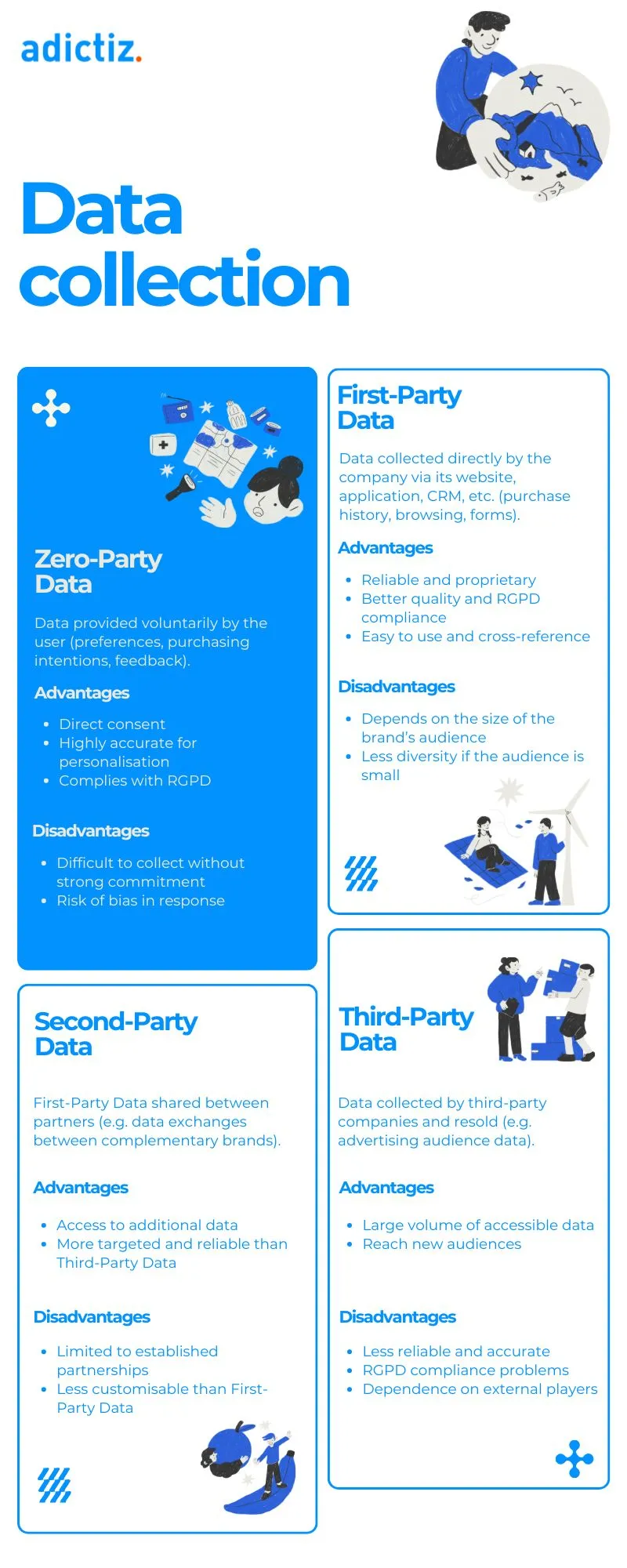
But we also need to differentiate between data depending on how it is collected and its source. There are Zero-Party Data, First-Party Data, Second-Party Data and Third-Party Data.

1. Zero-Party Data

Zero-Party Data is information that consumers voluntarily share with the brand. This includes personal preferences, opinions, purchase intentions, wishes or specific feedback.


Advantages :

  • User consent, which strengthens the trust between the brand and its audience;
  • This data is invaluable for personalisation, as it reflects what users want or expect from a brand.
  • Compliance with regulations (in particular the RGPD), as consumers have explicitly shared this information.

Disadvantages :

  • They are difficult to collect because they depend on the goodwill of the consumer.
  • There may be a bias in the responses if consumers are not honest or do not wish to share certain information.

    2. First-Party Data

    First-Party Data is data collected directly by the brand, through interactions with users on its channels (website, application, social networks, etc.). This includes information such as purchase history, browsing behaviour, account information, etc.

    Advantages :

    • This data is proprietary and therefore available to the brand.
    • Collected directly, without the intermediary of third parties, which guarantees a certain reliability and protection of personal data.
    • Easier to manage and analyse because the brand has total control.

    Disadvantages :

    • First-Party Data can be limited in quantity, as it depends on interactions with the brand.
    • Large-scale collection is more difficult, particularly for brands with a small audience.

      3. Second-Party Data

      Second-Party Data is First-Party Data collected by another company. In other words, it is data collected by a partner and then shared ethically between the two parties.

      Advantages :

      • Allows brands to access data that they would not collect themselves, particularly if they do not have a very large customer base.
      • Less intrusive than buying data from third parties (as in the case of Third-Party Data), because the data comes from partners with whom there is a relationship of trust.

      Disadvantages :

      • Limited availability, as you need to establish partnerships with other companies that share relevant data.
      • The data may be less personalised than First-Party Data, because it comes from a different source.

        4. Third-Party Data

        Third-Party Data is data collected by third-party companies (other than the brand or its direct partners) and resold or shared with brands. These companies specialise in data collection and gather information about behaviour on different websites or across different platforms.

        Advantages :

        • Reaches new audiences that the brand would not otherwise have been able to identify.
        • Can offer highly detailed data on user behaviour, consumer trends, etc.

        Disadvantages :

        • This data may be less accurate or reliable than First-Party Data, as it may lack context.
        • Confidentiality issues: Using this data without users’ consent may entail legal risks (particularly with regulations such as the RGPD).
        • Collecting this type of data can be perceived as intrusive, and some consumers use tools to avoid being tracked (e.g. ad blockers, VPNs).

        To sum up, here is a summary infographic to help you remember the most important information:

        Data Collection

        Which data collection method should you choose?

        Now that we have identified the types of data and the uses that companies can make of it, we turn our attention to data collection.The organisations have a range of tools
        which can be used (in synergy) according to their objectives and needs. Here are the most effective.

        1. CRM (Customer Relationship Management)

        CRM software (Salesforce, Hubspot, Brevo) is used to collect, organise and analyse data throughout the buying process. These tools centralise the information collected on prospects and customers.

        Use case :

        • Enables First-Party data to be collected (contact information, purchase history, preferences, etc.).
        • Helps personalise customer relations by centralising relevant information.
        • Automate the collection and use of customer data by integrating other marketing tools (emailing, chatbot, etc.)

        2. Gamification tools

        Gamification consists of integrating game elements (interactive mechanics, challenges, rewards, etc.) into communication to encourage users to interact. Playable marketing attracts attention, stimulates engagement and collects data in a fun and less intrusive way than a form.

        Use case :

        • Game marketing boosts user engagement and encourages them to provide data (via a contact form before or after the game) in exchange for a stimulating experience and/or rewards.
        • Certain mechanisms can make it easier to collect first-party data and identify needs and preferences. This is the case with Swiper or Battle, which identifies the specific interests or behaviour of each user.
        • Surveys (or open quizzes) are gamified mechanisms for asking questions on a range of subjects (preferences, purchasing intentions, satisfaction, etc.).
        • Gamification can be used to energise a loyalty programme to encourage redemption and provide the brand with accurate data.

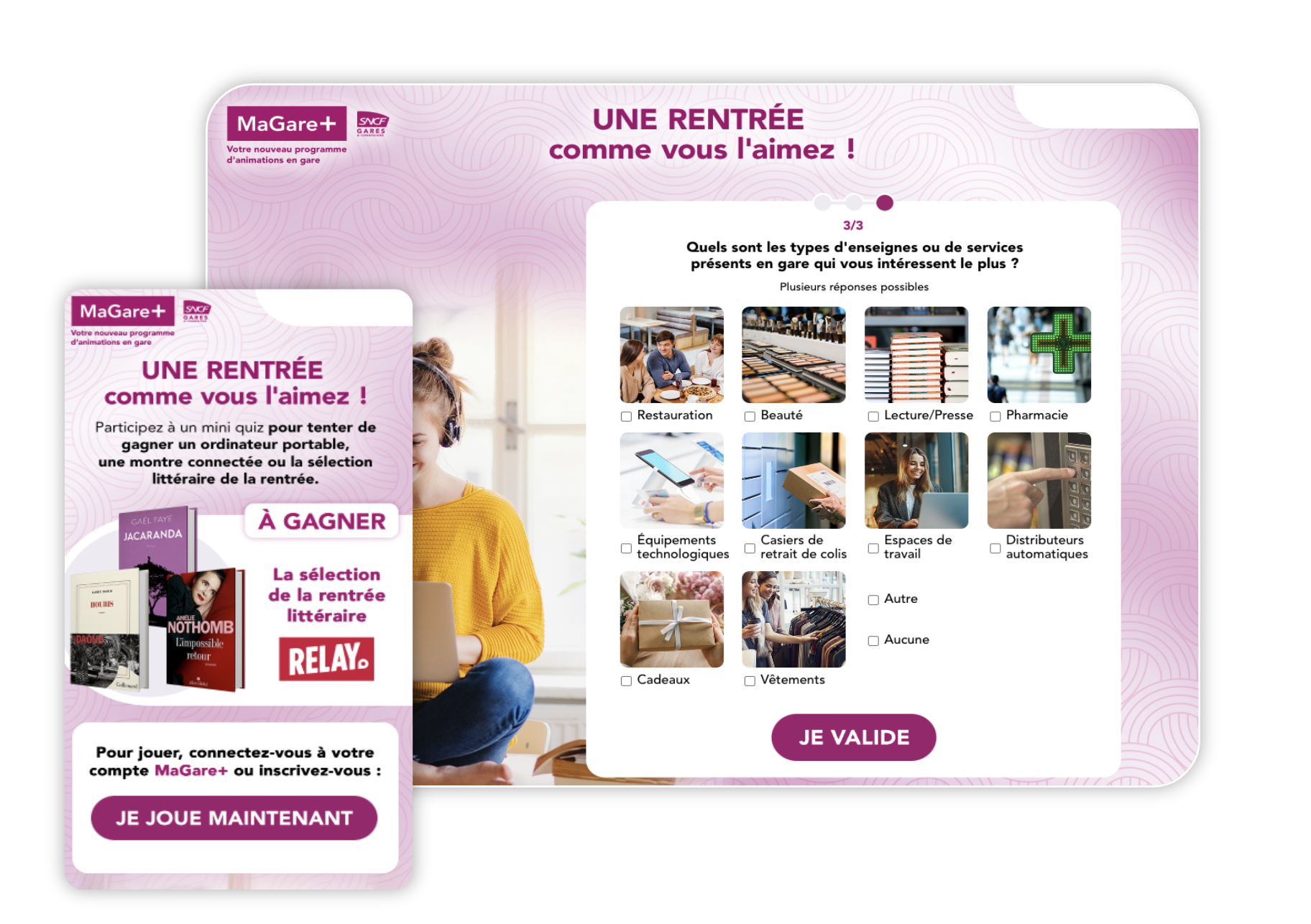
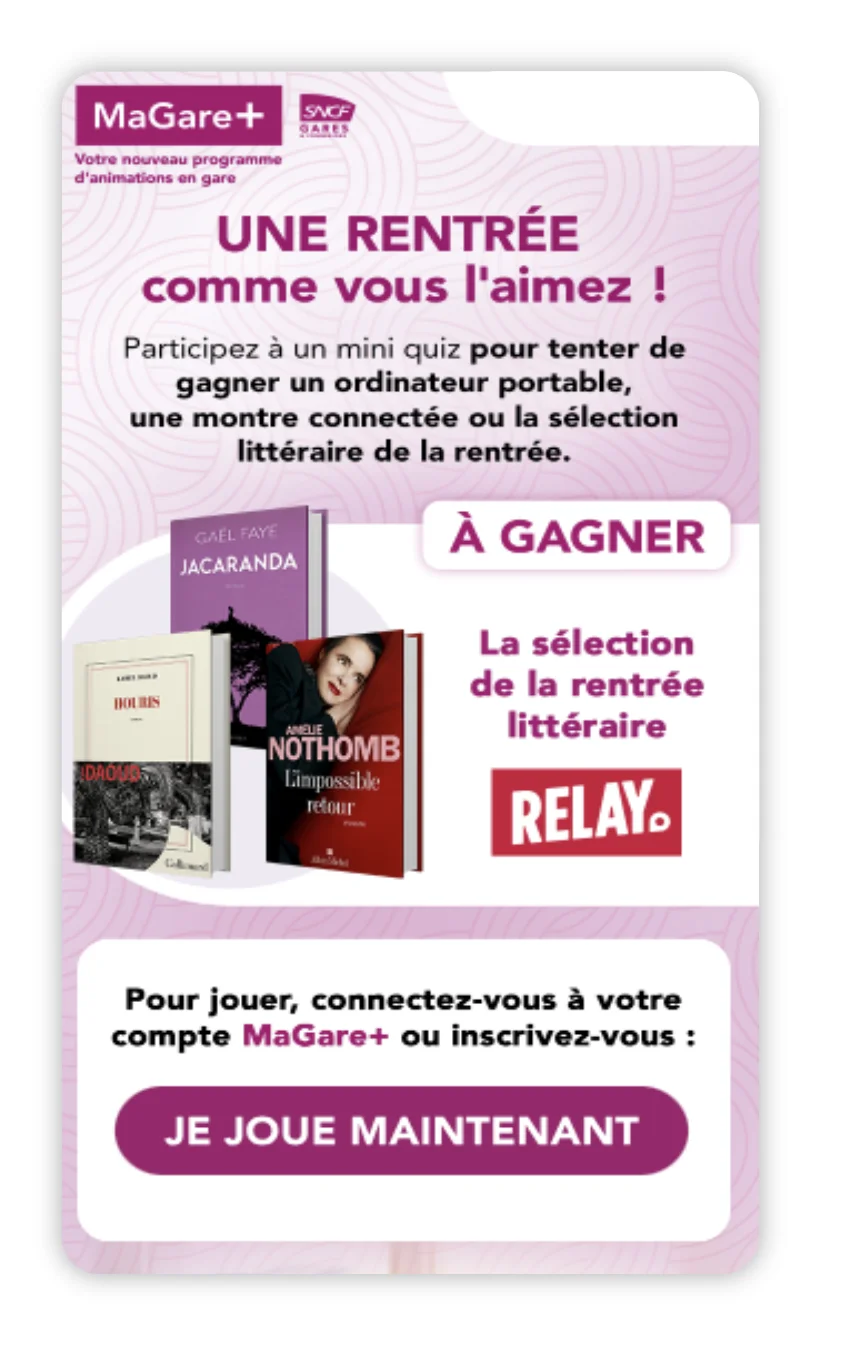
        Ma Gare + ran a marketing competition, including a survey of travellers’ habits and their desire for station facilities. This quiz enabled Ma Gare + to collect more than 15,000 new qualified leads, many of which were new accounts.

        MaGare+ - Back to school data collection game
        MaGare + - Mobile survey

        3. Opt-in and data enrichment solutions

        Opt-in collection solutions allow explicit consent to be collected (when subscribing to a newsletter or service). This type of collection makes it possible to enrich the data initially held on users, added to their profile from external sources.

        Use case :

        • Obtain explicit consent for data collection, thereby complying with regulations (e.g. RGPD).
        • Collection of First-Party data to enrich profiles and understand their needs. When people sign up for a newsletter, they may indicate their interests or their location. This data is used to personalise communications according to preferences, by sending geolocated promotions.

        4. Behavioural analysis tools

        Behavioural analysis tools make it possible to track and analyse behaviour on a website or application (pages visited, time spent on each page, actions taken). These tools are invaluable for collecting behavioural data and understanding interactions with the brand.

        Use case :

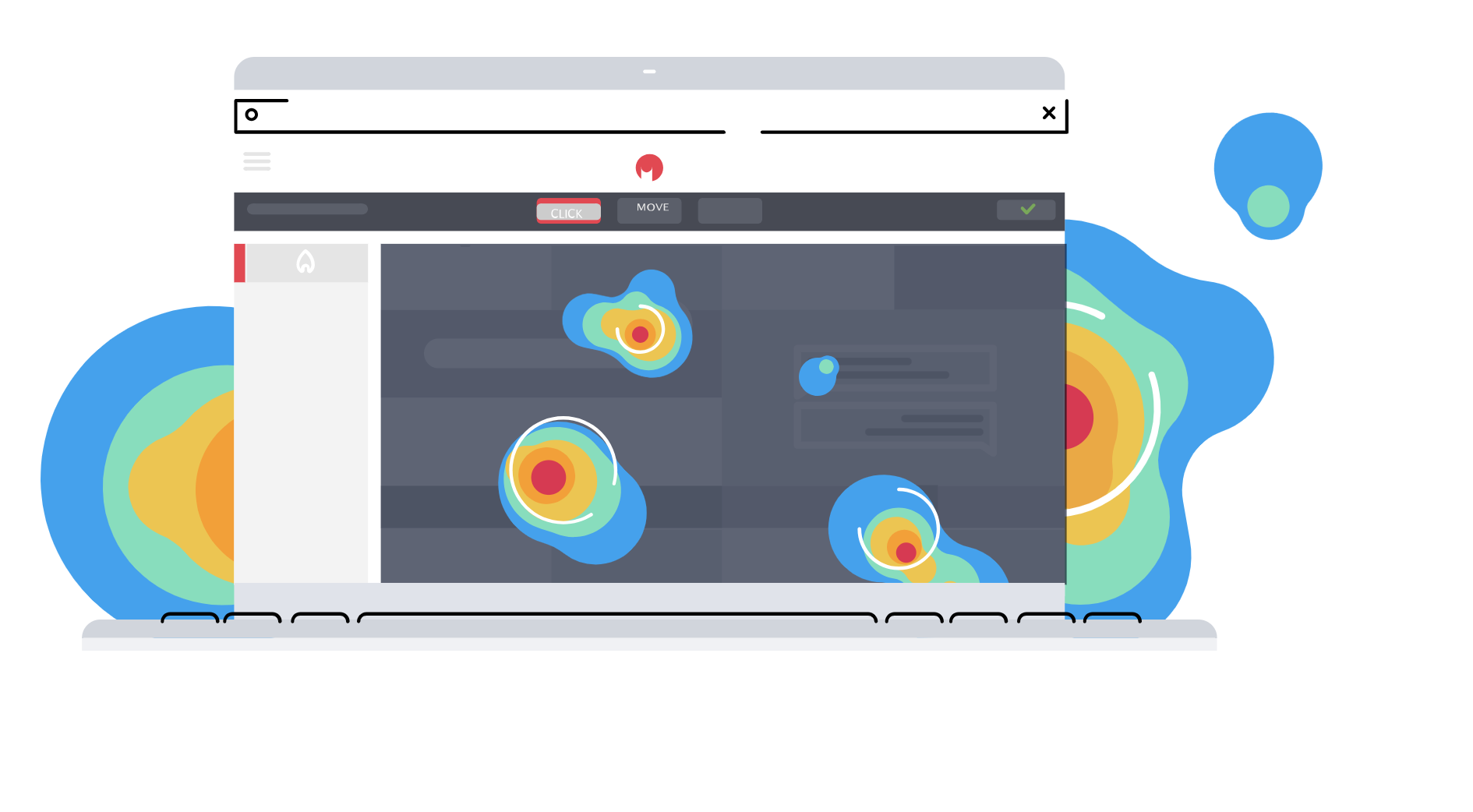
        Tools such as Hotjar can be used to create heat maps to improve the design of the brand’s website or application. They help to understand which elements are noticed by users and which can be ignored. This helps designers to improve the interface by highlighting key elements.

        Hotjar - data collection <br />

        In the same way, behavioural data can be collected by recording visitor sessions or analysing user engagement. This is also useful for optimising the user experience as well as conversion rates.

        5. Tools for collecting data on social networks

        Social network data collection tools allow you to retrieve information from interactions on platforms such as Facebook, Instagram, LinkedIn and so on. This includes behavioural, demographic and even psychographic data.

        Use case :

        • Provides access to a wealth of data on online behaviour.
        • By tracking interactions and analysing data on social networks, we can understand their interests, opinions and attitudes, and therefore optimise content.

        The choice of data collection tools therefore depends on the brand’s objectives, resources and the type of data it wishes to collect. It is advisable to combine these tools to obtain a complete picture of its audience while complying with the rules on consent and data protection.

        Customer data collection and Playable Marketing: the example of Leroy Merlin

        Playable Marketing is one of the most effective methods of collecting data. By incorporating game elements into the collection process (quizzes, competitions, surveys), this lever offers a number of advantages:

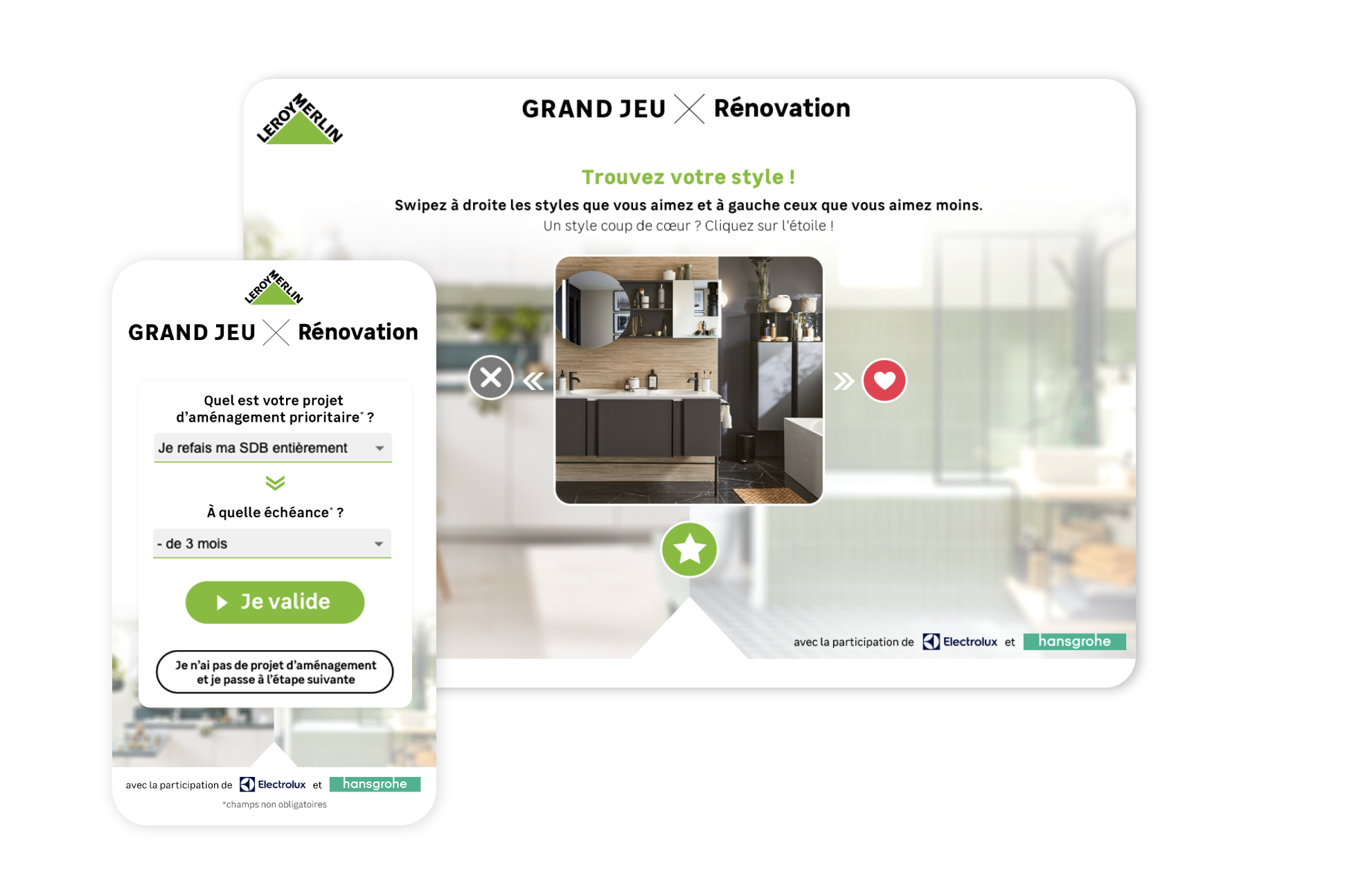
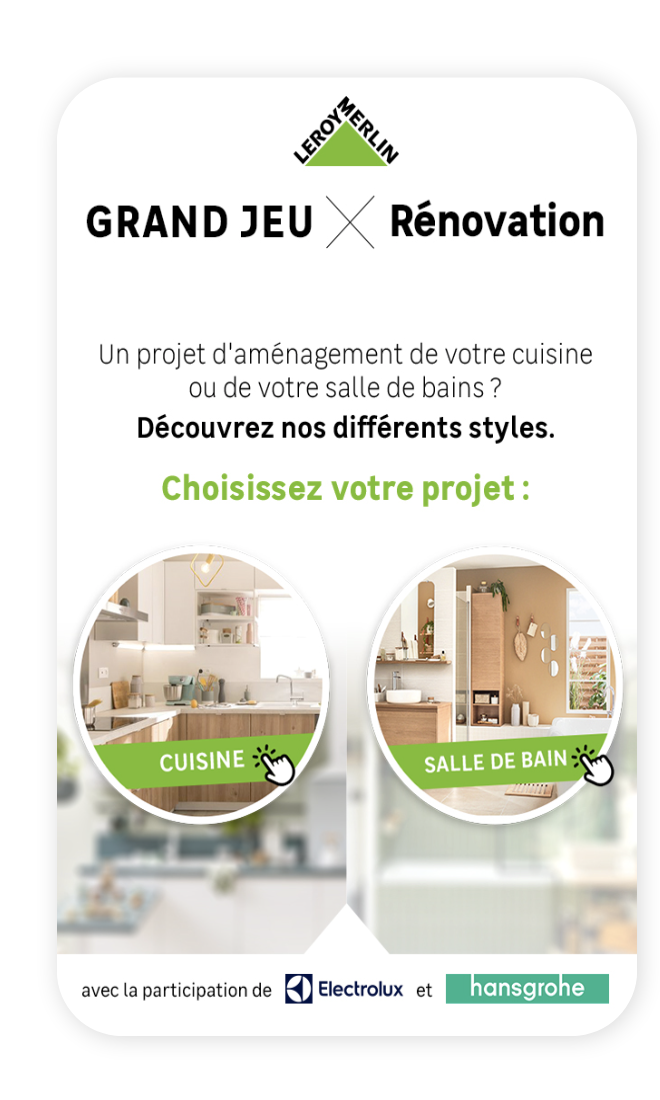
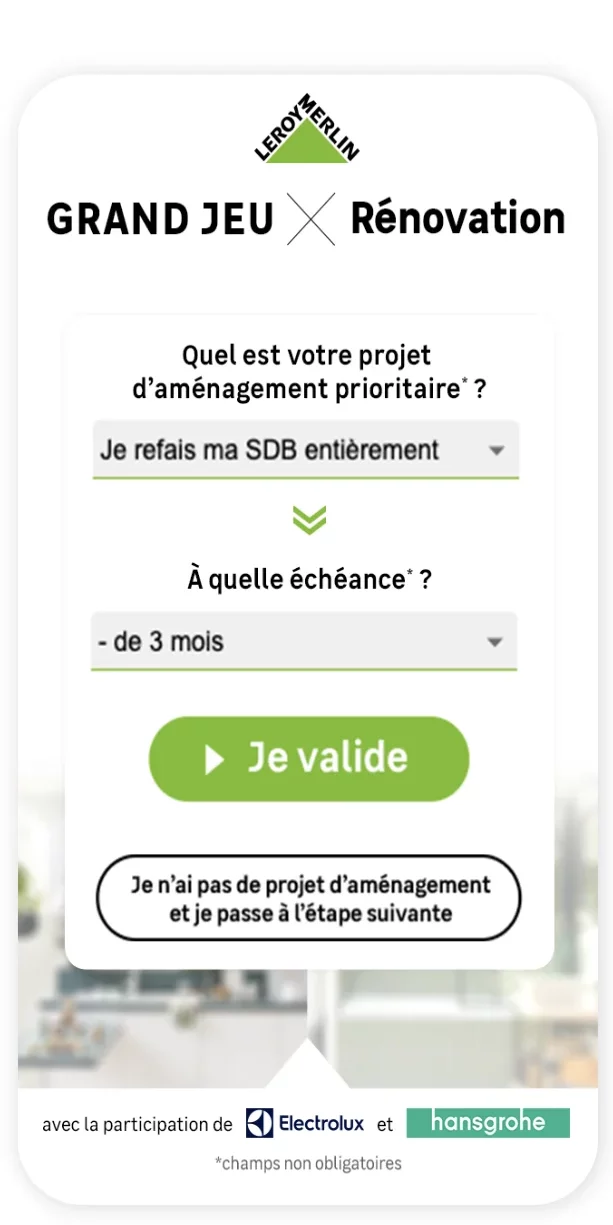
        For these reasons, Leroy Merlin chose gamification to optimise its data collection strategy. The ‘Renovation’ campaign was based on a Swiper to identify its audience’s renovation projects.

        This game enabled Leroy Merlin to collect leads (creation of customer accounts) and qualify them according to their preferences. Each lead was segmented according to its intentions and projects (kitchen, bathroom, decorating preferences), enabling the brand to send offers tailored to the needs of the participants.

        The campaign has increased Leroy Merlin’s visibility and brand awareness. It inspired customers and prospects to launch renovation and home improvement projects. The campaign resulted in the collection of 3M pieces of information and increase traffic to the site with over 40k clicks.

        Leroy Merlin - Swiper renovation game
        Leroy Merlin - renovation game mobile
        Leroy Merlin - data collection - mobile <br />

        Conclusion

        Collecting data may seem like a complex subject, but there are a number of tools that can make the job easier, while improving the relationship and trust between your brand and your customers. Discover our interactive mechanisms and use gamification as a powerful lever for collecting qualified data!

        In 30 minutes, we show you how to launch your own high-performance interactive marketing campaign

        How to create an online Wheel of Fortune?

        How to create an online Wheel of Fortune?

        The Wheel of Fortune is a popular game mechanic. It’s known from numerous television game shows.
        With an easily identifiable visual, simple rules and the chance to win attractive prizes, it’s an attractive experience. For the same reasons, it’s an interesting lever for bradns wishing to use gamification to make their communication interactive.

        In this article, we offer you a guide to creating an online Wheel of Fortune and maximise its impact. Step by step, we’ll look at how to configure the game and make it an effective tool for recruiting, engaging and retaining customers!

        Presentation of the Wheel of Fortune mechanism

        Wheel of Fortune is a game mechanic belonging to the instant win family. Where participants know immediately whether they have won or not (unlike a game with a draw) as wekk as the nature of their reward.

        The principle is simple: users are invited to spin a wheel to find out if they have won. Which is ideal for capturing attention and maximising your brand’s recruitment objectives.

        The Wheel of Fortune is divided into severak suqares, on which the cursor can stop, sealing the participant’s fate. Each box can be associated with a game prize (a percentage discount or a gift voucher amount).


        This personalisation enables retailers to offer their audience a game experience that captures their brand universe and engages their target audience. Participants are more inclined to play the game. They can find out what they have won, creating anticipation that reinforces their commitment.

        What are the objectives of this marketing game?

        The online Wheel of Fortune is an ideal marketing game mechanic for :

        Rapidly recruit new users

        As we’ve already mentioned, it’s a popular and identifiable game. It captures the attention of users. The fact that it is an instant win reinforces the appeal of the mechanics and encourages participation. Participants can be invited to share the campaign, increasing its reach and helping to recruit new leads. This instant-win mechanism is therefore an effective way of boosting brand awareness.

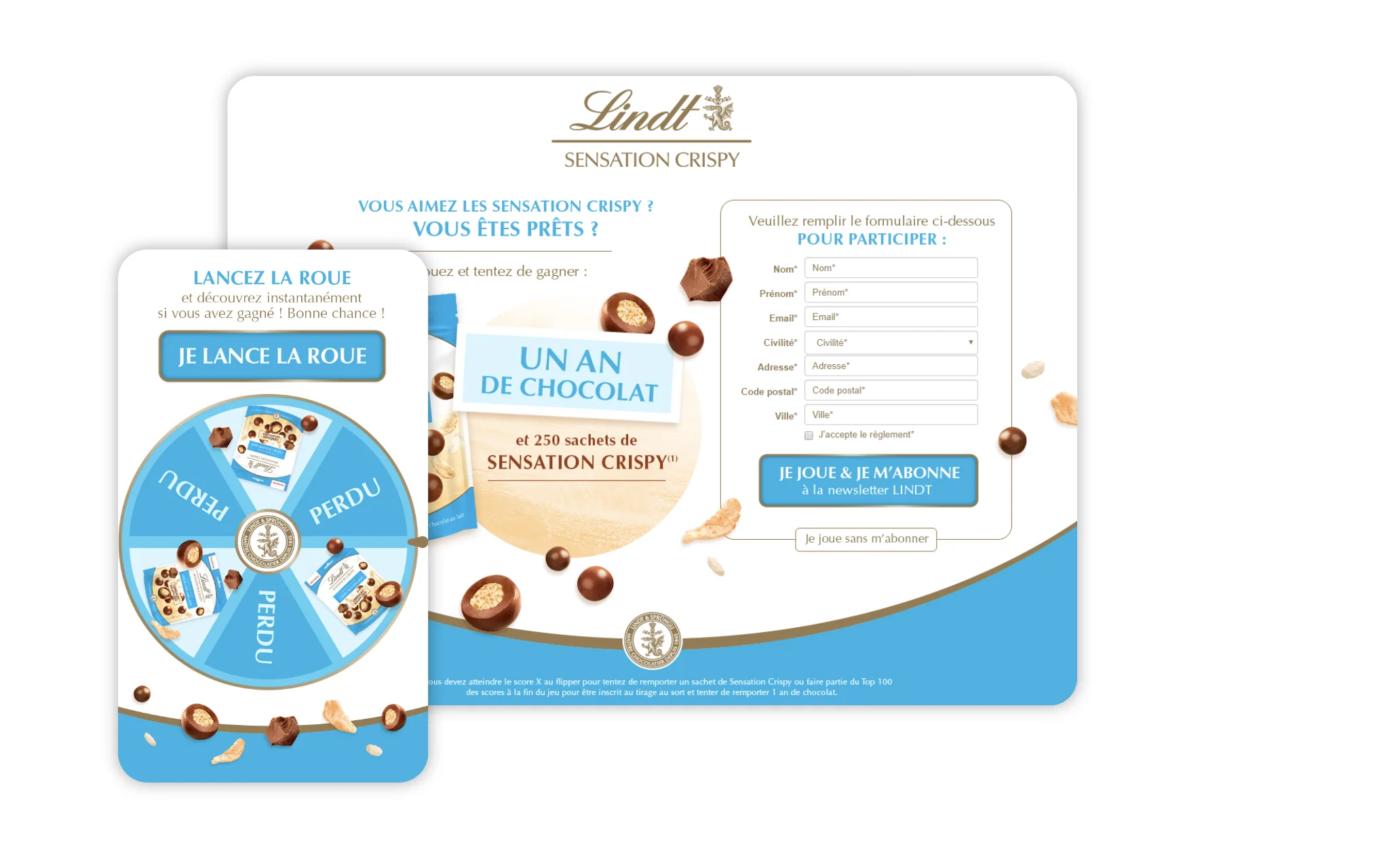
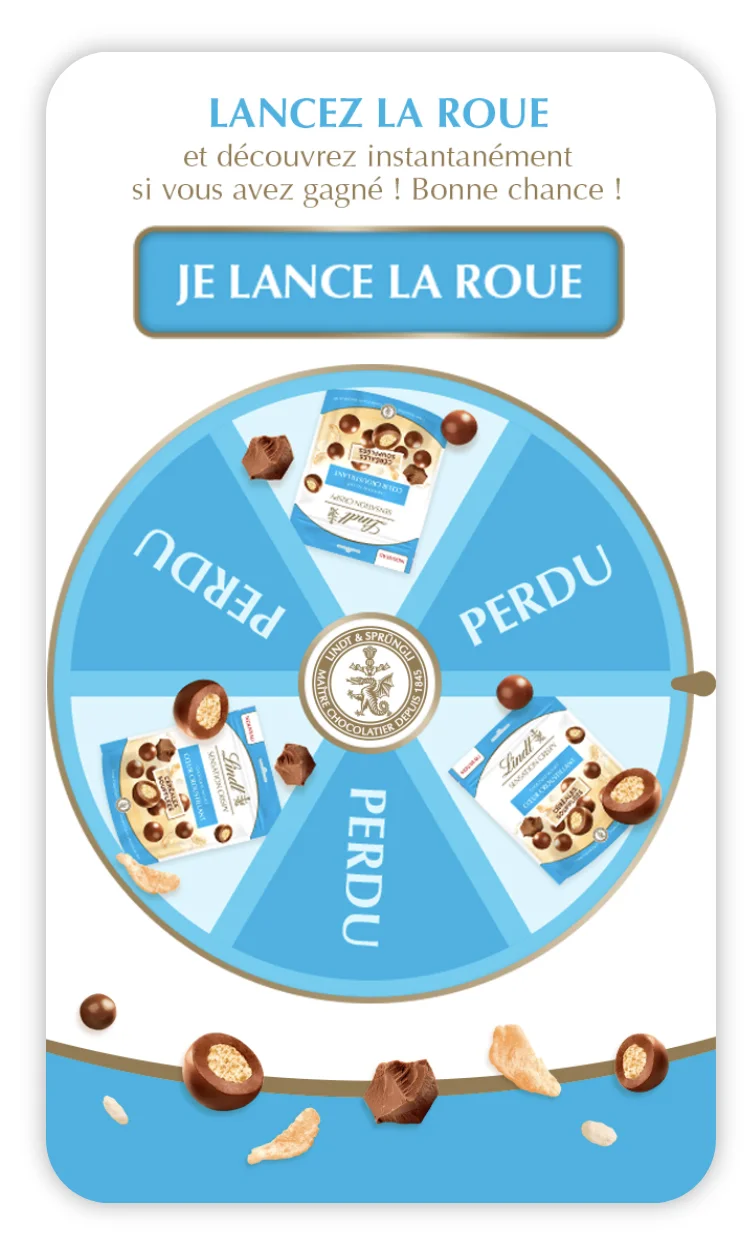
        Example: Lindt ran a Wheel of Fortune on its social networks to recruit opt-in leads and promote its products. The campaign exceeded 15,000 leads, with an opt-in rate of 62%.

        Lindt - online wheel of fortune
        Lindt - mobile wheel

        Engage your audience and immerser them in your bradn universe

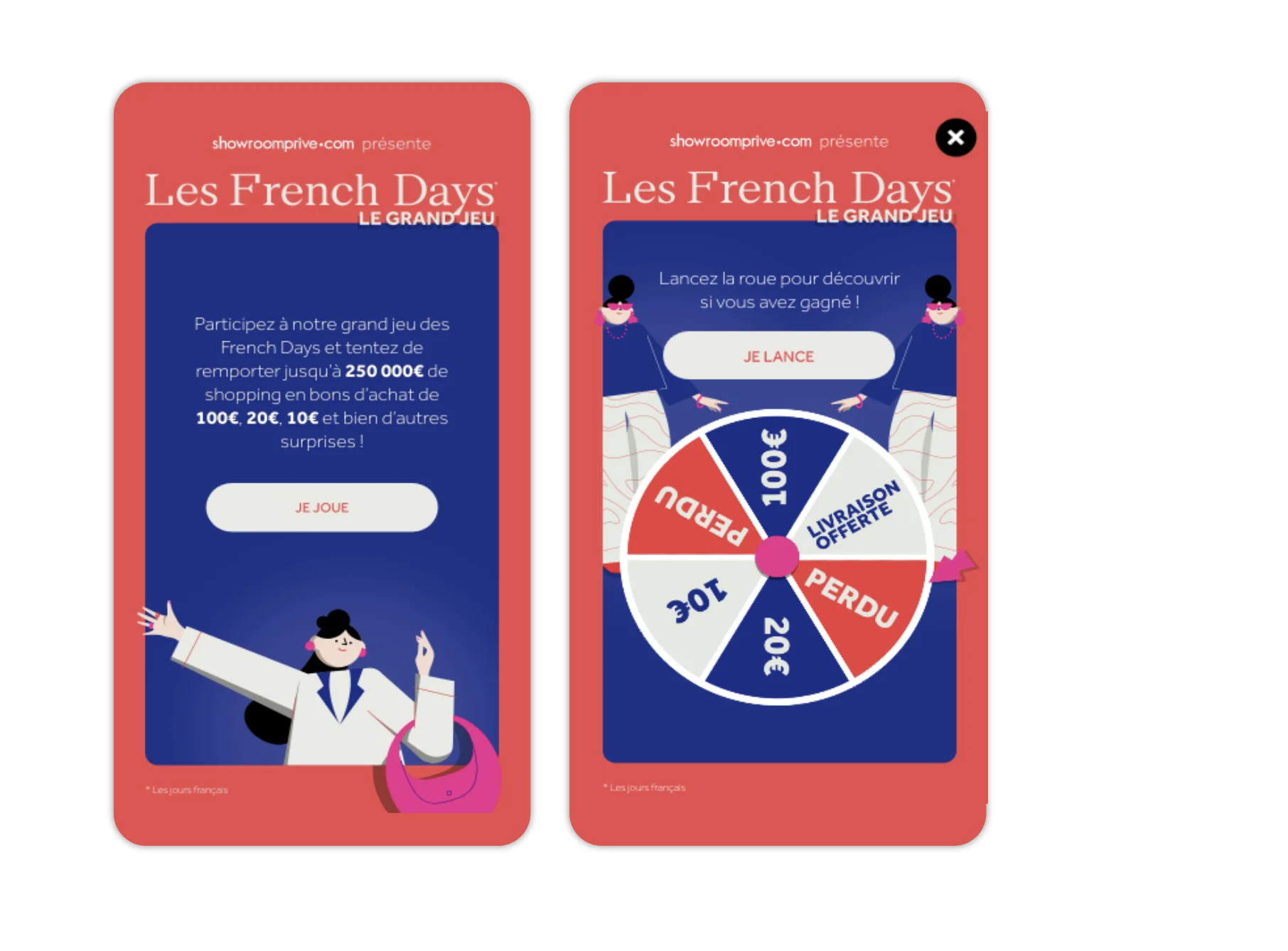
        The customisable configuration of the online Wheel of Fortune means that it can be adapted to your brand universe. Brands can create a unique game experience that reflects not only their aesthetics, but also their values. What’s more, the mechanic can be distributed across a variety of channels (a website, mobile application or social networks).

        Example:
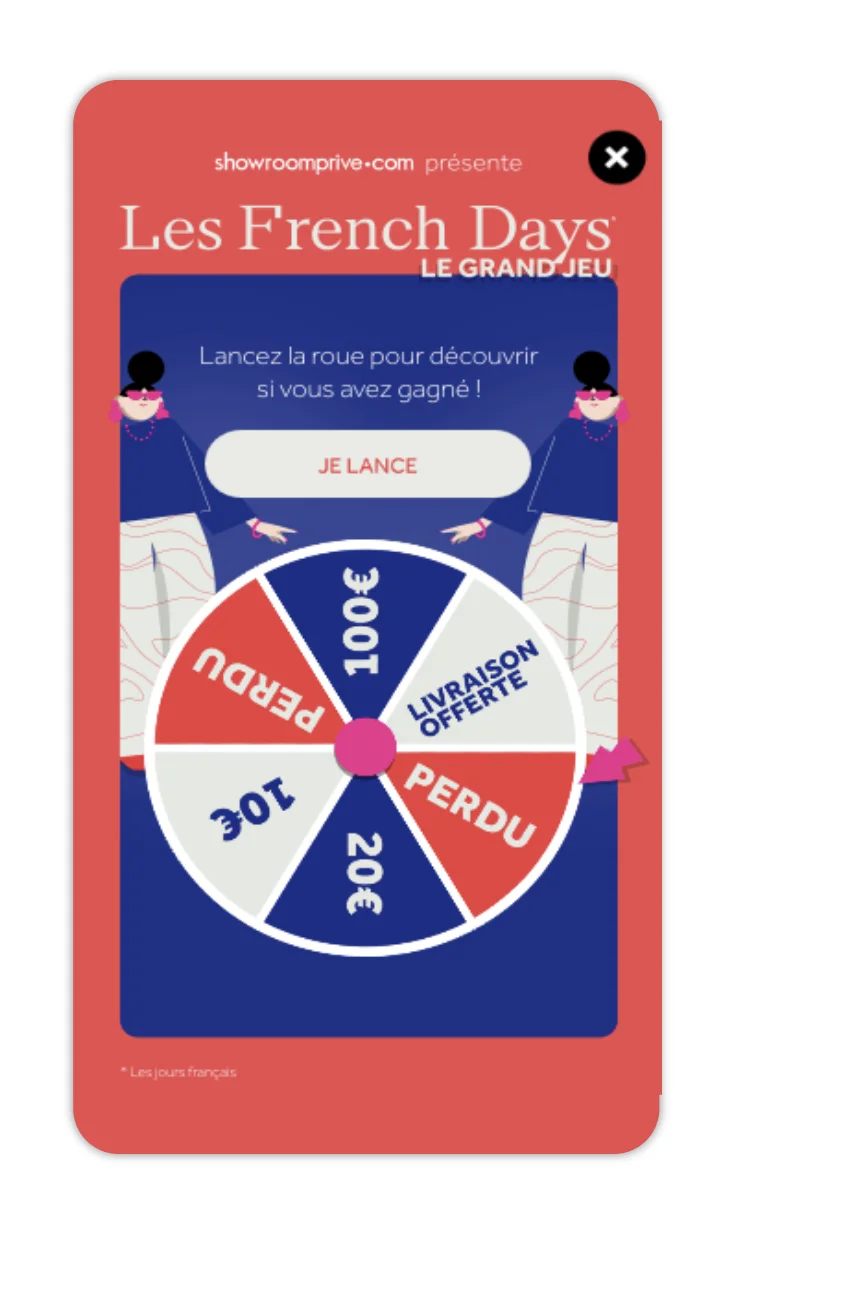
        Showroom Privé’s French Days campaign took the form of a Wheel of Fortune.

        Showroomprivé - online wheel of Chance
        ShowRoom Privé - French Days campaign

        Boost your retention rate by rewarding customers for their loyalty

        Finally, the Wheel of Chance is ideal for rewarding customers and ecouraging them to buy again. The game can be shared post-purchase (
        directly at the checkout via an interactive terminal
        or following an online order). Access may be restricted to a VIP program (via a gatecode
        ). In both cases, the Wheel of Fortune can be used to strengthen brand loyalty by distributing benefits (gifts) or incentives to buy again (discount coupons).

        Example:
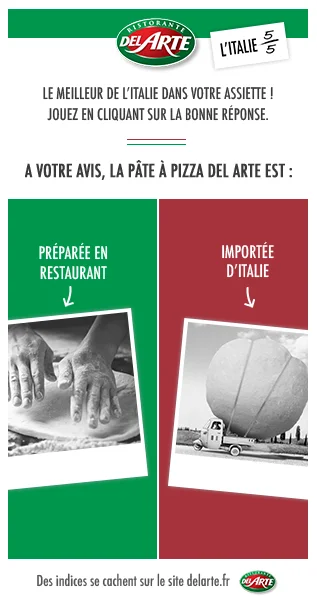
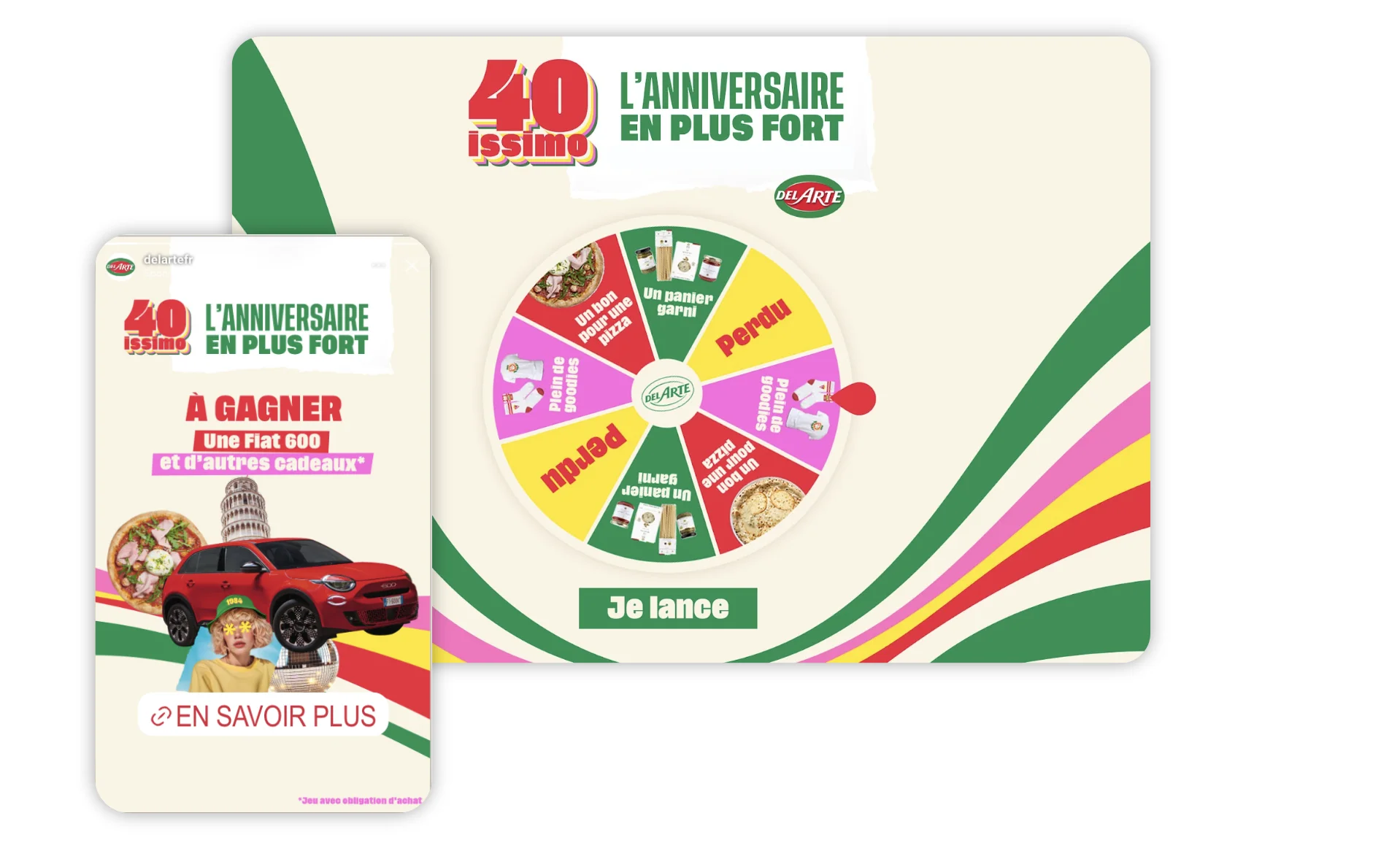
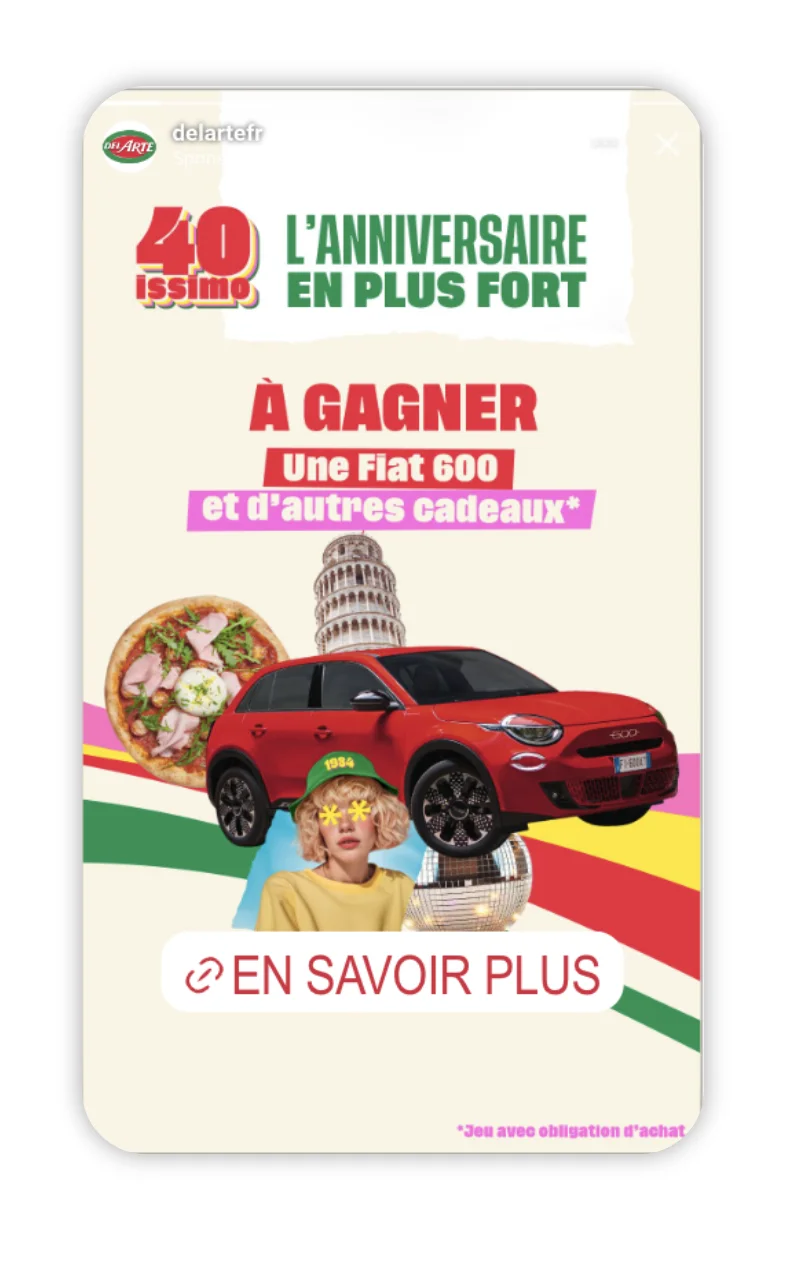
        Del Arte’s 40th birthday campaign aimed to promote the brand’s anniversary through a Wheel of Fortune. Designed to generate in-store traffic, it enabled the company to record over 4k clicks to the loyalty program.

        Del Arte - online wheel of fortune
        Del Arte - birthday campaign

        How to create an online Wheel of Fortune?

        Now let’s get down to the nitty-gritty, with the steps you need to follow to create and distribute an online Wheel of Fortune

        1. Set up the player’s route

        Once the Wheel of Fortune mechanic has been selected, the first step is to configure the route for future players. As the game can include several stages, depending on the brand’s need and objectives:

        • The entry form for capturing customer data;
        • The Wheel of Fortune itself;
        • The result page: Win or Lose – unless the store opts for a 100% winning game;
        • The page already played (if players can only try their luck once) ;
        • The campaign end page (which may allow the brand to redirect participants to a landing page, for example);

        You can also add a home page (to hare the rules of the games or give a bit of context about the campaign) and a teaser page.

        2. Customise your marketing game

        before configuring the campaign, the bradn will nedd to create the graphic elements
        to personalise the experience. On Adictiz, you can import your visual for the wheel, define the colour of the cursor or adjust the alignment of the boxes. The options settings allow you to configure the loading bar or customise the animation of the result box.

        The idea is to create an immersive experience by choosing visuals and colours that reflect the world of the brand.

        3. Configuring the mechanics of the Wheel of Fortune

        Depending on the objectives it has set itself, the company will then be able to configure its winning moment down to the smallest detail, and in particular choose :

        • The numbers of particpants (per day, week, month or campaign and per user). We recommend that you allow players 1 participation per day to encourage them to return to the campaign on a regular basis, while ensuring that it remains profitable;
        • The number of squares on the wheel, depending, ofr example, on the number of prizes. A minimum of one “Lost” box is mandatory on the Wheel of Fortune.
        • The uniqueness of the winners
          The option allows you to choose the number of prizes that the same user can potentially win on the campaign. If the company chooses the “No Uniqueness” option, each player can potentially win several prizes.

        The results pages (winner and loser) will be displayed instantly once the wheel has stopped.

        4. Choose the prizes

        To work, the Wheel of Chance must offer attractive prizes (linked to the brand’s universe of the highlight of the event).
        This mechanism makes it possible to
        award prizes
        for each square of the wheel. Users will discover their gift when the cursos stops on a square.

        5. Test and adapt the mechanics to all channels

        Before boradcasting your campaign, it is crucial to test it both on the desktop (for computer users) and on mobile (to check how it displays on a smaller screen).
        To enhance the experience for mobile players, we recommend that you place the “Play’ button above the wheel.

        6. Boost the visibility of your campaign

        Once the Desktop and Mobile versions have been finalised and tested, all that’s left to do is distribute them.Here you need to think about :

        • Choosing the right channels to reach your audience and achieve your objectives;
        • Boost the reach of your campaign with a teasing effort, but also with appropriate levers (such as an Ads campaign on social networks or a personalised emailing suite).

        Conclusion

        Would you like to recruit new customers by creating an online Wheel of Fortune? The Adictiz platform allows you to configure each stage of your campaign and, if necessary, provides support from the creation of your visuals to the configuration of your mechanics and the media coverage of your marketing game!

        In 30 minutes, we show you how to launch your own high-performance interactive marketing campaign

        Mother’s Day: 3 examples of original marketing competitions

        Mother’s Day: 3 examples of original marketing competitions

        With the arrival of Spring and the return of fine weather, the French are looking forward to the May bank holidays, as well as Mother’s Day. This is a symbolic event and therefore a key moment on which brands can capitalise.

        Mother’s Day marketing campaigns are a strategic way of raising visibility, stimulating a community and boosting sales. In this article, we share some ideas for Mother’s Day competitions based on the objectives to be achieved.

        Mother’s Day: a key commercial event for brands

        Mother’s Day (which takes place on the last Sunday in May in France) is an event celebrated by more than 80% of French people. It’s a time to celebrate mothers and spend time with loved ones. It generates major spin-offs for brands. This is the second biggest marketing event in France in terms of gifts, just behind Christmas.

        It has an impact on company sales and is a major boost to revenues. In France, the budget for Mother’s Day is 66 euros. Brands use this opportunity to showcase their products and services or share gift ideas with their customers.

        Mother’s Day is an opportunity to communicate values. Retailers can share campaigns that will strengthen their brand image, raise their profile, increase their sales strengthen relationships with their audience.

        Gamification to communicate around Mother’s Day

        To stand out from the crowd at this major event, companies can engage their community with fun, interactive experiences. Gamified marketing, or the introduction of playable elements into campaigns, is a lever for capturing an audience’s attention.

        Companies can turn to different marketing game formats. A photo contest can engage the community around a challenge while generating content (or UGC for User Generated Content) that the brand can share.

        The sales promotions, in-store or online, enable you to :

        • Collecting data to understand customer expectations around Mother’s Day;
        • Share gift recommendations based on collected product preferences;
        • Generate sales by sharing incentives such as e-coupons, gift cards, etc.
        • Build loyalty among the leads generated by collecting opt-ins so that they can be retargeted throughout the year.

        Here are 3 examples of original interactive campaigns inspired by gamification, such as the Mother’s Day marketing campaign.

        1. Mother’s Day competitions to stimulate your community

        Mother’s Day is an opportunity to forge closer links with the community. The campaigns surrounding this special day are an opportunity to promote family values.

        Brands can take advantage of Mother’s Day to create a close relationship with their audience. Using sales events to extend the time spent with the brand.

        Example: Galeries Lafayette’s Mother’s Day game

        For Mother’s Day, Galeries Lafayette have come up with a 100% winning One-Armed Bandit via a game terminal installed for 3 days in 6 shops in France. Results exceeded expectations, with above-average participation. The 1 minute 20 second game time demonstrated an interest in the animation, confirming the success of this campaign.

        Galeries Lafayette Mother's Day terminal

        Mother’s Day competition was available in mobile format via a QR code. This strategy increased the reach of the campaign. It made it possible to animate all the shops, with
        a 100% winning concept. In addition, this co-branding operation made it possible to collect opt-ins for Galeries Lafayette and its partner brand, Rosemood.

        Galeries Lafayette Mother's Day competitions
        Galeries Lafayette - 100% winning<br />

        2. A Mother’s Day sales promotion to engage customers

        To build customer loyalty, brands need to multiply the number of points of contact. Trade fairs are strategic in terms of engagement because they offer opportunities to connect with the audience.

        For Mother’s Day, many people turn to social networks to find gift ideas. It’s a good idea to create a competition to engage prospects and customers and move them along the buying funnel.

        Example: SFR’s Mother’s Day campaign

        SFR’s Mother’s Day campaign in the Caribbean aimed to raise brand awareness by engaging its audience. The mechanics Match 3 was a resounding success, boosted by Adictiz Ads media coverage. Participants were highly engaged, spending an average of 11 minutes on the game per user.

        SFR - Mother's Day competition
        SFR - match3

        3. A marketing game to generate sales for Mother’s Day

        Finally, Mother’s Day is an opportunity to encourage consumers to buy their gifts. The competition is a tool for generating sales, as it allows you to share attractive incentives (vouchers, discounts, free products, etc.) with your customers.

        Gamification makes it easier to personalise recommendations by offering retailers methods of collecting product preferences.Via mechanisms such as Swiper or Gift Finder. Brands will be able to offer customised gift guides that are effective in generating conversions.

        Example: Galeries Lafayette’s Mother’s Day marketing campaign

        To mark the occasion, Les Galeries Lafayette offered its customers the chance to win gift cards. This instant win strategy ( the Pinata) has enabled us to collect qualified leads and boost conversions.

        This strategy, based on encouraging purchases, was based on an end page that directed users to offers, while encouraging them to use the gift card on the merchant site.

        Galeries Lafayette - Mother's Day Piñata
        Galeries Lafayette - pinata

        Conclusion

        Stand out from the crowd this Mother’s Day by offering your prospects and customers the chance to take part in a competition. Thanks to our 100% customisable mechanics, you’ll be able to capture buyers’ attention and move them up your sales funnel!

        In 30 minutes, we show you how to launch your own high-performance interactive marketing campaign