

Drive to store: 4 strategies to better in-store conversions

Drive to store: 4 strategies to better in-store conversions

Consumer habits have changed, particularly with the spread of e-commerce and the increase in online sales. The way in which brands reach, engage and retain their customers must therefore adapt to these new practices. One of the most crucial challenges for companies is to increase in-store traffic, in particular through drive to store campaigns.

These are an integral part of the harmonisation of the online and offline shopping journeys. In an increasingly omnichannel world, brands need to be able to engage and convert customers both in-store and online.

In this article, we present the 4 most effective strategies for attracting consumers to your shops and converting them into loyal customers.

What is drive to store in marketing?

Drive-to-store is a set of marketing strategies designed to attract online customers to physical shops. It’s an omnichannel approach that combines consumer geolocation, recommendation of the nearest point of sale and optimisation of the retail experience.

While consumer habits have tended to go digital during the pandemic, in-store shopping is not yet a thing of the past. Customers continue to embrace the retail experience, whether to discover the world of a brand, test its products, or return or exchange an order placed online.

Drive to store is therefore a central element of modern marketing, and this despite the fact that 62% of consumers say they will refuse to buy from a brand if it has no online presence. The discovery stage is increasingly carried out via digital channels, but physical purchasing has not said its last word.

A recent study shows that 72% of people who carry out a local search online will go to a shop located less than 8 kilometres away of their current location. This underlines the importance of an active online presence in redirecting qualified prospects to your points of sale.

What’s more, 28% of all local searches result in a purchase. A comprehensive omnichannel promotional campaign – one that harnesses the power of multiple channels – can help businesses attract visitors to their physical shops and generate more retail conversions.

What are the most effective strategies for a drive-to-store campaign?

An effective drive-in-store campaign therefore involves using a mix of digital and physical tools to attract and convert customers in-store. Here are the most effective ways of achieving this.


1. Localised advertising campaigns

The particularity of Drive to Store is that, to be effective, this marketing strategy needs to target consumers who live or are located close to a point of sale. Qualifying prospects is therefore a crucial element in maximising the ROI of your media budget.

A good way of achieving this is to display your ads to a geolocalised audience near a physical shop. Social networks such as Facebook, for example, have developed advertising targeting tools specifically for Drive to store. This is the case with Meta’s Store Traffic objective, which redirects users from an advertising insert to a physical point of sale.

Referencing your shops on Google Maps is another essential lever in any successful drive-to-store strategy. 86% of consumers use Google Maps to find local businesses.

2. Offer Click & Collect

The Click&Collect principle is simple. It consists of offering customers collect their online order from the nearest shop. The main advantage of this strategy is that it offers an alternative to home deliveries, which can occur when the customer is not at home. It is also a good way for consumers to save on postage costs.

For the brand, encouraging a customer who has already been won over (because they have just bought from the brand) in-store is beneficial in a number of ways. It’s an opportunity to strengthen its links with the company by immersing them in their world. This approach can also play a part in the post-purchase conversion strategy by recommending complementary offers to customers in shop.

3. Offer exceptional discounts to in-store customers

Offering exclusive discounts to consumers in-store is a simple but effective way of boosting your drive-to-store strategy.. Les soldes disponibles uniquement en retail, mais aussi les opérations de déstockage sont d’excellents leviers pour attirer ses clients dans un point de vente physique.

4. Gamification to maximise in-store conversions

Playable marketing is another excellent way of attracting consumers to the shop, but also to convert them. Broadcast online, an interactive game can, for example, enable participants to win discount or purchase vouchers that are only valid in-store.

But gamification can also be used as a lever for visibility and conversion in a physical point of sale. Whether in the form of a digital interactive terminal or tablets available at the checkout, these phygital devices make the in-store experience more attractive and fun.

Here again, it’s the opportunity to win rewards via an in-store competition that will encourage consumers to enter the point of sale and interact with the brand. Not to mention that, for the brand, it’s an excellent way of collect qualified data. It will then be able to use this data to optimise its future digital drive-to-store campaigns.

Best practice for a successful drive to store campaign

Let’s move on to the practical side. To boost the impact of a Drive to Store strategy, here’s some advice to apply before, during and after the campaign.

    Before the campaign

    • Targeting the right audiences based on their geolocation to boost its conversion rate. Brands should start by drawing up a list of their points of sale so that they can target the right audience. Note that it is important to consider a radius that encompasses a reasonable walking or driving time.
    • Use attractive creative formats to capture consumers’ attention. Providing relevant information from the nearest shop also boosts the impact of the Drive to store campaign.
    • Define the right attribution window (i.e. the length of the period taken into account before conversion, during which the contribution of marketing contact points is collected and analysed). A window of between 15 and 30 days, for example, enables you to monitor footfall in your shops and therefore focus on the most effective advertising channels.

      During the campaign

      Dive into granular reports. The success of a Drive to Store campaign can mean different things to different advertisers. Granular reporting tools make it possible to drill down into the data that is relevant to the brand, depending on whether it just wants to increase traffic, convert new customers, increase its re-purchase rate, build customer loyalty or build its audience.

      After the campaign

      Measure conversions in real time. This makes it possible to focus on 3 key KPIs: the improvement factor (i.e. the probability that a visit to a shop is motivated by the Drive to store campaign), the percentage of exposure and, in particular, the percentage of incremental visits.

      Conclusion

      The Drive to Store strategy is therefore the cornerstone for brands wishing to activate their prospects and customers across all their channels, both digital and physical. One of the most effective tools for strengthening the omnichannel customer journey is gamification. Discover our interactive mechanisms to increase the visibility and appeal of your points of sale.


      In just 30 minutes, we’ll show you how to launch your own high-performance interactive marketing campaign.

      What data strategy for the future and how to implement it?

      What data strategy for the future and how to implement it?

      In the age of ‘big data’, and given the huge amount of data to which businesses now have access, it is becoming crucial for them to put in place a relevant data strategy. This is especially true in a world where data is becoming an increasingly valuable currency.

      The transition to GA4 (Google Analytics 4) was already shaping up to be a colossal challenge for marketing teams. But the latest earthquake to rock the data landscape is the imminent end of third-party cookies announced by Google for July 2024.

      This transition, which has already been made by Apple and Firefox, is forcing companies to rethink their customer data collection strategy and therefore their marketing campaigns. In this article, we share some practical advice and effective levers for updating your data strategy.

      Why do you need a data strategy?

      In a world where lead acquisition costs and the cost per click of the main advertising networks are exploding, companies are being forced to rationalise their marketing efforts. They can no longer simply sail by sight and adjust their campaigns according to their performance, a posteriori.

      To invest their marketing budgets in the right channels, on the right messages and with the right audiences, they need to base each of their decisions on hard facts. And these proven facts take the form of customer data.

      These include a wide variety of information, but also of formats. Il peut s’agir de données démographiques ou comportementales, de fiches contact dans une base de données CRM, d’historique de ventes ou d’échanges avec le chatbot du service client, sans oublier les commentaires sur les réseaux sociaux.

      Collecting data, in sufficient quantity and of good quality, is essential for :

      • Make business decisions based on tangible, verifiable evidence;
      • Anticipating consumer trends and meeting consumer expectations;
      • Offer more suitable products or services;
      • Personalise your message and offer a better customer experience than your competitors.

      The challenge of personalisation in marketing

      This last point is very important to remember. It is, 74% of consumers say they are frustrated by receiving marketing messages (in the form of sponsored advertising on social networks or email campaigns) that are not tailored to their needs.

      Companies that don’t adopt a personalised marketing strategy are therefore more likely to be throwing their money away (by sending the wrong message to the wrong person). But they also risk devalue their brand image by giving consumers the feeling of being spammed and increasing their advertising burn-out.

      But the key to personalised marketing is to have the right tools for collecting, analysing and activating customer data.

      The 4 key elements of a data collection strategy

      Any good data strategy needs to answer the following question: how do you collect data, ensure it is relevant and use it effectively?

      Companies must therefore adopt a multi-dimensional approach that includes :

      Relevant data collection tools

      69% of consumers are more willing to interact with a brand that offers games or interactive marketing campaigns with prizes to be won. Companies therefore need to diversify their data sources by making the most of gamified experiences.

      These are all the more relevant in a cookieless context. En effet, le marketing interactif offre des sources de données plus fiables et RGPD friendly. Les informations collectées seront considérées comme de first-party data, i.e. data shared directly by users with their explicit consent.

      A data analysis tool

      Collecting data is not enough. A good data strategy also relies on the systematic and meticulous analysis of this information.

      The tool chosen by the company should preferably offer a visual representation. Data visualisation will enable all teams, even those least at ease with data, to draw relevant conclusions in terms of marketing strategy.

      Identifying the right frequency to collect data

      Brands need to be able to rely on relevant, regularly updated data. However, it is also crucial not to put too much pressure on users. Today’s users are more concerned about protecting their personal data.

      To strike the right balance, brands can not only rely on relevant incentives to share data (such as the prizes in a marketing competition, for example). But they will also need to establish a marketing calendar to ensure that their various campaigns are sufficiently spaced out.

      A data activation strategy

      As already mentioned, a good data strategy should above all help the company to make better decisions. It will be used primarily to optimise its marketing efforts, in particular by delivering a personalised message to each customer and prospect.

      A solution like Adictiz makes the most of the data collected. For example, companies can use it to segment their target audience, then send automated emails and personalised offers.

      How to develop your data strategy

      Now let’s get practical. Here are the 3 essential steps to develop a solid data strategy.

      1. Define your objectives

      Data collection can enable brands to optimise every stage of the conversion funnel. However, it is crucial to identify those that are the most strategic for the company, so that efforts can be focused in the right place.

      A brand that has just launched, for example, could focus on lead generation. A company with a low repeat purchase rate, on the other hand, should concentrate its efforts on providing personalised offers to build customer loyalty.

      2. Create targeted collection campaigns

      Depending on the objectives set and the audience, the company can then run targeted campaigns. The key is to diversify sources, using a mix of :

      • digital: via competitions on social networks, as well as post-purchase satisfaction surveys by email;
      • and retail: via interactive terminals or in-store events, for example.

      3. Test, analyse and optimise

      A good data strategy serves all stages of the customer journey, from identifying new leads to conversion levers, not forgetting post-purchase loyalty. To measure the quality of your data and the relevance of the marketing decisions you make on the basis of it, AB testing is crucial.

      Defining relevant KPIs will make it easier to analyse the performance of each collection scenario. These metrics must, of course, be aligned with the objectives chosen for the data marketing campaign.

      The company can then put in place a virtuous loop consisting of :

      • testing new strategies,
      • analyse their results,
      • and continuously improve its data collection process.

      Adictiz supports you at every stage of your data strategy. From creating and distributing collection scenarios to analysing and activating your customer data, find out more about our all-in-one Playable marketing solution.

      In just 30 minutes, we’ll show you how to launch your own high-performance interactive marketing campaign.

      Choosing the right prizes for a marketing competition

      Choosing the right prizes for a marketing competition

      There are many reasons why consumers take part in a marketing competition. First and foremost, the majority want to take part in a unique experience, compare themselves with a community (by climbing the leaderboard), but also find out about new products or brand news.

      Nevertheless, it’s impossible to deny that gamers enjoy marketing games largely because they offer them the chance to win rewards. The choice of prizes for a competition is therefore crucial to its success. It is a lever for increasing the number of participants, making your interactive game viral and boosting participant retention.

      In this guide, we share practical advice and concrete examples of how to choose the best prizes for a marketing competition.

      Why is choosing the right gifts so important?

      Do you know what the first thing participants remember when they discover a competition for the first time?

      The prize!

      Overall, it’s the game that attracts the most attention from users, ahead of the concept of the marketing game, its graphic universe, the calls to action and the organic brand.

      The golden rule for creating an engaging marketing game that encourages your target audience to take part is to choose a striking prize that will capture their attention or stimulate their curiosity!

      The prize money for a competition will have an undeniable effect on its appeal. To attract the maximum targeted audience, so it’s crucial to choose your endowment carefully. But it’s also crucial to promote it in all your communication media (media plan, home page, landing page).

      This in no way precludes designing a competition that is attractive, challenging and original.

      But in order of priorities, the equation for a successful competition is as follows:


      A well-chosen prize + a well-thought-out concept = guaranteed seduction

      Prizes and gamification

      Understand the motivations of the participants of the competition to choose its endowment

      Like any other marketing strategy, the choice of prizes for a competition must be user-centric. Cela signifie concrètement qu’il ne faut pas choisir les lots à remporter en fonction des objectifs de son entreprise (par exemple des produits invendus qu’elle souhaite écouler).

      The rewards of a marketing game must be thought out according to the participants’ expectations and what is likely to motivate them to play!

      In practice, the right prize will not be the same for all companies and all competitions. The company will have to base its decision on the data it possesses about its target audience. In particular the first-party data it has collected from previous marketing campaigns.

      Nevertheless, a better understanding of consumers’ motivations as a whole, and of the current economic context, will enable us to sketch out the contours of the ideal endowment!

      Boosting purchasing power with its interactive game prizes

      The current boom in marketing competitions is part of a social and economic context that is very specific.

      On the one hand, consumers value authentic and playful interactions with brands. They are sensitive to the efforts made by companies to offer them quality content and who are committed to creating a real, close relationship with them.

      On the other hand, 74% of French people say that the year 2022 (and its inflationary context) have weakened their finances. 62% will have changed their consumption habits by 2022 to preserve their purchasing power.

      Against this backdrop, with household morale at half-mast, businesses have a role to play. They can offer promotions or other commercial actions (such as the famous anti-inflation basket) to help consumers preserve their purchasing power.

      But they can also give their target audience the opportunity to win prizes as part of a competition. This will serve the interests of consumers at the same time. In fact, 59% of them are actively looking for promotions. But the marketing game is also a powerful vector for brand awareness, commitment and loyalty.

      The golden rules of good gamified marketing staffing

      Now that the company has a better understanding of the motivations of future participants in its competition, all it has to do is choose the right prize accordingly.

      Above all, it needs to ask itself the right questions:

      • What is the context of my scheme?
      • What are the objectives of my interactive marketing campaign?
      • What is my target audience: the typical profile of participants, their motivations and their expectations of the brand?
      • What is its budget (for the campaign itself and for endowments)?
      • What human resources does it have?

      Based on their answers and the information we’re about to share with you, it will be easier to organise a winning competition!

      The most effective prizes

      As a general rule, vehicles, money (in the form of a voucher, for example) and trips are the three most popular rewards for participants in a competition. However, there are other possible prizes to explore, depending on your objectives and the resources available.

      Fashion/beauty items, home furnishings and high-tech appliances are also excellent endowment choices.

      Choosing a striking prize

      The whole point of a good competition prize is to catch the eye and convert as many Internet users as possible into the target players.

      The prize must be eye-catching. To do this, it must be visible in the form of a good-quality photo. The visuals must also show the full extent of the prizes up for grabs, as well as their overall value (in euros).

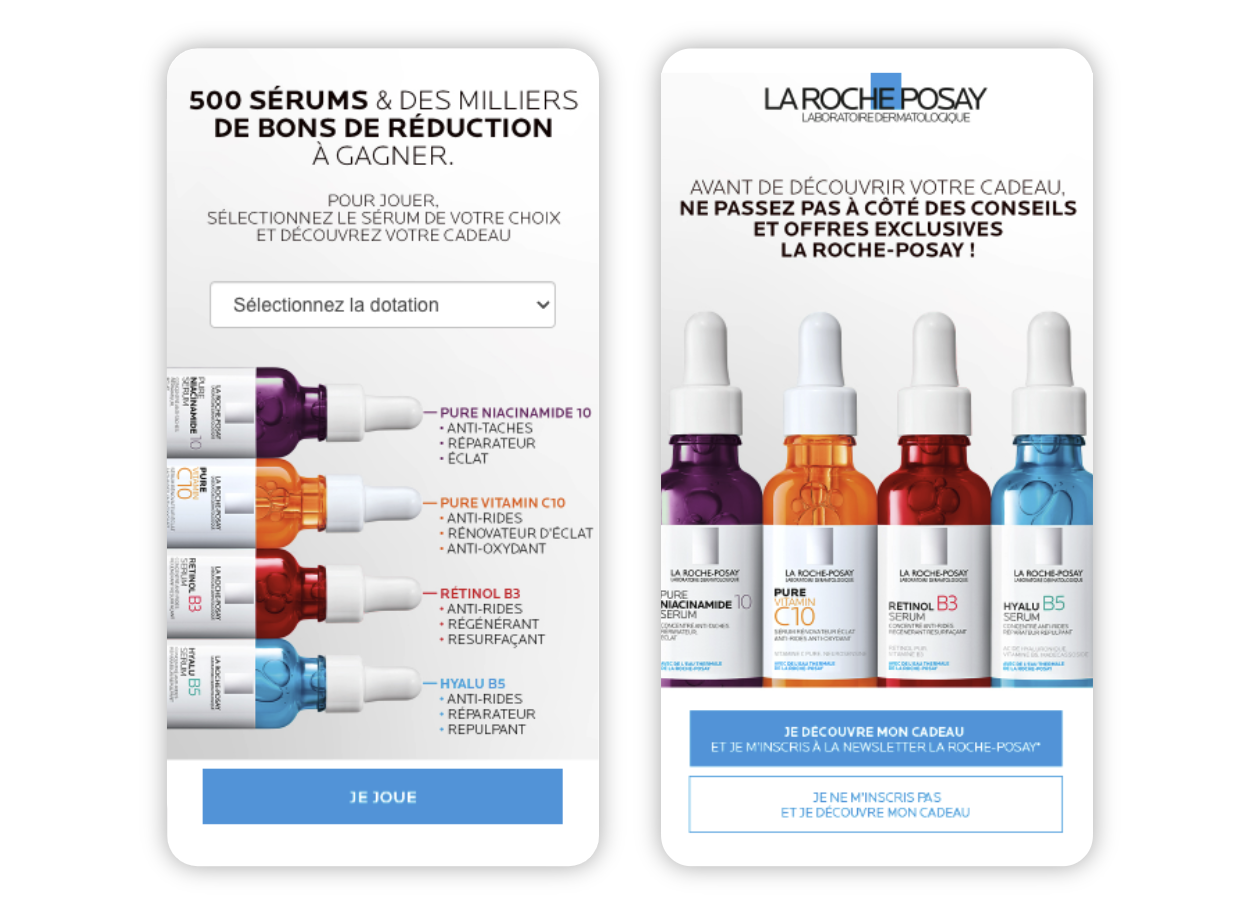
      A very good example of hard-hitting prize comes from the competition organised by La Roche-Posay. The campaign’s visuals perfectly showcase the brand’s new serums, which players can win by taking part in a Click & Win. The result: over 69,000 people signed up.

      Example of a La Roche Posay prize

      A prize consistent with the brand universe

      50% of participants expect a prize linked to their brand. It is therefore advisable to choose a prize that is easily associated with your company, your sector of activity or the marketing highlight ( Christmas, Halloween, etc.). This choice of endowment will increase the conversion rate of the campaign as well as its memorability.

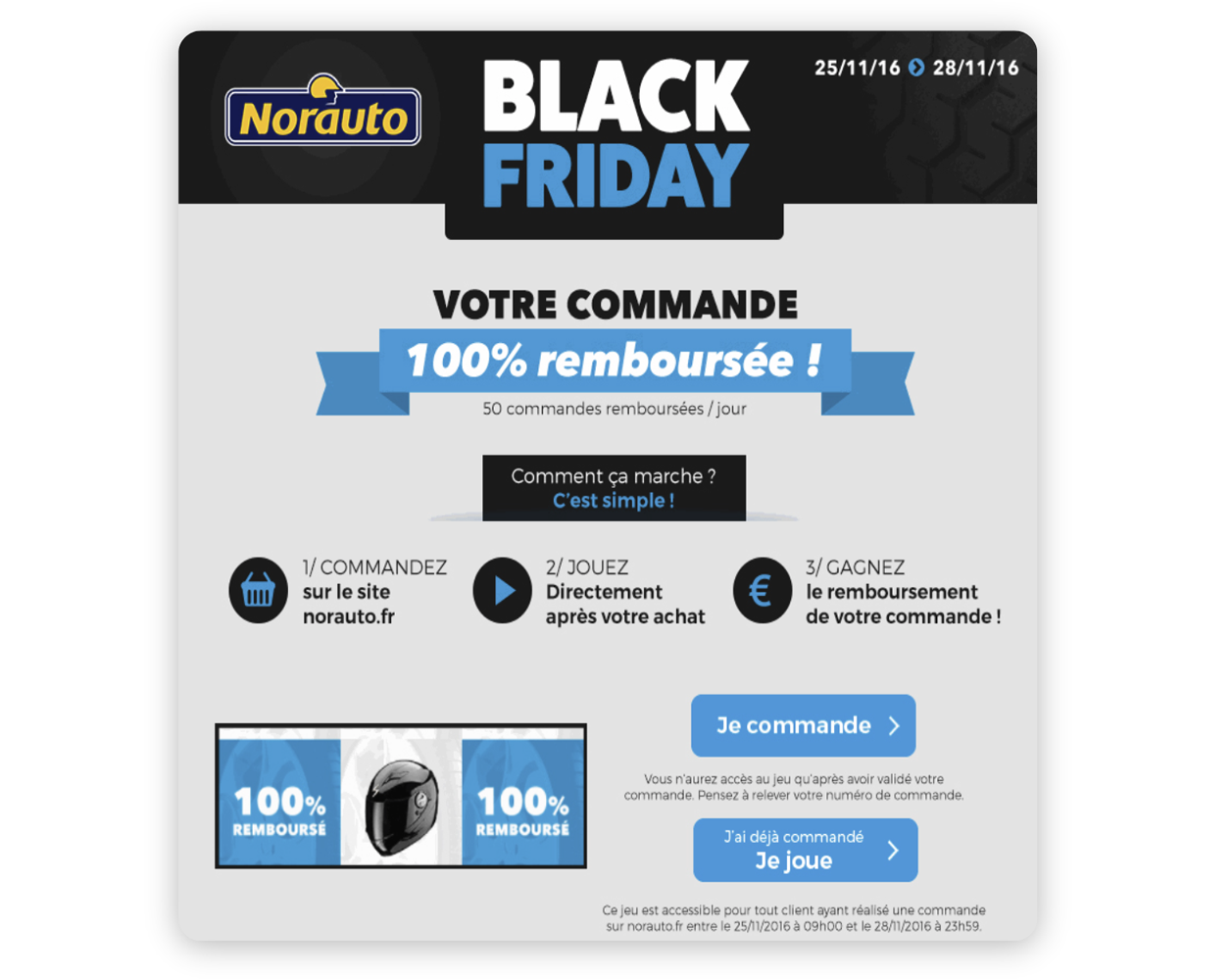
      For Black Friday, Norauto has therefore proposed a ‘your order 100% reimbursed’ scheme. This is a promise that is consistent with marketing highlights, giving consumers the chance to grab a bargain.

      Example of a Norauto prize

      A prize in line with its interactive marketing campaign

      The choice of prize must also be adapted to the context of the marketing game and the objectives it is designed to achieve.

      For example, a competition organised to generate leads should choose an exceptional prize (a car or a high-tech device). It can also multiply the number of prizes. To generate traffic and encourage conversion, the gift chosen should be linked to an act of purchase (gift card, discount, etc.).

      Targeted prizes for participants

      Choosing the right reward for a competition also means defining the target audience you want to reach.. Il peut s’agir d’une cible familiale, avec des enfants. Ou plutôt d’un public féminin/masculin. Les marques devront également s’intéresser à l’âge/génération de leur audience pour choisir la bonne dotation.

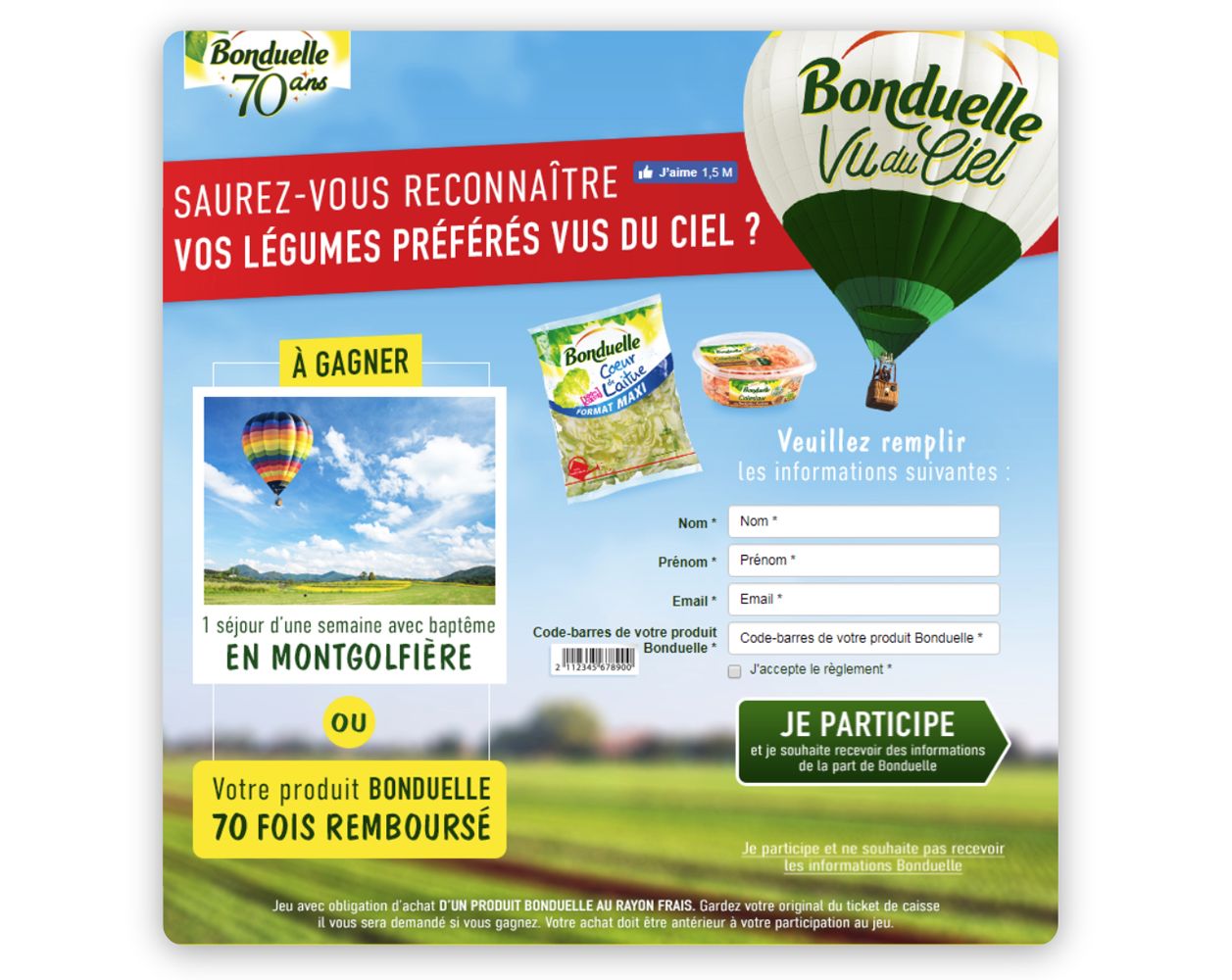
      The Bonduelle brand has opted for a targeted approach by launching a campaign aimed at customers who have purchased a Bonduelle product. To take part, you had to enter the bar code of your Bonduelle product.

      Bonduelle marketing competition

      The choice of prize is crucial to accelerating the performance of a marketing campaign, whatever its objective (loyalty, engagement, visibility). So take the time to select rewards or prizes that are both relevant to achieving the objectives you’ve set yourself and meet the expectations of your target audience!

      And to make organising your competition easier, discover the Adictiz solution!