

Online sales: how to boost sales through gamification

Online sales: how to boost sales through gamification

Online sales are a constantly evolving sector, particularly when it comes to the most effective conversion strategies. Brands are constantly looking for new, more effective and affordable ways of raising brand awareness, boosting sales and building customer loyalty.

One strategy that has always been tried and tested (and proven to be effective at every stage of the conversion funnel) is gamification.. Cette dernière joue en effet sur deux ressorts émotionnels très puissants chez le consommateur : le divertissement et l’opportunité de décrocher une récompense.

To help brands boost sales through gamification.In this article, we present the main advantages of game marketing in e-commerce. You’ll also find a simple, effective strategy for integrating game marketing into your sales funnel.

What is gamification?

Gamification is a marketing concept that involves applying the mechanisms of games (competition, accumulation of points and the hope of a reward) to engage and convert consumers.

Gamification can take the form of a loyalty program offering rewards (such as discount vouchers) in exchange for points accumulated. But also that of an interactive game generating traffic to its online shop.

In short, it’s a multi-faceted approach that aims not only to improve the performance of sales teams, but above all to increase company revenues through innovative interactive strategies.

And it works! A recent study by Gigy shows that gamification boosts consumer engagement by 30%.

One of the pioneers in this field is the Chinese marketplace AliExpress. It offers a gamified model with its ‘Coins and Coupons’ feature. Users can earn coins by completing basic tasks on the platform. They then convert these tokens into discount vouchers for use on the site. The result: a substantial increase in the engagement of AliExpres users, better retention and a record repeat rate.


What online sales challenges can gamification address?

For a brand that wants to increase its online sales, the best strategy will be one that removes the disincentives for potential customers at each stage of the conversion funnel. This is is why gamification is so effective in terms of awareness, consideration, conversion and retention.

Increase brand awareness before launching a new collection

Above all, gamification is an excellent way of increasing visibility and reach a greater number of qualified leads. Thanks to gamification, brands are better able to attract the attention of consumers, offering them a more entertaining and rewarding experience overall.

Many gamified applications incorporate social elements such as ranking, challenges and the ability to share achievements on social networks. This not only encourages users to become brand ambassadors within their own network, while fostering a sense of belonging and community around the company.

By adopting a fun game mechanic such as the piñata (and attractive prizes such as a trip to Parc Astérix), the Tape à l’Oeil brand has increased its visibility and brand awareness. Used as a data collection lever, TAO has succeeded in attracting qualified leads that it can target and retarget, while promoting its spring-summer collection ahead of the holiday period.

Example of online sales

Generate more traffic and boost sales during the sales period

When a brand’s customers are regularly involved in marketing games, they are more likely to be loyal and to make new purchases.. Les éléments gamifiés tels que les points de fidélité, les niveaux ou les badges peuvent être liés à des incitations telles que des remises, motivant les utilisateurs à racheter.

According to recent statistics, companies using gamification have seen an increase in their conversion rate of between 15% and 50%.. Pour la marque TAO, l’introduction d’un jeu interactif a engendré une hausse de 27 % des taux de clics vers son site.

Retarget qualified leads with the right product suggestions

The interactive nature of gamification enables companies to collect valuable data on the behaviour and preferences of their target audience. This first-party data can be used to optimise the customer experience, personalise marketing efforts… and ultimately to stimulate business growth.

For example, the brand can trigger a segmented emailing sequence after participation in a marketing game. The participation form or the data collected as part of the game (via a personality test, a swipper or a shopping list) will enable them to better target the buying preferences of their leads. They will then be able to send them tailored content that is more likely to trigger a purchase.

Reduce shopping basket abandonment

One of the biggest problems facing e-tailers is shopping basket abandonment. According to recent research, the average rate of basket abandonment in the e-commerce sector is 75%, which represents a huge loss of revenue.

Gamification helps to overcome this by creating a sense of urgency, which encourages customers to complete their order. This could be a discount coupon with a time limit.

3 steps to boost your conversion strategy with gamification

The results offered by gamification for online retailers will depend on their ability to choose the right game mechanics depending on their objective. Here’s our advice on how to optimise your gamified customer experience.

Step 1: Define your objectives (conversion, lead generation)

The first step in a gamification-fuelled conversion strategy is to identify the behaviour the brand wants to encourage. Do they want users to buy more products, share content about the brand, leave a review after receiving their order?

By defining these objectives, the company can build a relevant gamification system. For example, Amazon encourages its users to rate its products by offering them the opportunity to become a ‘best reviewer’. This leads to a 58% increase in the number of reviews left and boosts the reassurance of new prospects arriving on a product sheet.

Step 2: Choose the right game mechanics

Depending on the objectives defined, the brand can then choose the right gamification mechanics. Games that are fun and clearly present the possibility of winning a reward are very effective for generating leads and increasing visits to an online shop.

Brands will be able to opt for the winning instant with an e-mail address capture form. Thanks to a tracking pixel set up on the game, it is easy to track sales made by participants in the instant win, and thus calculate the ROI of the marketing campaign.

The same applies to a mechanical device such as the Gatecode which implies an obligation to buy. This type of interactive game is perfect for boosting online sales, as you need to be able to show proof of purchase in order to play. This effectively increases the chances of conversion and loyalty.

The choice of rewards is also crucial. To make sure you get it right, read our guide to offering the right gifts.
Step 3: Test, iterate and improve to maximise conversions

As with any online sales strategy, it is essential to test your gamification elements to evaluate their effectiveness, brands will be able to integrate a form into their interactive games to gather feedback from users. This will enable them to identify areas for improvement to enhance their experience.

Conclusion

In an increasingly competitive e-commerce landscape, gamification is an excellent vector for differentiation. It will enable brands to facilitate the progression of their leads through their conversion funnel and boost their growth. Find out how to get started with an effective gamification strategy, discover all the Adictiz game mechanics!

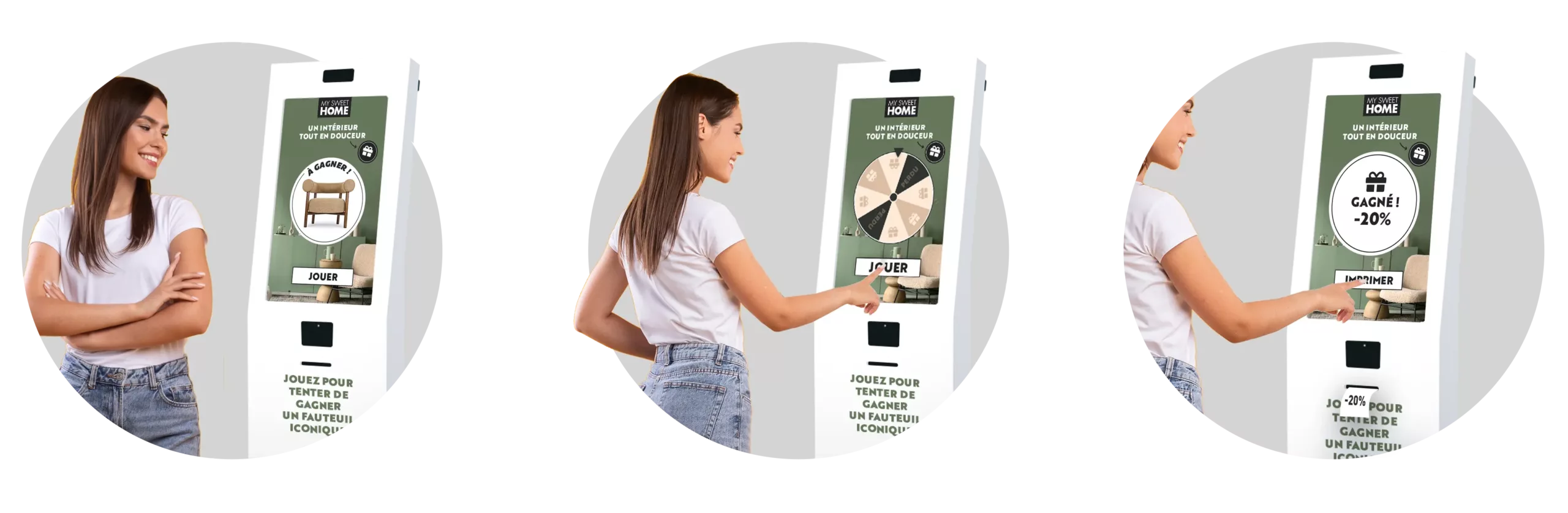
Why install an interactive terminal in your shop?

Why install an interactive terminal in your shop?

A shopper’s experience in a physical shop is very different from that in an online shop. This is precisely why consumers, who are increasingly familiar with e-commerce, expect more from their visit to a physical shop. And in particular more interaction with the brand. That’s where the interactive terminal comes in!

Another growing demand from consumers is the possibility of enjoying a hybrid, phygital shopping experience (one foot in the physical store, the other in the digital world). For example, many want to be able to order an item online and collect it in-store, or to combine loyalty points from online purchases with those earned in physical.

Interactive terminals are certainly one of the most effective tools for meeting all these expectations. Elles s’inscrivent plus globalement dans une tendance de This is a key factor in the digitalisation of retail, enabling the creation of an interactive, omnichannel experience that appeals to new generations of consumers.

Let’s explore how they work and the advantages that digital terminals can offer businesses in their drive to store strategy.

What is an interactive terminal?

An interactive terminal is a digital medium that facilitates the exchange of information between a shop and its customers. To be more precise, this is generally a compputer terminal with a touch screen and management software that enables brands to offer a “self-service” type of in-store experience.

One example is the digital terminals present in some fast-food restaurants, where customers can order their meal before collecting it (and sometimes paying for it) at the checkout.

Thanks to a user-friendly interface, thse digital terminals provide access to information and/or applications dedicated to retail. Interactive terminals can be wall-mounted or freestanding.. Elles sont même parfois autonomes, comme c’est le cas par exemple des tablettes présentes en caisse. Leur usage peut aussi varier. On fait ainsi la différence entre les bornes pour payer, les bornes de jeu, ou encore les bornes d’informations.

Technically, digital terminals can be connected to the Internet via a wi-fi or LAN connection. This makes it easier to customise the display, update it remotely, or integrate new sales media such as marketing games. All of these levers make it possible to make the kiosk more eye-catching and engaging, and so encourage customers to interact with it.

interactive terminals

What are the advantages of an in-store interactive terminal?

Interactive terminals are part of a more general trend towards digitising points of sale, in the same way as digital checkout systems. These tools are very interesting for brands, as they enable them to improve their in-store experience and respond to a wide variety of their commercial challenges.

Here are the top 5 reasons why businesses should consider installing an interactive terminal at their physical points of sale.

1. Stand out from the competition with an in-store interactive terminal

First impressions count for a lot in retail. Installing interactive terminals in-store can intrigue passers-by and make them want to discover the world of your brand. It’s a great way to increase traffic at its points of sale. It will also give the company a more modern image and encourage customers to familiarise themselves with its products, services, etc.

Interactive terminals also provide a link between the physical and digital experience. Consistency between these different communication and distribution channels will anchor the brand (its logo, its messages) in the minds of consumers. Consumers will find it easier to remember their experience with the company, which will encourage them to return to its shops or e-commerce site.

2. An interactive terminal for collecting customer data

When they interact with a digital terminal, a shop’s customers provide it with crucial information about themselves and their purchasing habits. This is particularly the case with interactive terminals that invite consumers to fill in a form before they are invited to take part in a survey or competition.

Brands can collect first-party data in this way such as the demographic profile of their customers or their contact details. Data collection also includes invaluable information about their expectations, budget, preferences, etc.

Thanks to this data, brands can better understand their customers. They will be able to adjust their offering and their customer experience to better meet their customers’ needs.

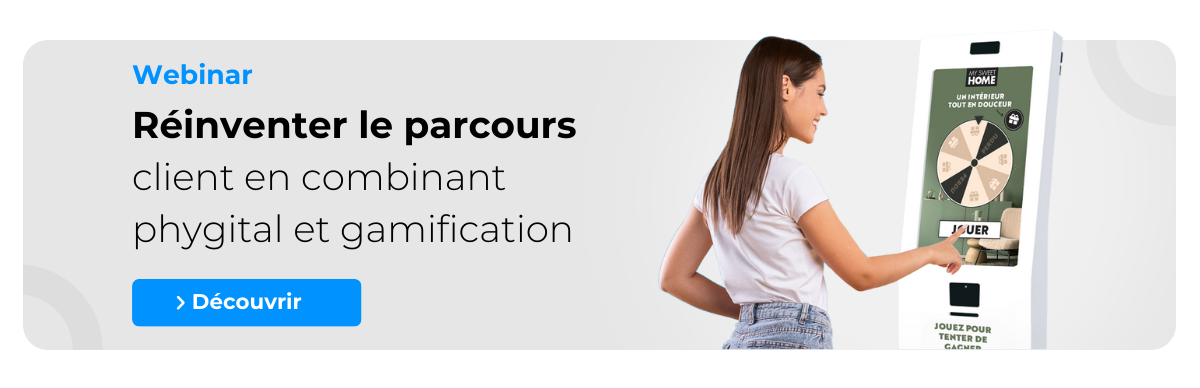
Phygital experience webinar

3. Maximising conversions with in-store digital terminals

Although they can be expensive to purchase, digital terminals are a worthwhile investment for brands. They have a positive impact on shop sales because digital signage is much more effective than static displays for presenting your offer and advertising. The multimedia content displayed on interactive terminals is more dynamic than a simple poster, and therefore more engaging.

The digital terminals also provide a comprehensive overview of the product catalogue If a product is no longer available in shop, customers can order it directly from the terminal and have it delivered to their home. In this way, the brand can also offer to customise your items or even recommend complementary products. This will significantly increase their average shopping basket, and therefore their revenue.

Given that it is now possible to hire temporary kiosks for a commercial operation, this marketing tool is becoming increasingly accessible. And its Return On Investment (ROI) is even more attractive.

4. Offering an interactive in-store experience thanks to a phygital device

Another way of maximising revenue from physical shops and building customer loyalty is to offer an exceptional customer experience. Interactive terminals help to achieve these commercial objectives in a number of ways.

First and foremost, the digital terminals will help visitors to find their way around more effectively. They can, for example, tell them which department a product is in or what stocks are available. The terminals also share more precise information than a simple label or even a gondola. This will enable customers to make better decisions, which will increase their satisfaction while limiting returns.

Above all, an interactive terminal can make the in-store experience more entertaining and profitable for customers. For example, it will give them the opportunity to benefit from advantages (such as free goodies or discount vouchers) by taking part in a survey or a scratch card game. Là encore, gamification and interactivity of the in-store experience are powerful drivers of satisfaction, conversion and retention.

5. Save your sales staff time with interactive terminals

Interactive terminals take self-service to the next level. They are ideal for improving the efficiency of sales teams and saving employees time.

The sales team will spend less time providing information to customers, taking orders and processing payments. This will enable them to devote more time to consulting and to creating a genuine human relationship between the company and its customers.

An interactive terminal is an excellent way of increasing shop traffic and generating more sales. Combine the benefits of a phygital device with those of gamification by integrating interactive games into your kiosk. Adictiz offers a new service, the Playable Instore, to liven up your points of sale. Contact us to find out more.

Why create an online interactive quiz?

Why create an online interactive quiz?

The quiz, whether interactive or static, is a particularly popular marketing format for brands, because of its powerful engagement skills. Remember the personality tests you used to fill in in magazines, or the cultural quizzes that enlivened your evenings as a student. The simple curiosity of discovering the number of correct answers you had found or your most prominent character trait encouraged you to answer all the questions in the quiz.

Adapted to marketing, the interactive quiz has all the ingredients to activate your audience and collect valuable data that you can then use to improve your offer or optimise your communication.

In this article, we present the main advantages and types of online interactive quiz that you can organise. Finally, we share our tips and best practices for creating a successful marketing game.

What is an interactive quiz?

An interactive quiz is a type of game in which, after answering several questions, the user obtains the expected answer. A knowledge quiz will reveal the correct answers to the questions asked. As for the personality quiz, it will tell the participant which character trait or personality typology he or she most closely corresponds to.

The whole point of an interactive quiz is to learn a little more about yourself or a subject you’re passionate about.. En tant que tel, le quiz est par nature un jeu interactif, puisque le résultat dépendra des réponses données par l’utilisateur.

Very popular in its educational format, the interactive quiz can also be a powerful marketing tool. For example, it can enable brands to test their audience’s knowledge of their offer, their world or their niche. It’s also a good way of finding out more about their buying habits, what consumers think of a company, and their specific needs.

Why offer an interactive quiz to your audience?

As well as collecting first-party data (i.e. data shared directly by the people concerned) on your audience’s opinion or knowledge, an interactive online quiz generates a number of tangible benefits for the companies offering them.


Engagement and virality

The first obvious benefit of interactive quizzes is to boost the virality of content and audience engagement. Take BuzzFeed, for examplewhich has become famous largely thanks to its interactive online quizzes. These quizzes can be shared thousands or even millions of times on social networks, increasing the brand’s visibility and brand awareness.

The interactive quiz mechanism is one of the most engaging, particularly when it comes to holding your audience’s attention. Because they want to know the answer to the questions asked, or the result of their online personality test, participants will be much more inclined to follow each stage of your interactive quiz, right up to the final revelation. And because they’re curious about the results of their friends and family, they’ll also be tempted to share your quiz with their friends and family.

Creating an interactive quiz is also a very effective way of generating traffic to your site. By adding a ‘hint’ button under a question, it is possible to direct the participant to a page (such as a product sheet, for example) to help them find the answer they are looking for. This way, users who want to win will be more inclined to visit the website, increasing its traffic organically.

Consumer education and differentiation

Another advantage of the interactive quiz is its ability to educate your audience, and therefore generate more qualified leads. A survey conducted by Demand Metric in partnership with Ion Interactive revealed that marketers consider interactive content to be seven times more effective at educating their audience. According to the same survey, this difference in lead qualification generates three times more conversions than in a sales funnel in which the content is exclusively static.

Finally, organising an interactive quiz can enhance your brand image and help differentiate from your competitors. For 88% of the professionals surveyed, interactive content is effective or very effective in this respect, compared with 55% of marketers who only work with static content.

Lead recruitment guide

The different types of interactive quiz and their marketing benefits

One of the advantages of creating an interactive quiz (other than collecting first-party and zero-party data) is the possibility of choosing from a wide range of formats and game mechanics. Depending on your audience and your objectives, you can turn to :

Personality quizzes for collecting and activating first-party data

Already well known to users, the personality test is engaging because we are naturally attracted by the prospect of finding out more about ourselves or those close to us. This format, applied to marketing games, can be used, for example, to discover the product preferences of your audience and optimise your retargeting.

The prediction game to engage a fan base

In the run-up to a major sporting event, an interactive prediction quiz is a highly effective way of boosting community involvement. The excitement generated when the results are revealed and the chance to win prizes encourages the commitment of prospects and brand customers alike.

The same applies to other interactive quizzes such as the Blind test (or music quiz), but this time in the world of music.

In this way, semantic targeting offers a more subtle and precise approach to reaching users interested in a specific subject, while preserving the confidentiality of their data.

Surveys to gather additional information about your audience

It is also possible to create an interactive survey-type quiz to collect qualitative data on its customers and better understand their needs and preferences. Rather than a simple MCQ or personality test, the questions in this online quiz will relate to the buying habits, preferences or aspirations of a segment of consumers.

The company can then use the first-party data collected to optimise its advertising campaigns, improve or adapt its product/service offering, or strengthen the commitment of its community. And more, this gamification mechanism allows you to improve the qualification of your prospects and the satisfaction of your customers without having to use a traditional form.

Our tips for a successful interactive quiz

Ready to create an interactive online quiz? Here are the steps to follow to ensure its success:

  1. Identify the objective of your interactive quiz (to provide online entertainment for your audience or to collect data)
  2. Choose the subject of your quiz (a particular product, the history of your brand, a personality test);
  3. Draft intriguing and hard-hitting interactive quiz questions to keep participants engaged and arouse their curiosity;
  4. Apply a points system to each question in the interactive online quiz;
  5. Define the possible results once the quiz has been completed and any rewards based on these results.

Do you need help creating an interactive online quiz around your brand universe? Discover all our quiz mechanics as well as our different design options and choose the ones best suited to your marketing campaign.