

Attention time has become a central issue in digital marketing. Faced with advertising saturation, capturing and retaining a user’s attention determines the effectiveness of campaigns. This article explores interactive levers, including gamification, to extend this exposure time and improve conversion.
Table Of Content
What is attention time in marketing?
Attention time is the duration for which an individual remains focused on content. And this before shifting their gaze or interest. In marketing, it measures a brand’s ability to maintain a prospect’s or customer’s interest. For example, on a message, a visual, or an interface.
According to Microsoft, the average attention span has reportedly dropped from 12 to 8 seconds in just 15 years. That is less than that of a goldfish. Even if this statistic should be put into perspective, it highlights a clear trend. Attention has become volatile and difficult to mobilize sustainably.
Why is attention time an essential KPI in marketing?
Attention time reflects a brand’s ability to capture and then retain a user. It is not a superficial indicator. The longer a person remains exposed to a message, the more they understand it, memorize it, and can take action.
This engagement is a strategic data point. It is not limited to a superficial signal: it triggers concrete actions. This feeds the data available to a company to better understand its audience. During a game, for example, the time spent, the answers given, and the preferences expressed enrich the CRM database. These behavioral signals make it possible to create finer segments. But also to script more relevant follow ups and to personalize messages.
Attention is also a direct lever for conversion. An attentive user is more likely to click, explore an offer, and ultimately make a purchase. Attention thus becomes a marketing asset. It allows for better message delivery, enhances a proposition, and influences the decision.
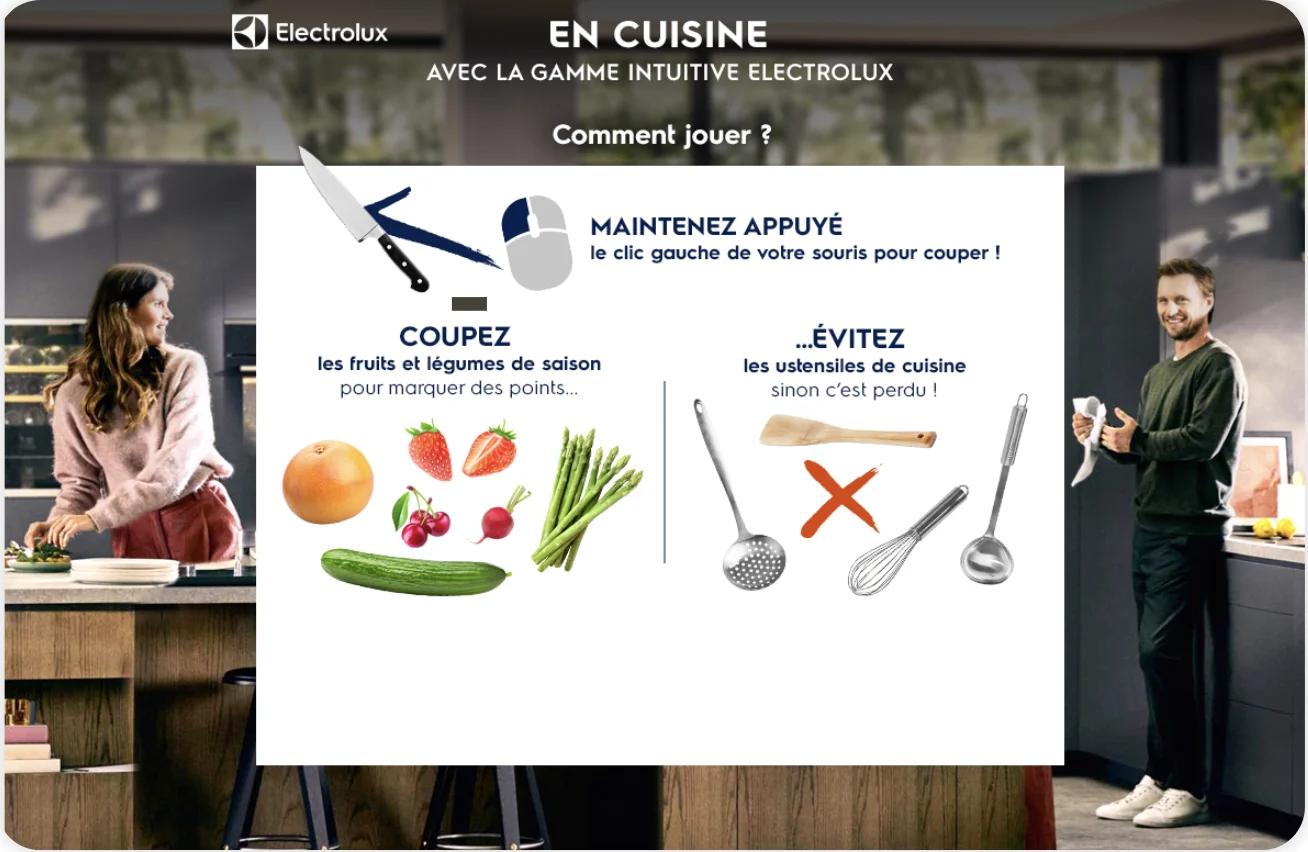
That is what Electrolux did when launching its eco-responsible range. The brand deployed an interactive game of the type Slicer to capture the attention of its target audience. And this allows for focusing on the promotion of these products. As a result: this operation generated new qualified leads and revealed the participants’ purchase intentions. Additionally, this has stimulated traffic to the brand’s e-commerce site thanks to the vouchers offered as prizes. The captured attention thus translated concretely into sales.

How to measure your audience’s attention more accurately?
Measuring attention time is no longer limited to click through rates. New indicators allow for a more precise analysis of how content is perceived and used.
- actual engaged time, which measures the duration during which the user actively interacts with the page,
- heatmaps, which reveal the most viewed areas,
- the scroll rate, to know how far the content is read,
- eye-tracking, used to evaluate visual attention points on a page.
These tools make it possible to detect what captures (or does not capture) attention. They offer a concrete optimization basis for improving UX, adjusting formats, or repositioning messages. By relying on these attention indicators, brands can adapt their marketing materials to make them more engaging and effective.
For example, actual engagement time highlights the formats that hold the most attention. If a landing page records a very short viewing time, it may indicate that the message is not clear or that the user cannot find what they are looking for. The brand can then rethink this page: simplifying the text, adding visuals, or inserting a mini-game to introduce the offer in a more interactive way.
Another concrete case: scroll depth . If the majority of users do not scroll past 30% of the page, the CTA (call to action) placed at the bottom is ineffective. It then becomes relevant to move this CTA higher up or to duplicate it in several places. One could also reorganize the content to provide quicker access to the essentials or insert an interactive carousel to encourage users to go further.
These optimizations, based on real attention signals, make it possible to transform passive content into more engaging experiences, with a direct impact on marketing performance: better retention, more clicks, and higher conversion rates.
Marketing games: how to increase attention time?
Interactive formats, such as Quizzes, Pinballs or Surveys, capture attention in an active way by directly involving the user. This interaction creates a dynamic where the user becomes an actor, which stimulates their curiosity and their desire to progress.
Beyond the simple format, gamification often integrates a potential reward — a prize, an advantage, or exclusive content — which motivates users to continue the experience until the end. This promise of a reward keeps the user engaged longer, as they want to discover their prize or improve their score. This process increases time spent, strengthens engagement, and improves message retention by transforming simple exposure into an immersive and rewarding experience.
These mechanics integrate easily into a marketing or CRM strategy. They make it possible to identify an interest, pre-qualify a profile, or trigger an action. Each interaction becomes a micro-conversion. By linking these steps, the chances of generating a real conversion: such as a registration, a purchase, or a sign-up for a loyalty program, are increased.
For example: a user who spends 3 minutes on an interactive quiz or reaches a high score on a points based game reveals an interest or an affinity for the brand’s world. This first-party data (also referred to as behavioral signals) then feeds into CRM scoring and marketing automation scenarios (targeted follow-ups, adjustments to the offer sent via email, etc.)
Case study: Quick’s marketing campaign
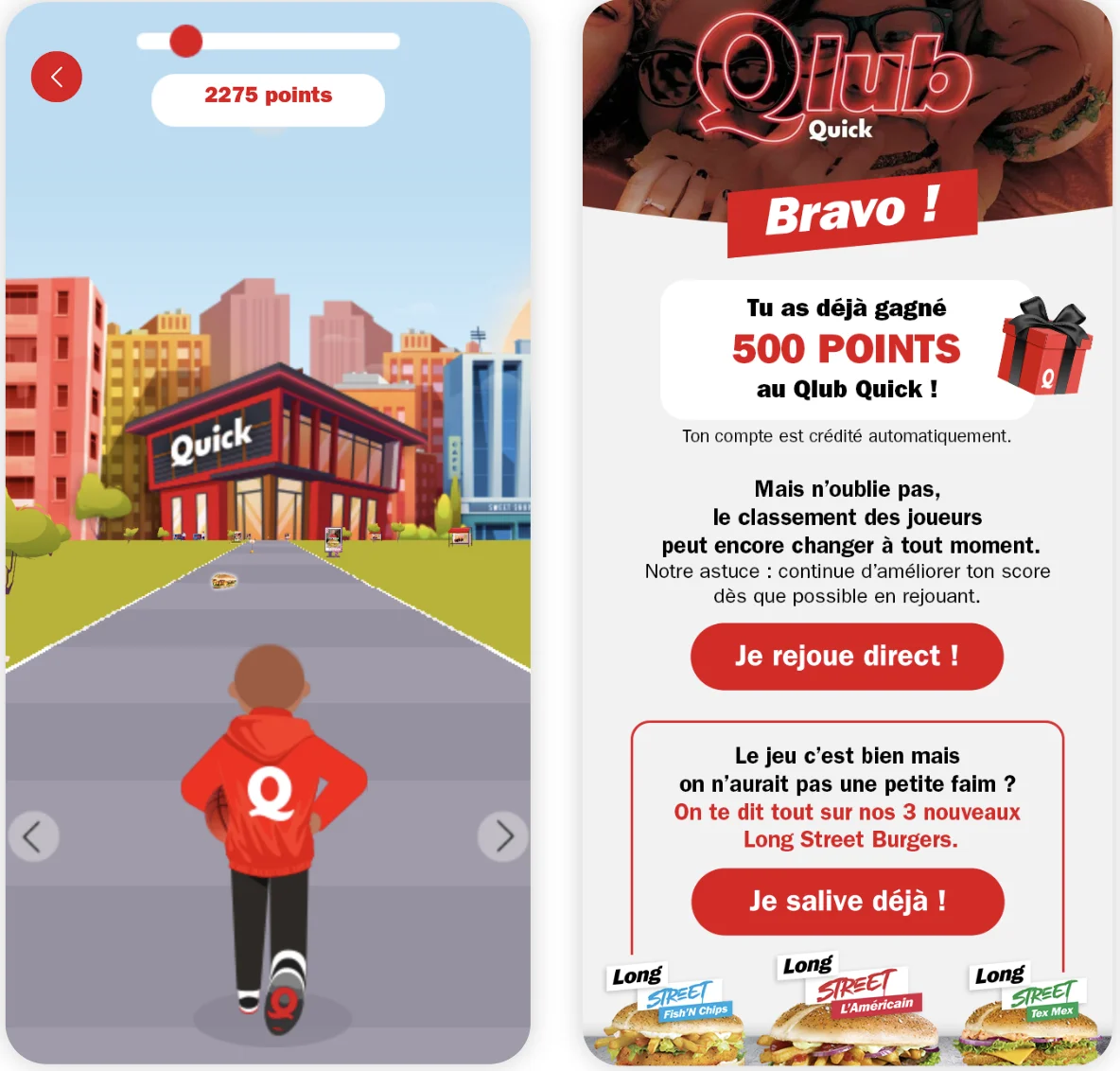
Take the example of Quick, which used a mobile campaign centered around Tony Parker used a Playable App in the style of Outrun for a mobile campaign centered around Tony Parker. The objective was twofold: to generate qualified leads and recruit new members into its loyalty program. The operation gathered nearly 4,000 registrants in one week, 69% of whom opted in. 250 participants joined the loyalty program, directly meeting the conversion objectives.
But what interests us here is that users spent an average of 6 minutes on the game, an attention time far exceeding the standards of traditional formats. This time spent is not anecdotal. It allows for a message to be effectively delivered, immersing the user in the brand’s universe and creating a stronger bond. The campaign thus illustrates how gamification acts as a driver for engagement and marketing performance by extending attention and triggering concrete actions.
How to attract a customer’s attention: standing out through gaming
Mini-glossary of attention time in marketing
- Attention span: the length of time a user remains focused on a piece of content before moving on to something else.
- Engaged time: the duration of real and active user interaction with a page or content (scroll, click, interaction).
- Playable marketing: an interactive advertising format that uses game mechanics to capture and retain attention.
- Scroll depth: a metric that measures how far a user scrolls down a page; used to evaluate the attention given to the content.
- Cognitive load: the mental effort required to process information; content that is too dense or complex can reduce attention.
Consumer attention is becoming increasingly difficult to capture with traditional marketing formats, which are often perceived as static and repetitive. However, attention remains the key to performance and conversion. Investing in innovative levers, such as gamification, makes it possible to create engaging and interactive experiences that truly hold interest. To effectively reach your audience and strengthen their engagement, the playful and original mechanics offered by Adictiz provide a concrete and high performance solution. Take this opportunity to boost your marketing strategy and maximize your results.
Adictiz, the platform to achieve
your marketing goals