

CSR marketing: how to put in place an impactful strategy

CSR marketing: how to put in place an impactful strategy

Today’s consumers are increasingly attentive to the values upheld by companies. They ask where the products they buy come from, how they are made and how employees are treated. Anxious not to fall into the trap of greenwashing, buyers expect action rather than fine words.

It is in this context that CSR marketing represents a real opportunity for brands. More than just promises, Corporate Social Responsibility commits companies to taking concrete action to protect the environment and promote social justice. By communicating these positive actions, companies can raise their profile, build a community of committed customers and stand out from their competitors.

In this article, we look at the interaction between marketing and CSR and how you can boost your communication strategy by using fun ways of raising awareness.

What is CSR?

Created by environmental and humanitarian organisations, CSR (or Corporate Social Responsibility) aims to encourage companies to make a voluntary commitment to sustainable development. Since 2010 (with the ISO 26000 standard), this concept has been governed by an international standard under which the CSR policy pursued by companies must address a number of key issues, including :

  • Local development ;
  • Defending human rights ;
  • The application of decent working conditions;
  • Actively protecting the environment (in particular by reducing its carbon footprint).

Both environmental and ethical, CSR is not just a declaration of intent. It must be translated into concrete action, throughout the company’s value creation chain. It is therefore a global strategy, encompassing the use of local and environmentally-friendly raw materials, the establishment of fair relations with all its stakeholders, the recycling of its waste and respect for more horizontal governance.

CSR is therefore a commitment to structural change, but it is also a growth factor for companies. Indeed, it is proving to be a marketing asset for brands wishing to differentiate themselves by focusing their communication on strong values (and actions).

Why integrate CSR into your marketing strategy?

While it is tricky to combine commitment and marketing, the two are not necessarily contradictory. In fact, CSR can be fully integrated into a company’s marketing strategy. Today, brands are no longer just economic players, but social players in their own right. This implies both moral and ethical obligations to produce better products. This positioning can be used to stand out in the marketplace and reach out to committed consumers.

CSR marketing can therefore encompass several elements:

Storytelling and corporate branding

By integrating its CSR initiatives into its brand territory, the organisation will create a strong narrative, more likely to generate emotions in consumers. This is the case with committed brands such as Asphalte or Respire, which strengthen the connection with their customers by communicating shared values and highlighting their authenticity and transparency.

Responding to consumer expectations

Companies must constantly adapt to the needs and aspirations of their audience. With consumers now fully aware of the ecological and social issues behind their purchasing decisions, CSR marketing enables companies to position themselves as committed brands that fully meet the demands of the new consumer-actors.

Brand differentiation

In an ultra-saturated market, CSR marketing enables companies to make a difference on more than just the price or quality of their products/services. Using recyclable materials, manufacturing in France or sharing revenues with all employees are all ways of creating a distinct brand identity.

Engagement on social networks

Communicating on your CSR policy can also be an excellent way of creating more authentic, less promotional content. Companies can share their employees’ initiatives and go behind the scenes to effectively engage their audience.

Buyer conversion and loyalty

CSR strategy can directly influence consumers’ purchasing decisions. Indeed, numerous studies show that buyers are prepared to pay more for products or services marketed by responsible companies. It is also a channel for building loyalty, as customers are more loyal to companies whose values they share.

Gamification to boost CSR marketing

To convey their values and actions in favour of the environment and social justice more effectively, companies can use more engaging marketing levers.

Gamification, i.e. incorporating playful elements into campaigns, is particularly well-suited to CSR marketing. This format enables audiences to be better engaged by encouraging interaction with the brand.

Quiz to raise awareness of CSR issues

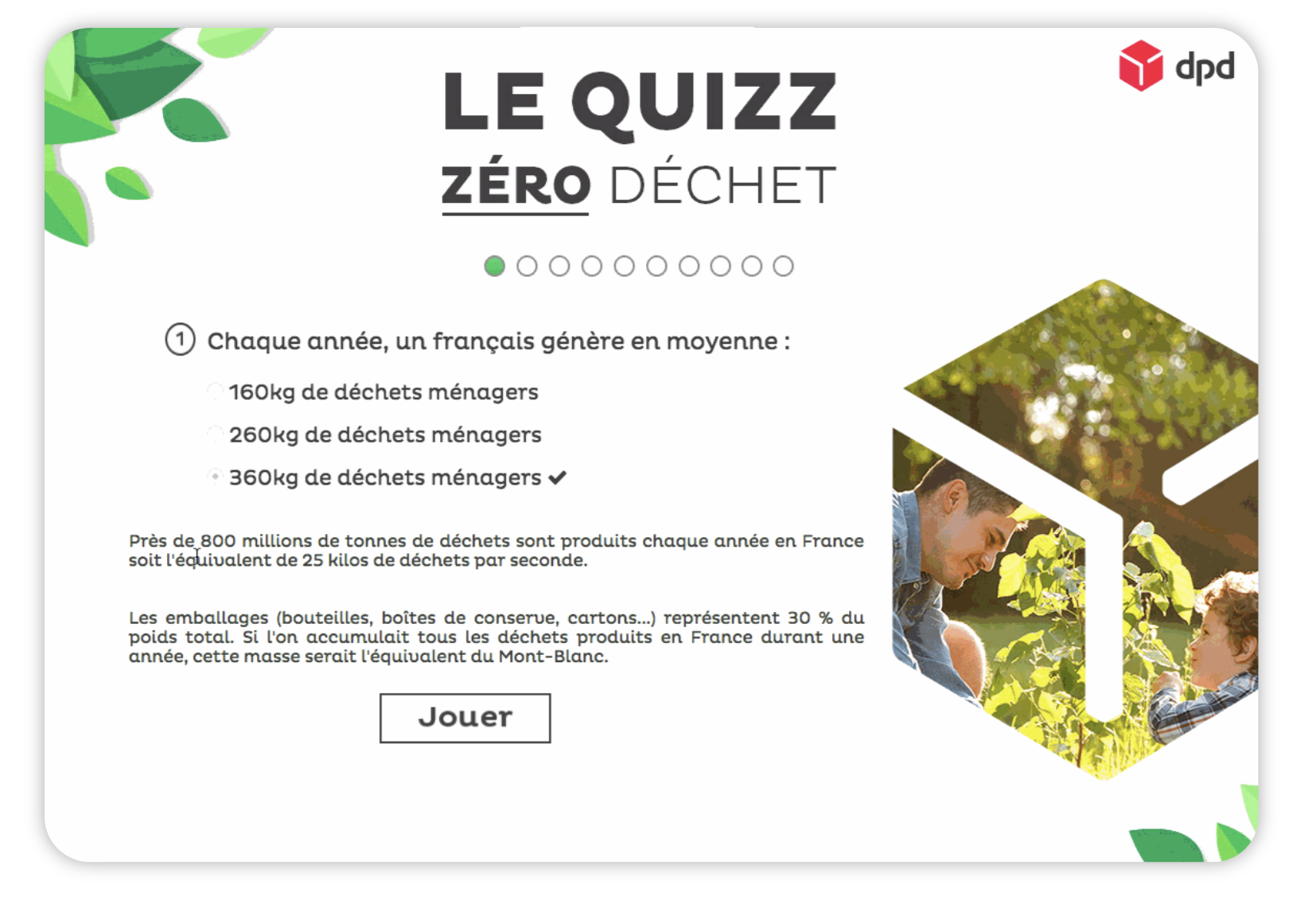
It is also a method already well known in education (known as edutainment) for encouraging the discovery and memorisation of new information. As part of a company’s CSR policy, for example, formats such as the Quiz or Memory can be used to effectively raise awareness among employees and customers about issues such as respect for the environment.

This is the route taken by the DPD transport company to raise employee awareness of the issue of waste reduction. The company is using this interactive mechanism to involve its teams in CSR issues, but also to promote its commitments, particularly its tennis sponsorship.

As well as the format itself, which tests knowledge and retention of the new information shared in the quiz, the company banked on attractive prizes. As a result, employees were all the more motivated to take part in this corporate CSR game to win electric bikes and connected caps.

DPD - zero waste quiz

Competitions to engage your community

Competitions are another excellent way of communicating more effectively about your CSR strategy and inviting your community (both internal and external) to get involved with your company. Adictiz a par exemple imaginé a CSR game in which employees were invited to take part in creating a reusable cup (using a Customizer) to help reduce plastic waste.
Adictiz - customizer marketing RSE
In the same way, brands can organise competitions for their customers on social networks. Content creator Lena Situations, for example, challenged her community to find eco-friendly ways of recycling unsold items form her clothing collection.

Conclusion

CSR marketing is an excellent way for your brand to create a stronger connection with its prospects and customers, but also with its employees. With Adictiz, you can easily organise interactive games around your company’s Corporate Social Responsibility, and communicate your values and commitments in a more authentic and fun way!

In 30 minutes, we show you how to launch your own high-performance interactive marketing campaign

5 methods for collecting qualitative data

5 methods for collecting qualitative data

To engage and convert prospects into customers more easily, brands need to know their audiences. This is known as customer knowledge, and involves gathering relevant, accurate and up-to-date information about their profile, expectations and habits. This data enables brands to :

  • Create products or services that meet real demand;
  • Communicate on the marketing channels their customers already use with content that resonates with them;
  • Offer a smoother, more enjoyable shopping experience;
  • Imagining and creating contact points to extend the customer relationship and build consumer loyalty.

The crux of the matter is data collection. This is invaluable information about who customers are and what they want. With the announced end of third-party cookies, brands need to come up with data collection methods that are both effective and non-intrusive.

What are the most effective techniques for collecting qualitative data? In this article, we present 5 tools for collecting data.

collection methods

1. The marketing game as a data collection method

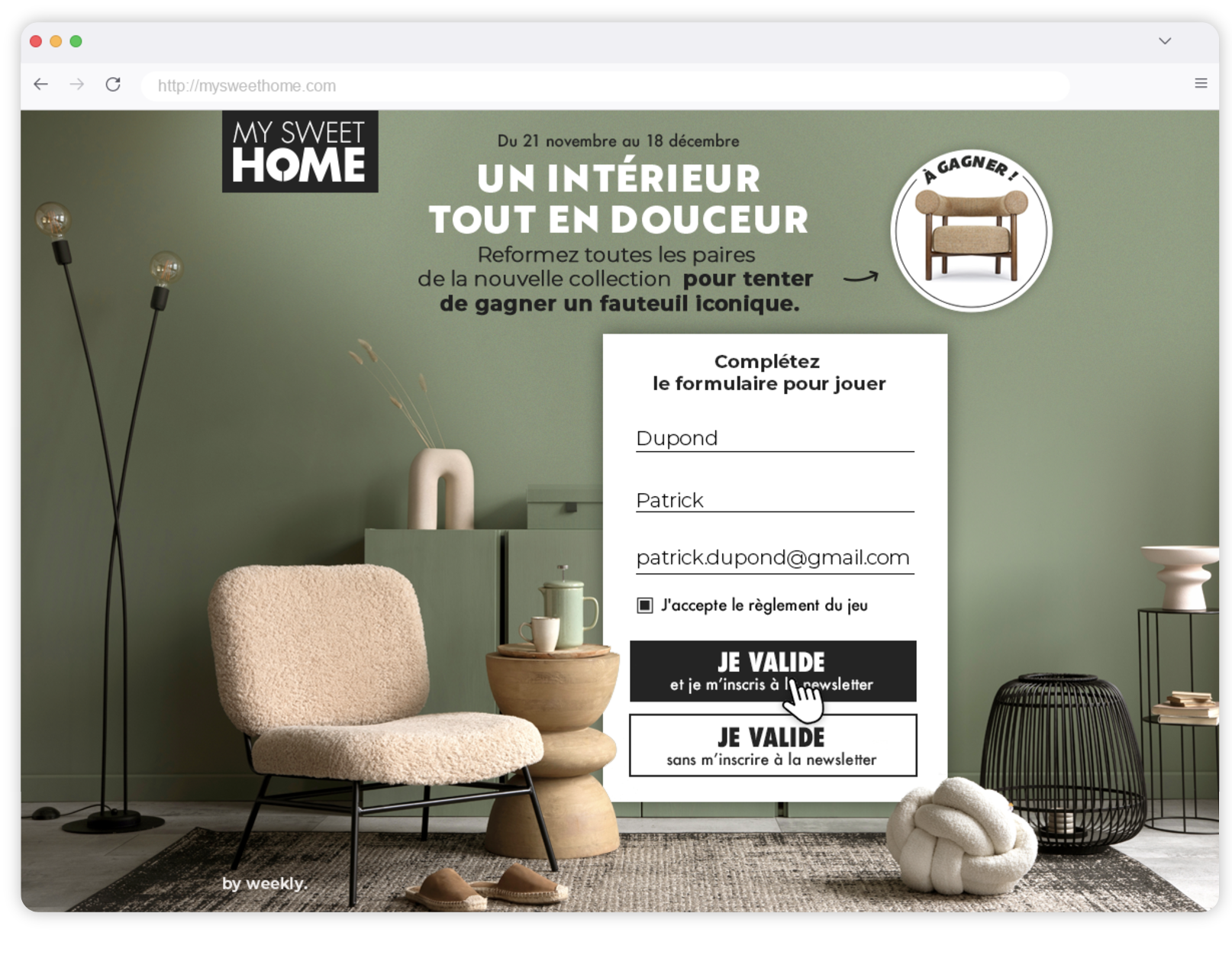
Fun and interactive, marketing games are an excellent way of collecting data. Not only does the prospect of winning a prize help to attract prospects and engage them, but the game itself incorporates data collection mechanisms (via interactions as in Swiper or Customizer ). La marque peu également intégrer un formulaire de collecte plus classique de type formulaire en début (pour accéder) et en fin d’expérience (avant de recevoir le gain). Ce second formulaire est dédié à la qualification des participants.

Why use it: to recruit, engage and convert prospects and customers by creating memorable brand experiences.

When to use it : at every stage of the customer journey. One example might be the distribution of an instant win via the brand’s website or social networks to generate new leads.

How to use it: game marketing works as long as the form or the method of collecting zero-party data (via interactions) is in harmony with the game experience.. Les prospects et clients seront également plus enclins à partager des informations si la marque leur propose de remporter une dotation attractive.

Weekly - collection methods

2. The form lead

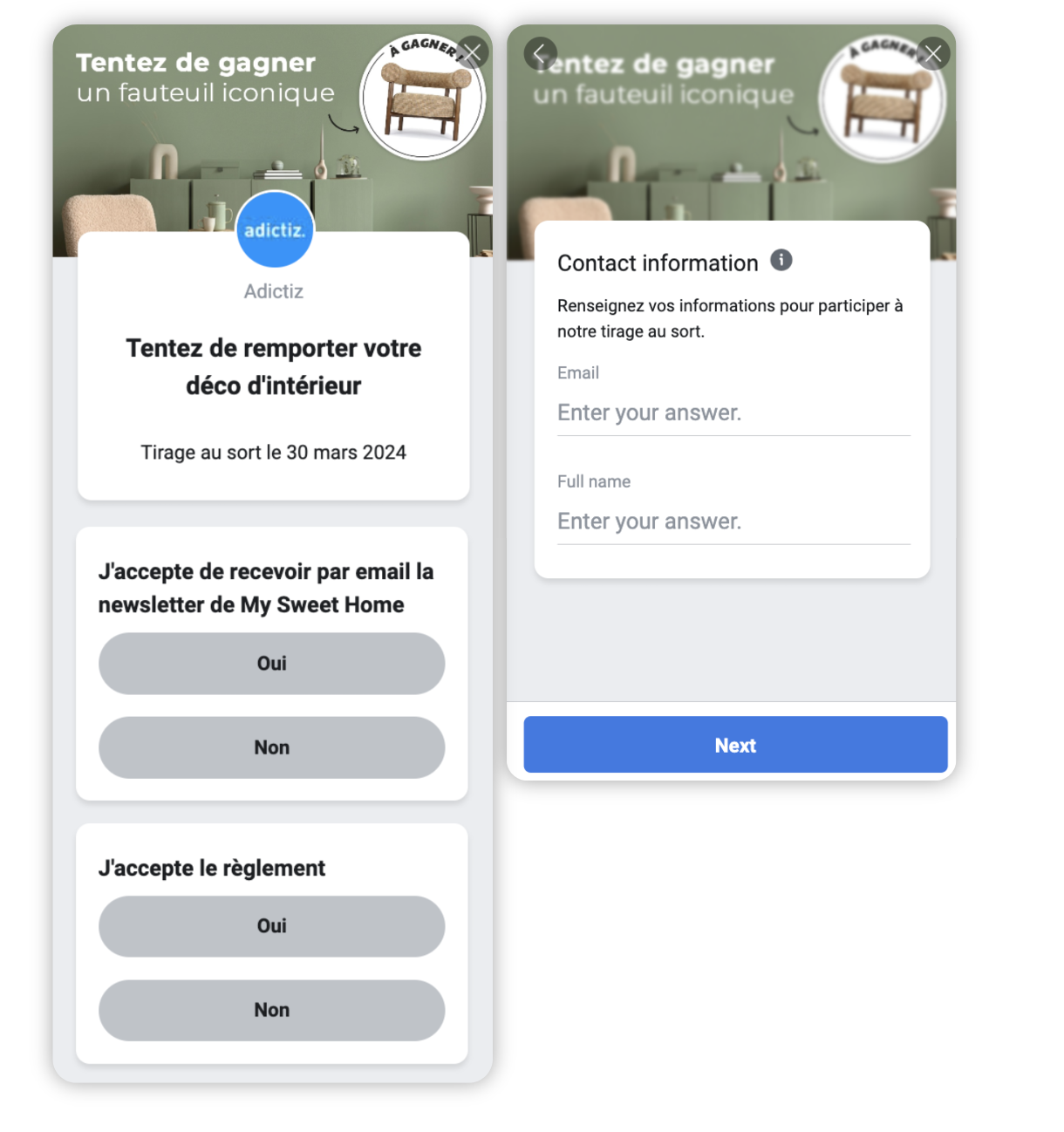
Le form lead (ou formulaire de prospection) permet de générer des leads en laissant les prospects soumettre leurs informations dans un formulaire intégré à une annonce publicitaire. 

Pourquoi l’utiliser : pour recruter et qualifier des visiteurs à l’aide d’un formulaire pré-rempli intégré à ses campagnes média. En plus de permettre de générer des leads, l’avantage de cette méthode de collecte réside dans sa rapidité. L’utilisateur ne quitte pas l’interface (réseau social, moteur de recherche etc.) puisque le formulaire est nativement intégré à la plateforme. Cela rend le remplissage du formulaire plus rapide et l’expérience plus rassurante pour le prospect. 

Quand l’utiliser : Les leads forms peuvent être partagés aux prospects de la marque à différents moments stratégiques comme lors d’une demande de devis ou de démonstration gratuite. Ou encore l’inscription à la newsletter ou à un évènement. 

Comment l’utiliser : Le form lead peut être configuré avec pré remplissage des données que l’utilisateur à rempli sur son profil (compte client ou profil sur les médias sociaux). Il est conseillé de diffuser un formulaire le plus court possible. Les champs sont entièrement personnalisables, ce qui permet à la marque de se concentrer sur les données qui sont pertinentes pour elle.

Weekly - form lead

3. Coresgistration

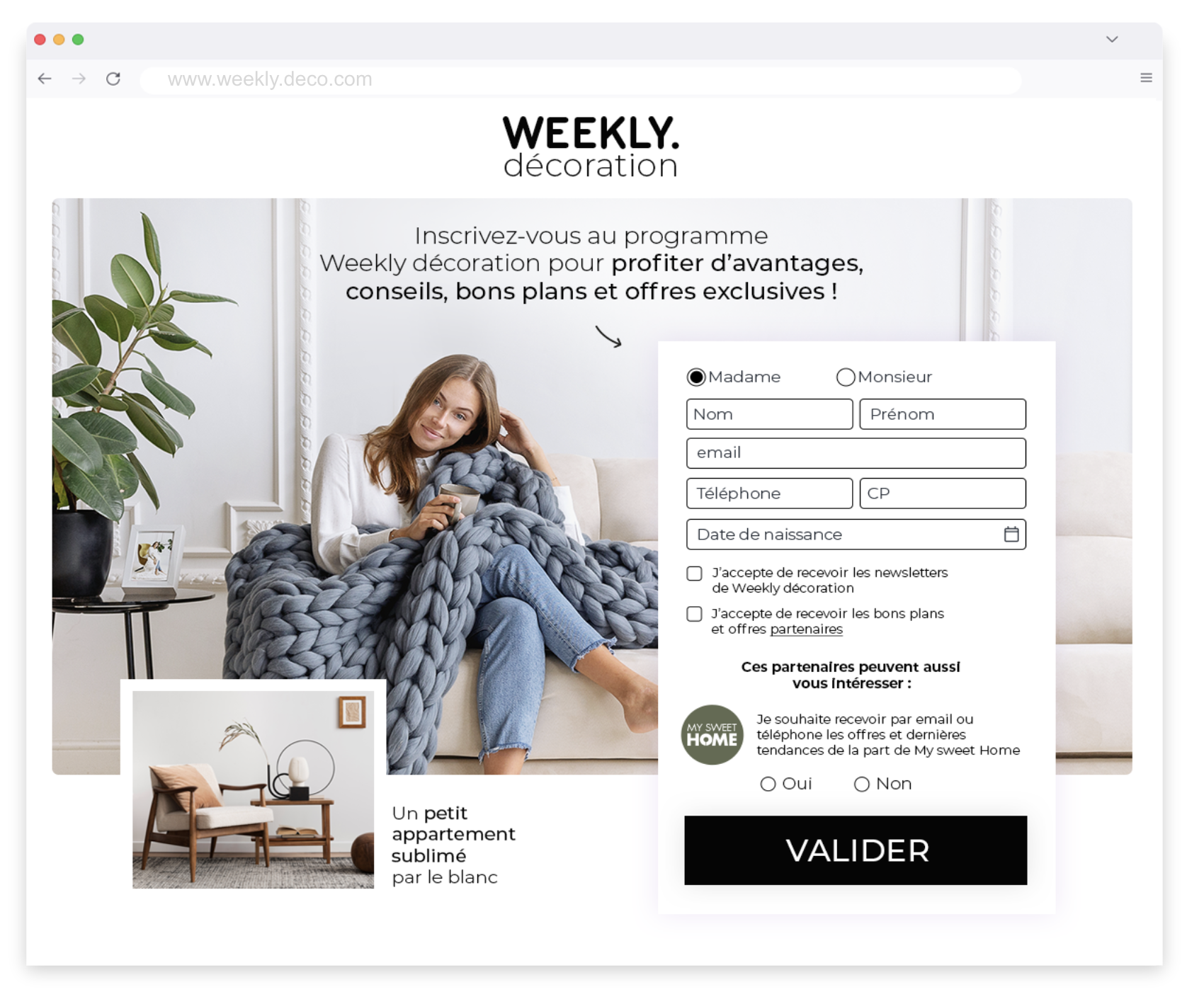
Also known as co-subscription, coregistration allows brands to take advantage of a user’s subscription to a newsletter or another form of subscription (for example, a monthly product box) to collect data or opt-in.

This method generally takes the form of an advertiser logo, a catchphrase and then a personalised check box. When users fill in their plan form, they can tick an additional opt-in box to subscribe to the partner brand’s mailing list.

Why use it: to recruit opt-in volumes via a partner campaign in order to benefit from its audience

How to use it: as with other collaborative marketing methods (such as cobranding), the key to coregistration is to target the right partner. The more closely the brand’s value proposition and positioning are aligned with that of the partner, the more likely customers will be to tick the co-subscription box.

weekly - data collection

4. Click-to-lead email to collect customer data

This data collection method consists of highlighting an offer to encourage users to sign up for the brand’s newsletter. The opt-in is generated by the click (click-lead), and the user is then redirected to the e-commerce site.

Why use it: to facilitate data collection and generate conversions, as part of a prospecting emailing campaign.

When to use it: as part of an email campaign to generate leads

How to use it: to encourage opt-ins generationThe offer highlighted in the campaign must be attractive. Adding a deadline for taking advantage of the offer can also create a sense of urgency that will encourage prospects to sign up for the newsletter or tick the opt-in box so that they don’t miss out on current promotions.

Weekly - clic to lead email

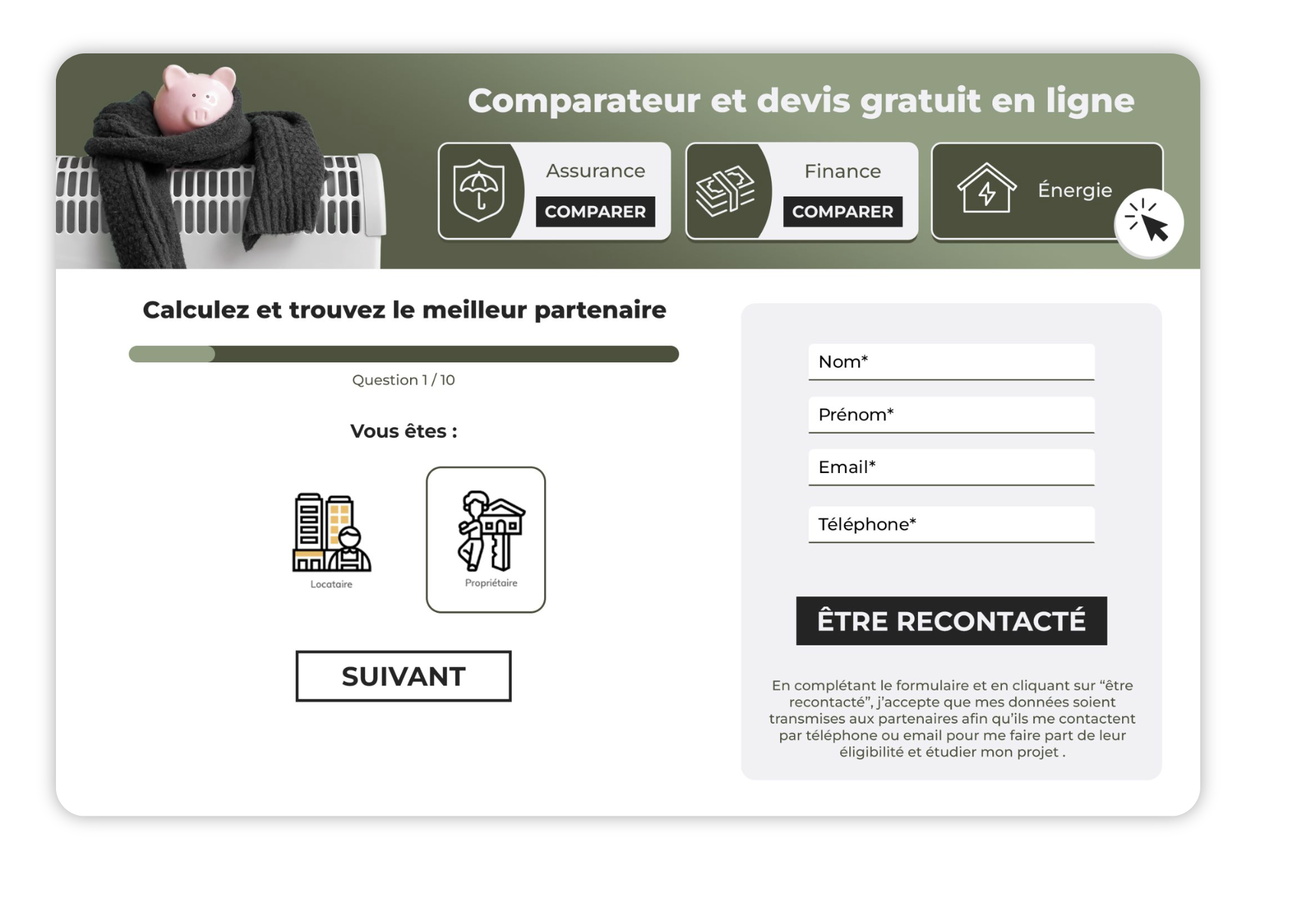
5. Comparators for recruiting highly qualified leads

Finally, online comparators can be a lever for collecting customer data. The principle is simple: users want to find out more before buying a product or service by comparing different offers. They use a comparator and provide precise information in order to benefit from recommendations.

Why use it: to recruit ultra-qualified data and opt-ins.

When to use it: when a new prospect arrives on the comparator to understand their needs.

How to use it : the data collection form must meet the needs of the user (and not just the needs of the company, i.e. the data it wishes to obtain). The questions asked should be geared towards the user’s expectations and focus on a better understanding of their preferences. To encourage prospects to fill in the form, brands can offer targeted incentives (such as the possibility of being called back within X days by an advisor). The prospect can then be targeted with personalised offers.

Weekly - collection comparator

Conclusion

Are you looking for effective ways to collect qualified data and get to know your audience better through an engaging interactive experience? Discover our different data collection formats to increase interaction with your prospects and customers. You are also welcome to view our webinar on data collection.

In 30 minutes, we show you how to launch your own high-performance interactive marketing campaign

Responsible marketing and gamification: challenges and solutions

Responsible marketing and gamification: challenges and solutions

The role of marketing is to encourage consumers to adopt a particular behaviour. It’s a creative discipline that that evolves with societal change and technological advances. In this way, marketing adapts to buyers’ preferences and expectations.

While we have recently seen an expectation of strong interaction with brands (facilitated by the Internet and social networks), consumers increasingly see themselves as committed players. Our consumer choices reflect our values, the causes we support and the changes we want to see in society.

Hence the demand for transparency and integrity on the part of economic players, including in the way they communicate. This trend is called responsible marketing. C’est une approche plus authentique, sincère et engagée d’échanger avec ses clients et prospects sur la manière dont opère l’entreprise.

This article looks at the challenges of responsible marketing and the benefits it can bring for brands. We will also look at how to embody a more ethical voice by using gamification to better understand the expectations of its audience and adapt its communication accordingly.

What is responsible or committed marketing?

Responsible marketing is a communications strategy in which a brand takes into account the impact of its activity and its statements on the environment and society. Also known as ethical marketing, this approach involves address social, ethical and ecological issues in its marketing campaigns. It is also important to use more sustainable media and communication tools that respect users’ privacy.

It should be noted, however, that responsible marketing should not be seen simply as a strategy for attracting customers. To have a real impact, this approach must be genuine, verifiable and translated into concrete action. In this way, it sets itself apart from washing practices (such as greenwashing or pinkwashing). This approach goes beyond mere posturing for the sole benefit of brands and takes into account the general interest.

Examples of responsible marketing

Responsible marketing practices can take several forms, depending on the sector in which the company operates and the expectations of its audience.

Examples include :

  • Highlighting virtuous practices (ecologically and socially). The Ikea furniture brand for example, has moved towards greener production methods. This means using materials with a low carbon footprint, but also designing circular products. They will remain useful and in good condition for many years.

  • Supporting charitable causes. Companies can also adopt responsible marketing by communicating their support for charities. This is the case, for example, with Patagonia, whose founder donates a considerable proportion of his profits to environmental NGOs. The Marriott hotel group has developed a programm in which members can earn points by booking in one of its hotels. They can then make a donation to partner organisations such as UNICEF and the World Central Kitchen.

  • The use of communication channels that respect their users. Brands can opt for less energy-intensive formats or avoid posting too often to avoid generating advertising burnout. Lush, for example, has decided to delete its Instagram and Facebook accounts in protest at Meta’s dubious practices when it comes to protecting user data.

The benefits of responsible marketing for brands

Responsible marketing is essential for building solid, high-quality relationships with customersBut also to ensure sustainable growth. Here are the main reasons for adopting more virtuous communication:

  1. Strengthen consumer confidence. This concerns the protection of their data and respect for their confidentiality. Users are cautious when it comes to sharing their information, and prefer companies that comply with the RGPD and are transparent about their data collection practices.
  2. Boosting customer satisfaction. Les marques adoptant un marketing responsable donnent la priorité aux intérêts de leur communauté plutôt qu’à leur bénéfice financier. Elles favorisent le bien-être de leurs clients, notamment en protégeant leur écosystème.
  3. Improve brand reputation and develop a competitive edge. Companies no longer stand out solely on the quality of their products or services. Those that gain market share succeed in capturing the attention and loyalty of consumers who favour committed brands.
  4. Stimulate customer loyalty. Brands that opt for ethical marketing tend to generate a stronger connection with their target audience. Shared values and commitments foster a strong emotional bond. This in turn encourages lasting relationships and brand loyalty.

Gamification for responsible marketing

Popular with brands as a way of increasing interaction and strengthening the connection with their audience, gamification applies to responsible marketing. The principle behind this strategy is to incorporate fun, playable elements into its campaigns. They take the form of marketing games, points systems or attractive rewards, etc.

Gamification therefore makes it possible to :

1. Promoting consumer awareness and education. La gamification est utilisée dans l’éducation pour faciliter la mémorisation de nouvelles informations et motiver les apprenants. En marketing, cela peut prendre la forme de quizzes, a fun and engaging format that companies can use to share information or raise awareness among their audience.

Total - Responsible marketing quiz

2. Encourage the adoption of responsible practices through committed challenges. Solidarity challenges are a way of mobilising your audience in support of a cause. By creating healthy competition and offering prizes, brands can encourage their customers to raise funds, adopt more eco-responsible actions, and so on.

3. Better understand the needs of your audience while respecting their privacy. Gamification is a responsible marketing lever that makes it easier to gather information on consumer expectations. All in a transparent and ethical way (in particular without tracking its audience with cookies) because customers voluntarily share this data via collection forms (before or after a marketing game).

Conclusion

Responsible marketing has become an essential lever to help brands create a strong connection with their audience and support sustainable growth. To adopt more ethical and transparent communication, your brand can rely on gamification. Discover our playable mechanics and transform the way you communicate with your customers!

In just 30 minutes, we’ll show you how to launch your own high-performance interactive marketing campaign.