


Knowing your customers better means selling more effectively. But with the gradual disappearance of third-party cookies, data collection is becoming a real challenge.
To feed their CRM with relevant insights, brands can rely on two complementary allies:
- gamification, which makes it easier to collect declarative data through playful and engaging mechanics (quizzes, tests, points-based games);
- and then AI, which refines segmentation and enables highly targeted activation scenarios.
Together, these two levers transform customer relations and boost marketing performance through more precise customer knowledge and actionable. In this article, we share practical tips on how to leverage both tools to improve customer knowledge and boost revenue.
SUMMARY
- The limitations of traditional marketing segmentation
- How AI is transforming CRM segmentation?
- How gamified campaigns enrich CRM and enhance customer knowledge?
- FAQ — AI and CRM segmentation: 4 key takeaways
The limitations of traditional marketing segmentation
Many brands still rely on basic CRM data to segment their audiences such as age, gender, location, and purchase history. However, these criteria alone are no longer enough to capture attention or effectively personalize messages.
For example, targeting all women aged 30–40 who have purchased a facial cream overlooks their actual needs: anti-aging, hydration, or mattifying?
The result: undifferentiated campaigns, with overly broad messages and stagnant performance. Without declarative or behavioral data, it becomes difficult to deliver the right content, at the right time, on the right channel. More importantly, it’s impossible to understand what truly drives each segment.
This highlights the importance of integrating more precise, higher-quality… and more interactive levers.
How AI is transforming CRM segmentation?
Artificial intelligence applied to CRM goes far beyond traditional socio-demographic criteria. It paves the way for behavior-based segmentation, customer intentions, and interests. Thanks to sophisticated scoring, clustering and prediction algorithms, profiles are automatically grouped based on their interactions with the brand, purchase intent, or conversion potential.
This dynamic segmentation becomes particularly meaningful when it leverages data from interactive activities, such as quiz responses or product preferences revealed in a contest. AI transforms these signals into actionable groups, ready to be utilized by marketing teams. This is a major advancement, allowing brands to move beyond static and often overly broad segmentation to activate more targeted — and therefore more effective — scenarios.
The benefits of AI-driven segmentation for marketing
What is the role of AI in CRM? Here are the main benefits of artificial intelligence for optimizing the performance of a customer relationship management tool.
- Personalized follow-ups: each message is tailored to the customer’s preferences, behaviors, and intentions.
- Lead prioritization: CRM teams focus primarily on contacts most likely to convert.
- Detection of subtle signals: AI identifies opportunities that are invisible manually, such as a budding interest in a new product line.
- Improved ROI: better-targeted campaigns generate more conversions and prevent brands from wasting their marketing budget on audiences with low purchase likelihood or underperforming communication channels.
Mini glossary AI & CRM
- Lead scoring a method of evaluating prospects based on their profile and behaviors (clicks, opens, interactions). AI enables automatic scoring of each contact according to their conversion potential.
- Clustering: an artificial intelligence technique that automatically groups similar profiles into segments based on behavioral data or interactions with the brand.
- Semantic analysis : the ability of AI to understand the meaning of words in a text. It is used to analyze open-ended responses (e.g., customer comments, verbatim feedback) and extract intentions or sentiments.
- Predictive segmentation: a technique that anticipates a customer’s future behaviors (e.g., likelihood of purchase or churn), enabling CRM campaigns to be adjusted accordingly.
How gamified campaigns enrich CRM and enhance customer knowledge?
Why combine AI and gamification in a marketing campaign? Simply put, gamified campaigns (quizzes, tests, mini-games…) allow the collection of valuable data for CRM and help refine customer knowledge. Each interaction becomes a source of insights, provided the right questions are asked.
- A quiz can for example incluse closed-ended (multiple-choice) questions to better understand the product preferences of its audience.
- But by asking open-ended questions, the brand can capture verbatim responses that reveal customers’ needs or purchasing barriers.
- Another option: Photo or Customizer Contests invite participants to upload images, providing valuable data once again. The shared photos can reflect a lifestyle (such as interior design choices) or purchase intent.
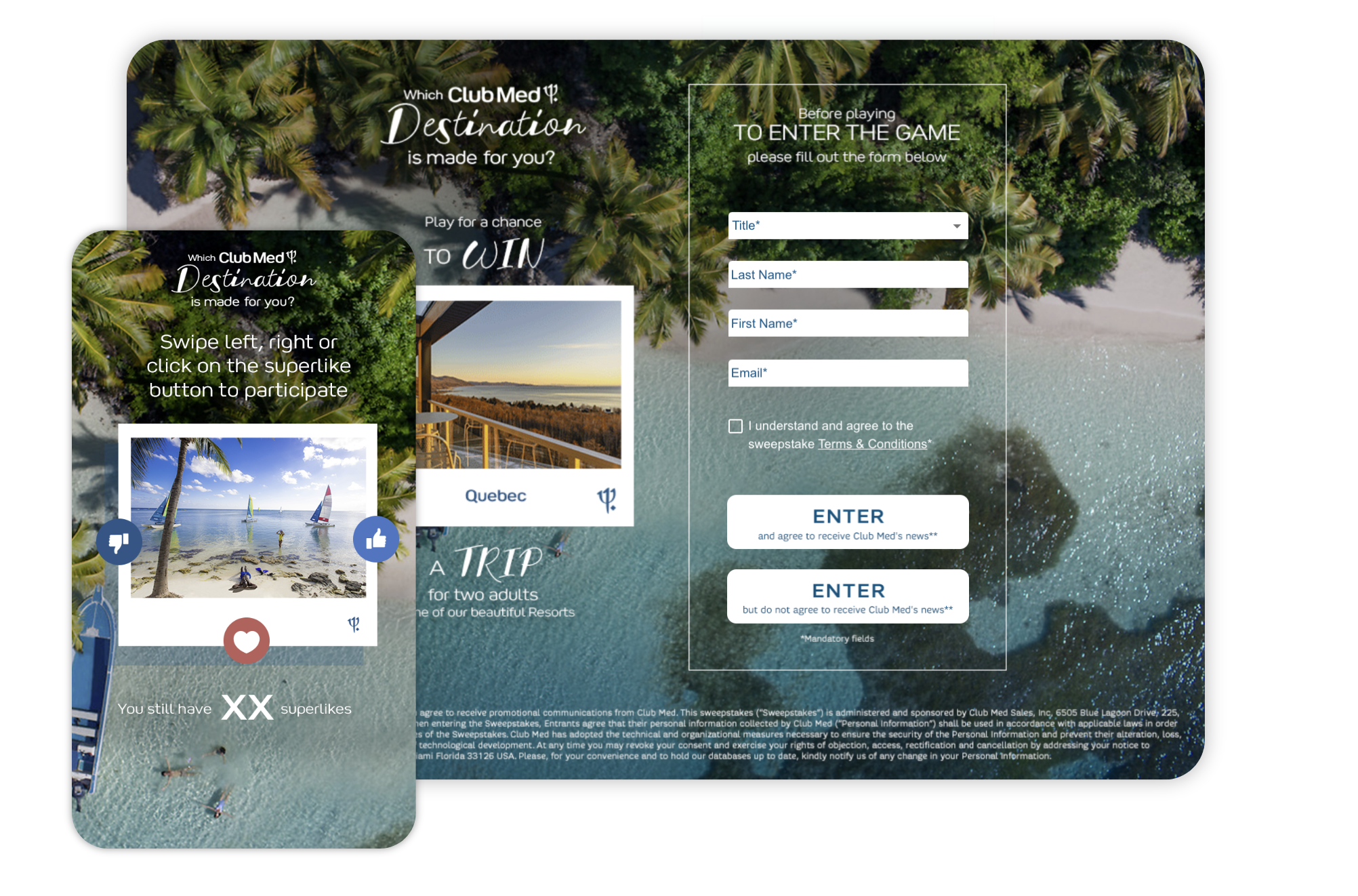
This data is then strctured to be interpreted by the CRM and AI. From this customer data, artificial intelligence automatically detects purchasing behaviors, identifies emerging interests, or uncovers subtle signals that the company can leverage in future campaigns. The result: richer, more actionable customer knowledge—and more targeted marketing actions.
Categorizing your customer base with a marketing game: a concrete example
Let’s take the example of an automaker preparing to launch a new hybrid model. The goal: to refine its CRM database in order to target the right profiles with a relevant message.
It all starts with a gamified campaign. Participants answer a few questions in the form of a quiz:
- What route do you travel most often? → “Mostly urban.”
- What is the most important factor when choosing a vehicle? → “Total cost (vehicle + fuel).”
- Finally, an open-ended question collects verbatim responses: What do you expect from a vehicle today? → “A modern and economical model, without relying on charging stations.”
Once this data is collected, AI comes into play. It analyzes the responses and automatically identifies regular urban usage, high sensitivity to total cost, a need for autonomy, and caution regarding charging constraints.
Result: the participant is automatically assigned to the “Hybrid” profile, predefined alongside other segments such as “Gasoline” or “Electric.” This new profile is enriched in the CRM and becomes immediately actionable for targeted campaigns.
FAQ — AI and CRM segmentation: 4 key takeaways
What is CRM gamification powered by AI?
AI-powered CRM segmentation is an automated process that groups contacts in a CRM database based on behavioral, declarative, or contextual criteria. AI detects patterns invisible to the human eye and creates more precise and relevant customer segments.
What are the advantages of AI segmentation compared to traditional segmentation?
AI segmentation is more precise, adaptive, and faster than traditional segmentation. artificial intelligence can continuously analyze large volumes of data, detect subtle signals, and create dynamic segments in real time.
What types of data can AI analyze to segment a CRM database?
Browsing behavior, purchase history, responses to quizzes or marketing games, verbatim feedback, engagement rates, geolocation… any structured or semi-structured data can feed AI-powered segmentation algorithms.
How to succeed in marketing segmentation using AI?
Here are four key best practices for successful marketing segmentation using AI:
- Collect high-quality data through engaging campaigns (marketing games, online and in-store promotional activities);
- Regularly clean and structure customer data;
- Combine multiple sources of customer data (behavioral, declarative, transactional)
- To continuously update customer segments to track evolving profiles
To deepen your customer understanding, focus on a winning duo: gamification to collect accurate data, and AI to automatically analyze, segment, and score your leads. With LeadSense, Adictiz’s AI-powered smart profiling tool, you instantly identify the right profiles based on their responses, behavior, and intent signals. You now have everything you need to design more targeted and, consequently, more effective campaigns. All that’s left is to take action and transform your data into performance!