

Health is a highly regulated field, sensitive, and sometimes taboo. Certain topics are delicate or complex to address. Prevention campaigns also have to engage diverse audiences, who are often difficult to reach.
To capture attention in prevention campaigns, relying on original and interactive formats can make a real difference. When used wisely, gaming is a powerful tool to inform, raise awareness, and motivate. It helps convey difficult messages, enhances retention, and fosters engagement on topics that are otherwise unappealing.
This article explores the issues and opportunities of gamification in health.
It examines how this approach can support prevention, therapeutic education, and the adoption of healthy behaviors. We also share practical advice for laboratories, health insurers, insurance companies, and e-health startups looking to energize their marketing and communicate more effectively with their target audiences.
Can a topic as sensitive as health be gamified? The paradox of gaming
Combining health and gaming may seem contradictory. The former evokes rigor, confidentiality, and life-or-death stakes. The latter suggests fun, entertainment, and fiction. Yet, it is precisely because it surprises that gamification works in health.
Gaming captures attention. It makes messages more accessible and helps simplify complex concepts. The playful formats such as Quizzes, Puzzles, or Contests also help to reduce anxiety around the topic, without downplaying its importance.
According to a study conducted by the University of Colorado Denver, a study conducted by the University of Colorado Denver found that serious games (whose primary goal is learning rather than entertainment) increase retention by 14% compared to passive methods. Gamification in health thus promotes learning through action, repetition, and reward, transforming information into a unique and therefore memorable experience.
Gamification also helps reach audiences who are difficult to engage: young people, for example. Less informed about their health and often more exposed to risks, they are generally unreceptive to traditional messages. Gaming can speak their language and also encourage adherence to prevention messages, whether related to mental health, addictions, or screenings.
In summary: gaming does not replace traditional campaigns; it complements them. In some cases, it even enhances their impact.
E-health serious games: which gamified formats really work?
Gaming can definitely be adapted to the health sector, but it must align with its specific issues. These include message reliability, fostering engagement without being patronizing, and compliance with regulations. Some formats, already tested, effectively meet these requirements. Here are three mechanics that have proven successful in the field.
1. Quizzes to test knowledge
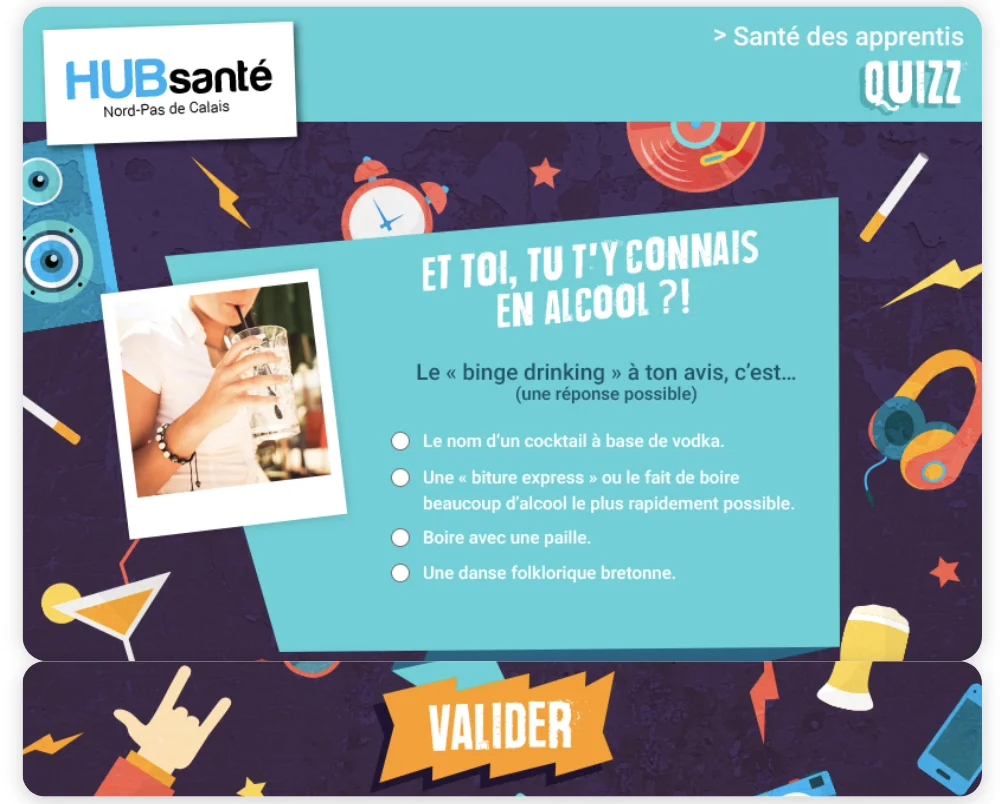
The Quiz is a simple and straightforward format that allows clear messages to be conveyed while measuring participants’ knowledge levels. It can be adapted to any topic, including the most sensitive ones. In health, it promotes awareness without judgment by making the information interactive and personalized.
The Sauvegarde du Nord association used this mechanic in a prevention campaign aimed at young people. The quiz covered several topics: addictions, sleep, road safety, and nutrition. The goal was to: engage an audience that is difficult to reach and strengthen the impact of the messages. The campaign allowed organizers to assess participants’ knowledge and guide future field actions—a strategy useful for tailoring communication to each profile.
2. Surveys to collect relevant data
The survey allows users to be directly asked about their health behaviors, expectations, and obstacles. It provides valuable data to segment the audience and thereby refine future prevention campaigns by delivering more targeted messages to each user.
The Wakamola initiative in Spain used an interactive survey to collect information on diet, physical activity, and BMI. The responses allowed participants to be segmented according to their health profile and receive tailored advice. A simple, effective, and replicable format for enhancing the personalization of awareness-raising actions.
3. Interactive tests for raising awareness
Interactive tests rely on engaging storytelling. By placing the user in a scenario, they place the user in a scenario, facilitating identification and enhancing retention of prevention messages. This format also captures attention longer than static content, allowing for deeper exploration of complex topics.
The Take‑Care serious game developed by France Assos Santé, raises awareness among 16-25 year olds about their health rights. The user embodies Farid, a young person seeking answers about their medical coverage, consent to care, or medical confidentiality. Through scripted choices, the test addresses complex subjects in a practical and educational way. An effective strategy for engaging a young and often poorly informed target audience.
5 tips for addressing the issues of gamification in health
Gamification can enhance the impact of health messages, provided certain balances are respected. The goal is not to entertain at all costs, but to use the game as an educational lever. Here are five best practices for designing an effective, engaging, and relevant campaign for the issues of the health sector.
1. Finding the Right Balance Between Playfulness and Information
The user experience must always serve the message being conveyed. In health marketing, it is therefore necessary to prevent the playful aspect from overriding essential information. Integrating clear, precise, and validated content enhances credibility.
Every element of the game must support the transmission of the message, without unnecessary distractions. For example, it is advisable to insert short explanations after each step to consolidate participants’ knowledge. The rhythm must alternate between moments of playful engagement and learning phases. This way, the game captures attention while facilitating memorization.
2. Respecting Medical Ethics and the GDPR
Any health gamification campaign must adhere to a strict framework. The messages disseminated must comply with medical recommendations and be validated by experts. Regarding data, the GDPR mandates transparency on their collection, processing, and storage. Responses must also be anonymized if statistical analysis does not require identification. In case of nominative data collection, explicit consent is essential.
3. Choosing the Right Gamification Format Based on Campaign Stakes
The choice of format must be adapted to the objectives and the target audience. To raise awareness about screening, an interactive quiz will make it possible to test knowledge while providing information. For nutrition, a simulation or a choice-based game (such as a Swiper for example) will encourage an awareness of the impact of behaviors. Sun prevention, on the other hand, will benefit from simple mechanics such as Memory to attract attention and deliver quick prevention messages or advice.
4. Relying on Co-branding to Strengthen the Credibility of Your e-Health Serious Game
Co-branding associates several recognized stakeholders, such as laboratories, associations, or foundations. This collaboration provides essential scientific endorsement for the credibility of the serious game e-health. It reassures users about the reliability of the content and the rigor of the messages. Furthermore, it facilitates dissemination through partner networks. In health marketing, this legitimacy strengthens the impact of campaigns and encourages public adoption.
5. Tracking a Mix of Health and Marketing KPIs
To evaluate a gamified health campaign, several key indicators must be combined.
- Adhesion measures the number of engaged participants.
- Progression tracks advancement through the playful journey, demonstrating interest.
- The conversion rate analyzes the impact on concrete actions, such as making an appointment or subscribing to a health offer.
- Finally, offline behaviors (modification of habits, medical consultations) reflect the real effectiveness of the campaign on health.
This mix of KPIs allows for campaign adjustment and maximization of benefits, both for the health of the target audience and for the strategic benefits for the organization disseminating it (awareness, trust, engagement, etc.).
Gamification is therefore a powerful lever for maximizing the impact of health marketing campaigns. It captures attention, facilitates access to complex topics, and engages audiences who are often unreceptive. Discover our playful mechanics and easily create your e-health serious game while ensuring compliance with the regulatory requirements of your sector.